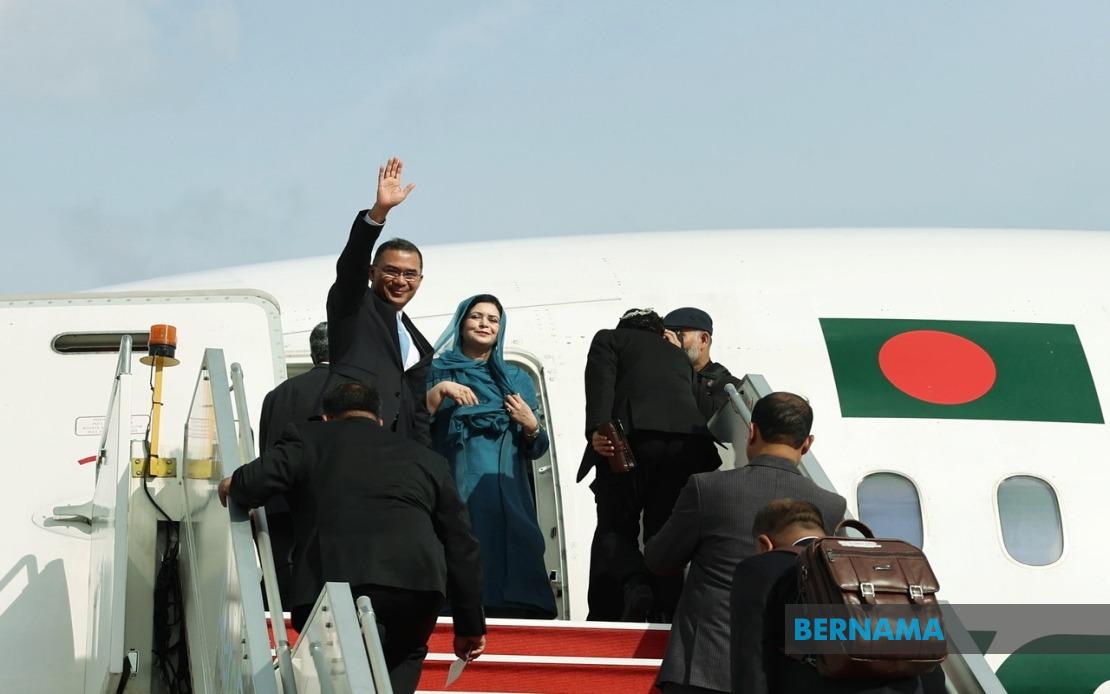
Bangladesh Prime Minister Tarique Rahman flew out of Kuala Lumpur International Airport on June 22, concluding a significant two-day official visit to Malaysia that highlighted deepening ties between the two South Asian and Southeast Asian nations. The departure, marked by a formal ceremonial send-off at the Bunga Raya Complex, included a guard of honour from the First Battalion of the Royal Ranger Regiment as Rahman's aircraft lifted off at 5 pm. The visit represented Rahman's first bilateral overseas engagement since assuming the premiership in February 2026, underlining Malaysia's strategic importance in his early diplomatic calendar.
Minister in the Prime Minister's Department (Religious Affairs) Dr Zulkifli Hasan represented the Malaysian government in bidding farewell to Rahman, his spouse Dr Zubaida Rahman, and the accompanying Bangladeshi delegation. The ceremonial nature of the departure reflected the significance both governments attach to strengthening their bilateral relationship at a time when regional cooperation mechanisms are evolving rapidly across South and Southeast Asia.
The centerpiece of Rahman's visit was a bilateral meeting with Prime Minister Datuk Seri Anwar Ibrahim at the Perdana Putra Complex earlier that day. During their discussions, the two leaders reviewed a broad range of regional and international issues affecting both nations and the wider Indo-Pacific region. The conversations extended beyond traditional bilateral commerce to encompass security concerns, humanitarian challenges, and strategic positioning within emerging regional frameworks that will shape geopolitical dynamics over the coming decade.
The substantive outcomes of the talks demonstrated renewed commitment to economic integration. Both governments prioritized accelerating a free trade agreement through an expedited track, recognizing that closer commercial ties can deepen political relationships and create mutual prosperity. Beyond trade, the leaders identified semiconductors, renewable energy, agricultural development, and educational exchanges as priority sectors for collaborative investment and knowledge-sharing initiatives. This diversified approach reflects recognition that modern bilateral relationships require depth across multiple economic dimensions rather than reliance on traditional commodity trade alone.
Three formal instruments emerged from the visit, signifying institutional commitment to expanded cooperation. A Memorandum of Understanding on Cultural Cooperation was signed, alongside two Exchanges of Notes addressing Counter-Terrorism Research and Investment Promotion and Facilitation. These agreements acknowledge shared security challenges in the region and the need for coordinated responses to transnational threats, while simultaneously creating mechanisms to reduce investment barriers and facilitate business-to-business connections between the two nations.
Bangladesh articulated significant regional ambitions during the visit, with Rahman reiterating his country's aspiration to become an ASEAN Sectoral Dialogue Partner and its strategic interest in joining the Regional Comprehensive Economic Partnership. Malaysia's support for these objectives could prove instrumental in Bangladesh's integration into Southeast Asian institutions, particularly as RCEP begins reshaping trade patterns across the Indo-Pacific. For Malaysian policymakers, Bangladesh's accession to these frameworks would expand the economic heft of Southeast Asia's institutional architecture and create new opportunities for Malaysian firms operating across supply chains.
The visit also revealed convergence on several critical global issues beyond the bilateral sphere. Both leaders emphasized shared commitment to supporting the Palestinian cause and addressing the humanitarian dimensions of the Gaza conflict. They also discussed efforts to achieve sustainable peace in the Gulf region and broader Middle East stability, reflecting how both nations navigate complex geopolitical terrain despite their different regional positions. These alignments suggest potential for Bangladesh and Malaysia to coordinate positions within international forums on Middle Eastern affairs.
The Rohingya refugee crisis emerged as a significant multilateral priority, with both governments committing to leverage ASEAN mechanisms in pursuit of durable solutions. The agreement to strengthen cooperation through ASEAN and engage with Myanmar authorities reflects frustration with the slow pace of repatriation efforts and growing recognition that bilateral and regional pressure must be sustained and coordinated. For Malaysia, hosting over a million Rohingya refugees, Bangladesh's collaborative approach offers potential support for burden-sharing arrangements and diplomatic strategies aimed at creating conditions for voluntary, safe, and dignified returns.
Trade statistics underscore the existing economic relationship's scale and Malaysia's strategic export interests. In 2025, bilateral commerce reached RM12.18 billion, with Malaysian exports totaling RM10.08 billion, dominated by petroleum products that reflect Bangladesh's energy demands as it pursues industrialization and infrastructure development. Bangladesh supplied RM2.10 billion in imports, principally textiles, apparel, and footwear, demonstrating complementary production structures. As the region's 28th-largest global trading partner but second-largest within South Asia after India, Bangladesh represents significant growth potential for Malaysian exporters seeking diversification beyond traditional markets.
The trajectory of Malaysia-Bangladesh relations points toward deeper institutional integration. Rahman's inaugural overseas bilateral visit to Malaysia signaled to Dhaka's diplomatic establishment that the Southeast Asian neighbor warrants priority attention. For Malaysian policymakers, Bangladesh's strategic location linking South Asia to Southeast Asia, its large domestic market exceeding 170 million people, and its growing manufacturing sector create compelling reasons to invest diplomatic capital in this relationship. The flurry of agreements signed during the visit suggests both governments recognize that economic interdependence and coordinated regional positioning serve mutual strategic interests amid evolving great power competition in Asia.

