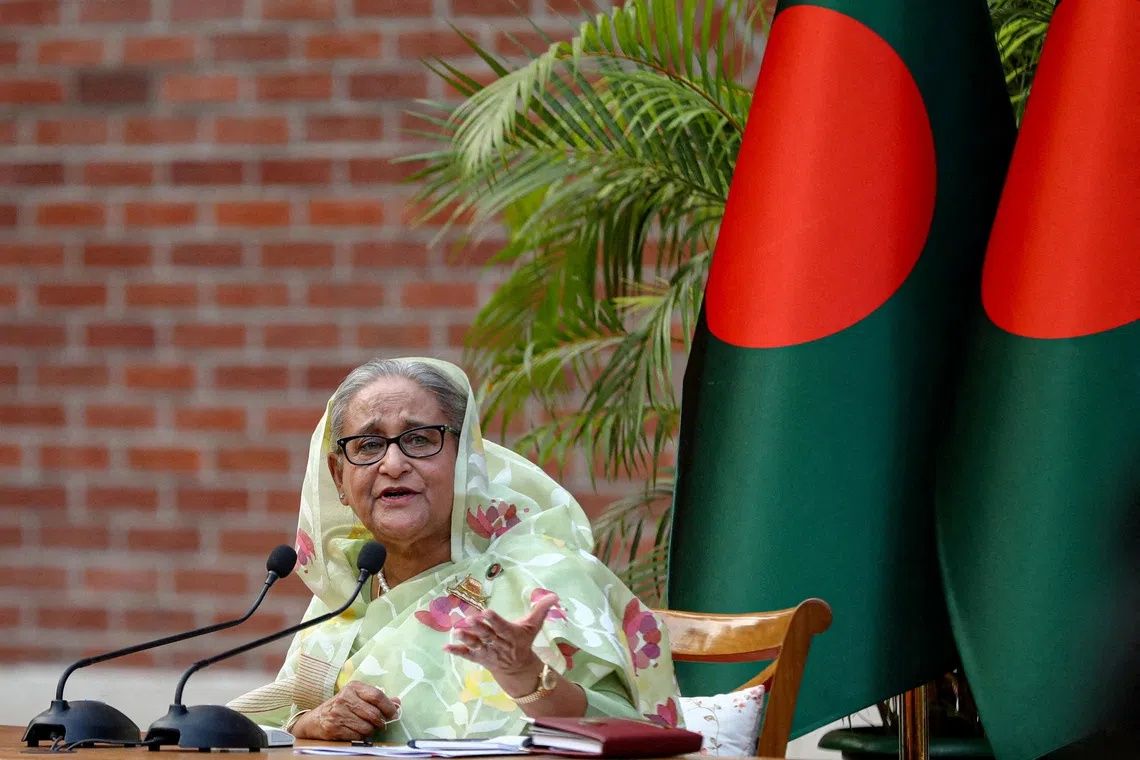
Bangladesh's government has formally requested that India clarify its official position on exiled former prime minister Sheikh Hasina's forthcoming virtual address scheduled for delivery from New Delhi on August 5, expressing concern that allowing a fugitive to conduct political activities from Indian soil could undermine the steady improvement in relations between the two neighbours. The intervention represents the first formal government response to Hasina's planned appearance at an event organised by the Foreign Correspondents' Club of South Asia, which will commemorate the second anniversary of the student-driven uprising that triggered her downfall in August 2024.
Shama Obaed Islam, Bangladesh's State Minister for Foreign Affairs, made the government's position explicit during a late Monday media briefing, emphasising that Dhaka wishes to advance its relationship with New Delhi on a forward-looking basis and does not want external complications to derail this momentum. She pointedly stated that India must provide transparent guidance on the matter, signalling that Bangladesh views the issue as sufficiently significant to warrant high-level diplomatic attention. The minister's carefully calibrated remarks reflect a delicate balancing act: maintaining diplomatic courtesy towards an important neighbour while protecting what Dhaka views as its sovereignty and legal interests.
The timing of this dispute carries particular weight given the regional context. Since Hasina's departure in 2024 and the subsequent rise of Tarique Rahman's government following February's election, both countries have publicly signalled their intention to rebuild diplomatic relations through expanded engagement and cooperation. Yet the appearance of Bangladesh's most prominent political exile preparing to deliver speeches from India threatens to undermine these nascent efforts, creating friction precisely when bilateral ties are beginning to stabilise. For Malaysian observers, this underscores how fragile post-transition relationships can be in South Asia, particularly when security establishments remain involved in governance transitions.
Hasina, now 78 years old, has maintained continuous residence in India since her government collapsed under sustained pressure from mass protests that resulted in significant loss of life. The Foreign Correspondents' Club confirmed that she will participate in the August 5 event via video link, alongside her son Sajeeb Wazed Joy and other panellists. The club has not yet responded to requests for comment regarding Bangladesh's diplomatic objections, leaving uncertain whether the event will proceed as scheduled or whether organisers might modify the format in response to government concerns.
Bangladesh's position is considerably strengthened by Hasina's criminal liability in her homeland. In 2025, she received a death sentence for crimes against humanity related to her government's 2024 crackdown on demonstrators, which international observers, including the United Nations, estimated claimed between 1,000 and 1,400 lives. Dhaka has formally requested India's cooperation in extraditing Hasina to face justice, making her continued presence in India and any political activities she conducts from that territory a matter of principle for Bangladesh's post-transition authorities. Hasina has rejected the verdict as legally baseless, but this assertion carries limited weight internationally given the severity of the allegations.
Islam indicated that Bangladesh has conducted multiple representations to India expressing concern about Hasina and other senior Awami League figures making political statements from Indian territory. These earlier communications apparently included assurances from Indian officials that New Delhi does not expect fugitives to engage in political activity from its soil, creating an apparent contradiction with the current situation that Dhaka is now seeking to resolve through renewed diplomatic channels. The minister made clear that if India does not provide satisfactory clarification, Bangladesh will escalate the matter through formal diplomatic procedures.
The statement carries an implicit warning that should India be perceived as tacitly supporting or enabling Hasina's political activities, this could significantly damage the bilateral relationship and potentially reverse recent progress toward normalisation. For South Asian specialists, this reflects a recurring tension in Indian foreign policy: balancing humanitarian considerations regarding political exiles with respect for the legitimate interests of neighbouring governments seeking to prosecute former officials for alleged state crimes.
Hasina herself has demonstrated apparent confidence in her political prospects, telling Reuters in a recent interview that she intends to return to Bangladesh in December. This claim appears highly optimistic given her death sentence and the current government's evident commitment to pursuing her extradition. Yet it suggests she is not abandoning her political future and views the August 5 address as a significant platform for rehabilitation of her public image and reassertion of her continued relevance to Bangladeshi politics. The virtual format effectively insulates her from physical risk while providing maximum media exposure.
India's foreign ministry has not yet issued any public response to Bangladesh's concerns, maintaining silence on whether New Delhi will seek to persuade the Foreign Correspondents' Club to modify the event or whether India views this as a private organisational matter falling outside government responsibility. This ambiguity is itself problematic for Bangladesh, which interprets official silence as potential tacit acceptance of the proceedings. The diplomatic impasse reflects broader questions about how South Asian nations should manage the presence of exiled political figures and the balance between freedom of expression and interstate courtesy.
For Malaysia and other Southeast Asian states, this situation offers instructive lessons about managing political transitions and exile politics. The dispute highlights how security transitions can create prolonged tensions with neighbouring countries, particularly when exiled former leaders maintain international platforms and continue asserting political relevance. Bangladesh's diplomatic approach—simultaneously cooperative while firm on fundamental issues—represents the narrow path that post-conflict governments must navigate when dealing with former adversaries who enjoy external sanctuary.
The resolution of this specific dispute may ultimately depend on India's calculation of its broader interests. Should New Delhi determine that accommodating Hasina's speech serves useful strategic purposes, it may proceed regardless of Bangladesh's objections, potentially accepting some diplomatic friction as an acceptable cost. Conversely, if India prioritises deepening ties with Bangladesh's new government, it might quietly encourage organisers to exclude Hasina or restrict her participation. The coming weeks will reveal whether India's recent signals of improved relations with Dhaka reflect genuine commitment or merely tactical positioning.

