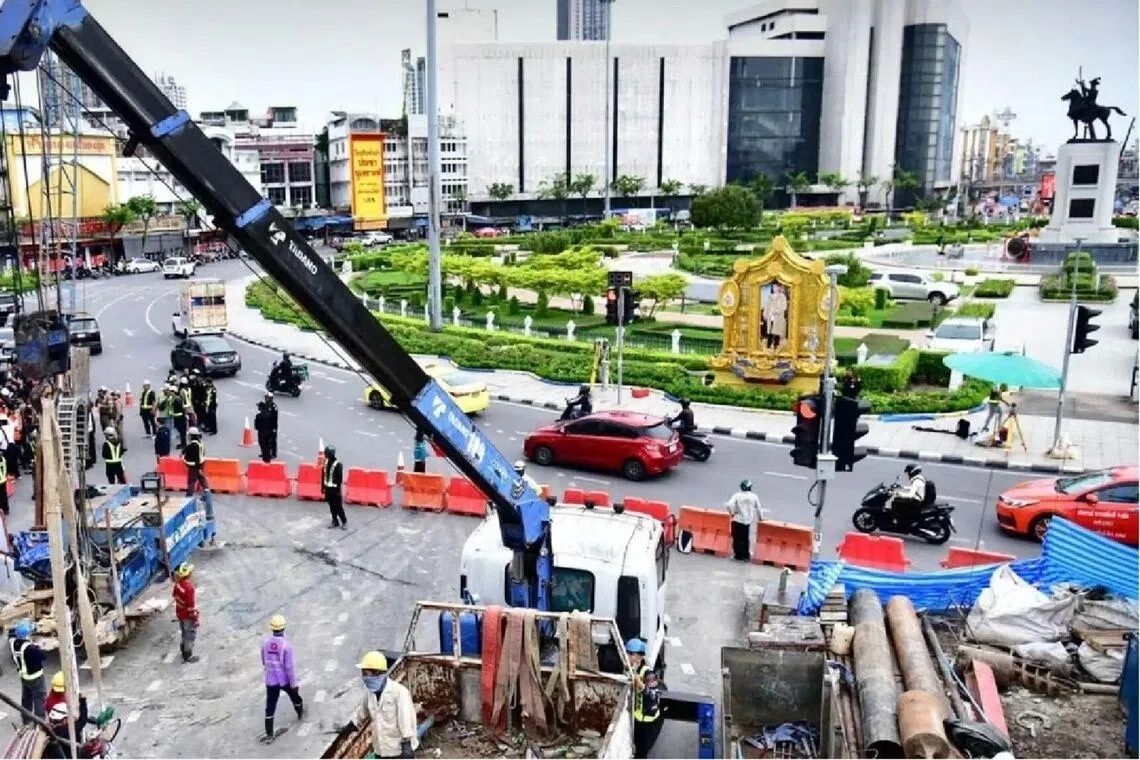
Bangkok authorities have evacuated roughly 60 residents from three commercial buildings located within 30 metres of a subsidence site near Wongwian Yai following water seepage in a tunnel drainage sump associated with the southern Purple Line subway construction project. The emergency response, coordinated by Bangkok Governor Chadchart Sittipunt and the Bangkok Metropolitan Administration, represents a significant precautionary measure against potential structural damage to nearby properties. Residents have been relocated to temporary accommodation, primarily hotels, where they are expected to remain for approximately one week whilst authorities assess the extent of the underground damage and monitor ground stability.
The subsidence incident originated from water leakage at the lowest point of the southern Purple Line construction tunnel, where a drainage sump failed to contain seepage. This allowed surrounding soil to be drawn into the underground structure, destabilising the ground above and creating visible cracks in the road surface. The incident has raised serious concerns about the integrity of neighbouring buildings and sparked a comprehensive response involving multiple government agencies and specialised monitoring equipment. Bangkok authorities have implemented round-the-clock surveillance to track water levels and the rate of subsidence, with preliminary reports indicating that both metrics have begun to stabilise, though the situation remains under close scrutiny.
As a precautionary measure to prevent further deterioration, authorities have closed approximately 200 metres of Prajadhipok Road between the Ban Khaek intersection and Wongwian Yai. The closure eliminates outbound traffic from the affected section, with temporary inbound lanes converted for outbound vehicle use to maintain some traffic flow. Motorists have been diverted to alternative routes including Itsaraphap, Lat Ya and Somdet Chao Phraya roads. This traffic disruption is particularly significant given the area's proximity to major schools such as Suankularb Wittayalai School and Suksanari School, which create regular congestion during school hours. Governor Chadchart has indicated that Bangkok may implement additional shuttle services for schoolchildren, drawing on measures previously employed following a similar subsidence incident near Vajira Hospital.
The monitoring infrastructure deployed around the affected area demonstrates the sophistication of Bangkok's emergency response capabilities. The Department of Disaster Prevention and Mitigation has installed two Rescue Guardian monitoring units on buildings within 30 metres of the damaged road surface. These sensors continuously measure tilting and structural movement, transmitting real-time data to a centralised monitoring system that automatically triggers warnings if abnormal displacement is detected. This technology provides early warning of potential building failures, allowing authorities to take protective action before structural collapse occurs. Engineers from Thailand's national Urban Search and Rescue team have joined the inspection process, evaluating neighbouring structures and ensuring that the response meets international engineering and public safety standards.
The financial responsibility for managing the emergency has been assigned to the Mass Rapid Transit Authority of Thailand's project contractor, who will bear the costs of temporary accommodation, resident compensation, and other related expenses. This arrangement ensures that affected residents are not financially disadvantaged by the construction incident whilst authorities work to resolve the underlying problem. The contractor's obligation to cover all emergency costs provides an important incentive for swift remediation and demonstrates accountability for the subsidence event. Officials have established that full access to buildings and the reopening of Prajadhipok Road will only occur after comprehensive engineering assessments confirm the structural safety of all affected infrastructure.
The immediate engineering priority is to seal the drainage sump leak and prevent additional soil migration into the tunnel structure. Specialised instrumentation is being used continuously to monitor the road surface elevation, soil movement rates, water seepage volume, and the structural condition of buildings within the risk zone. A forward command centre has been established near the subsidence point to coordinate activities amongst the Bangkok Metropolitan Administration, the Mass Rapid Transit Authority of Thailand, the project contractor, district authorities, police and emergency response teams. This integrated coordination structure ensures that technical decisions, public safety measures and traffic management are implemented consistently and efficiently.
The incident has renewed concerns about construction safety along the Purple Line project, which has experienced previous subsidence events. The affected tunnel forms part of the same southern alignment as the section near Vajira Hospital where a road collapse occurred in an earlier phase, though the current incident involves a different contractor. This pattern suggests that certain sections of the tunnel route present particular geological or hydrogeological challenges that require enhanced engineering precautions. The comparison with the Vajira Hospital incident indicates that Bangkok's emergency response protocols for subway construction incidents have been refined and expanded based on previous experience, resulting in more rapid deployment of monitoring equipment and more comprehensive inter-agency coordination.
The broader implications for Bangkok's infrastructure development are significant. The incident highlights the technical complexity of constructing subway tunnels beneath densely populated urban areas where ground conditions, water tables, and existing building foundations create multiple engineering challenges. The Purple Line project, intended to enhance Bangkok's public transportation network, has encountered multiple obstacles that have necessitated substantial disruptions to traffic and residential life. The financial costs of emergency evacuations, traffic diversions, and extended construction periods accumulate substantially, though they must be weighed against the long-term benefits that the completed line will provide to Bangkok residents and the wider metropolitan region.
From a Southeast Asian perspective, Bangkok's subway construction challenges reflect similar difficulties experienced in other regional cities undertaking major underground infrastructure projects. Cities including Singapore, Ho Chi Minh City and Jakarta have faced comparable issues combining geological complexity, high building density, and the need to maintain essential traffic flows during construction. The sophistication of Bangkok's response, including real-time structural monitoring and integrated emergency coordination, demonstrates regional technical expertise and provides a model that other Southeast Asian cities may adapt for their own rapid-transit development projects. The incident also emphasises the importance of stringent contractor oversight and contingency planning when undertaking major infrastructure development in complex urban environments.
Authorities have indicated that further announcements regarding traffic arrangements and timeline for restrictions will be released once engineers determine the required duration of the Prajadhipok Road closure. The assessment process involves multiple factors including soil stabilisation, water table normalisation, building structural verification, and subsurface tunnel integrity confirmation. Given the scale of the evacuations and the location's importance as a major traffic artery, the closure is likely to impose significant disruption on Bangkok traffic patterns for at least one to two weeks. Governor Chadchart's personal inspection of the site on July 9, accompanied by senior officials including Deputy Governor Wisanu Subsompon and Deputy Permanent Secretary Kanokwan Iamlim, underscores the administrative priority accorded to the incident and suggests that resolution will receive sustained governmental attention until full normalcy is restored.

