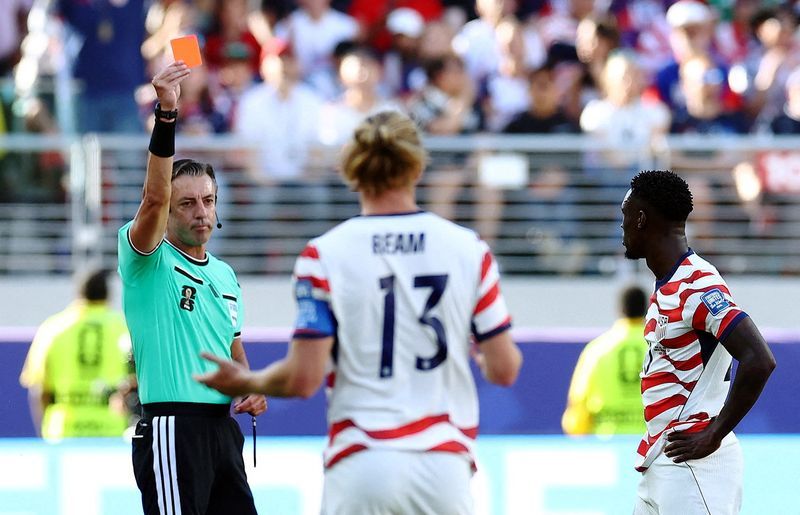
The fallout from FIFA's decision to lift Folarin Balogun's World Cup suspension has sent alarm bells ringing through English football's establishment, with senior figures warning that the incident threatens to corrode confidence in the sport's entire system of rules and enforcement. The controversy surrounding the American forward's dismissal and subsequent reprieve represents far more than a isolated disciplinary dispute; it exposes vulnerabilities that could haunt the sport for seasons to come, particularly as the new Premier League campaign prepares to commence.
Howard Webb, who heads Pro Ref and previously oversaw proceedings at the 2010 World Cup final, has emerged as the most vocal critic of how FIFA handled the matter. Webb's concerns centre not on the original decision itself but rather on the murky process that followed, when external political pressure visibly influenced the outcome. The involvement of a sitting U.S. President in demanding reconsideration of a sporting penalty represents an unprecedented breach of the boundary between politics and sport, establishing a troubling precedent that could invite similar interventions in future disputes.
The transparency deficit in FIFA's handling of the case compounds the damage. Webb highlighted that the mechanism used to overturn the suspension appeared entirely improvised, lacking any established precedent or documented procedure. This ad-hoc approach, combined with the documented political pressure, created an image of arbitrariness that undermines the credibility of football's disciplinary framework. When governing bodies appear to bend their own rules for political convenience, they invite questions about whether the same flexibility applies to other contentious decisions made throughout competition.
In today's hyperconnected sporting landscape, such incidents reverberate far beyond their immediate context. Webb expressed particular concern about how social media amplifies suspicions of corruption, transforming isolated controversies into evidence for broader conspiracy narratives. The Balogun episode provides fertile ground for those inclined to view major decisions through a lens of institutional manipulation. When supporters already harbour doubts about officiating integrity, a high-profile case where political interference demonstrably influenced the outcome validates those sceptics and emboldens them to question future calls.
Richard Masters, the Premier League's chief executive, framed the controversy in broader terms as a distraction from the sport itself. Rather than celebrating exceptional performances and tactical brilliance, football discourse has become dominated by procedural failings and governance questions. This shift in conversation reflects a deeper erosion of faith in the institutions managing the game. Masters specifically criticised FIFA for failing to provide adequate mechanisms for reviewing red card decisions, a gap that transforms genuine mistakes into permanent scarring moments.
The timing of this controversy proves particularly problematic for the Premier League's incoming season. Webb anticipates that every contentious decision, every VAR intervention, and every referee's interpretation will now face heightened scrutiny filtered through suspicions generated by the Balogun case. Officials entering stadiums across England will do so conscious that their professional integrity operates under a cloud of doubt, not through any fault of their own but rather through association with an institution that failed to demonstrate commitment to transparent, politically insulated decision-making.
The new regulatory framework governing English football's 2024-25 season introduces substantial changes designed to accelerate play and reduce stoppages. Webb outlined expectations that referees would demonstrate less leniency with technical offences and adopt a more proactive enforcement posture. These adjustments, while intended to improve spectacle, require marginal decision-making where the distinction between permissible contact and foul play remains genuinely ambiguous. Against the backdrop of the Balogun controversy, players, managers, and supporters may prove more inclined to interpret borderline calls as evidence of bias rather than honest disagreement about application of complex rules.
For Malaysian and Southeast Asian followers of English football, the implications extend beyond matters of sporting governance. The region's football development increasingly draws on Premier League models for refereeing standards, disciplinary approaches, and institutional architecture. When the world's most prominent football authority demonstrates vulnerability to political pressure and procedural opacity, it provides a concerning blueprint for how governance might function elsewhere. Regional football bodies may face similar pressures to bend rules for political or commercial advantage, emboldened by FIFA's apparent willingness to do so.
The episode also reflects deeper questions about football's identity as a genuinely rule-governed enterprise or as an industry where power dynamics ultimately determine outcomes. Webb's discomfort clearly stems from awareness that the Balogun case, while extraordinary, demonstrated that formal regulations represent mere suggestions subject to override when sufficiently powerful interests insist. This realisation poses a fundamental threat to the legitimacy of any subsequent decision, regardless of merit or adherence to established protocols.
Moving forward, the challenge facing Webb, Masters, and their counterparts involves rebuilding confidence through scrupulous consistency and transparent processes. The new season presents an opportunity to demonstrate that football's regulatory systems operate according to established criteria, immune to external pressure and immune to informal influence. However, rehabilitating institutional credibility after such a visible breach of trust demands more than simply promising future compliance. It requires acknowledging that the damage extends beyond any single case, affecting the sport's broader reputation for fair competition.
The Premier League's relative autonomy from direct political intervention provides some protection, but Webb's evident anxiety suggests concern that the Balogun precedent has altered global norms around what FIFA and other bodies will tolerate. If football's governing institutions abandon the principle that decisions rest exclusively on sporting merit and formal procedure, they transform from rule-making bodies into instruments of political will. For a sport that prides itself on universal application of consistent standards, such a transformation represents an existential threat to legitimacy.

