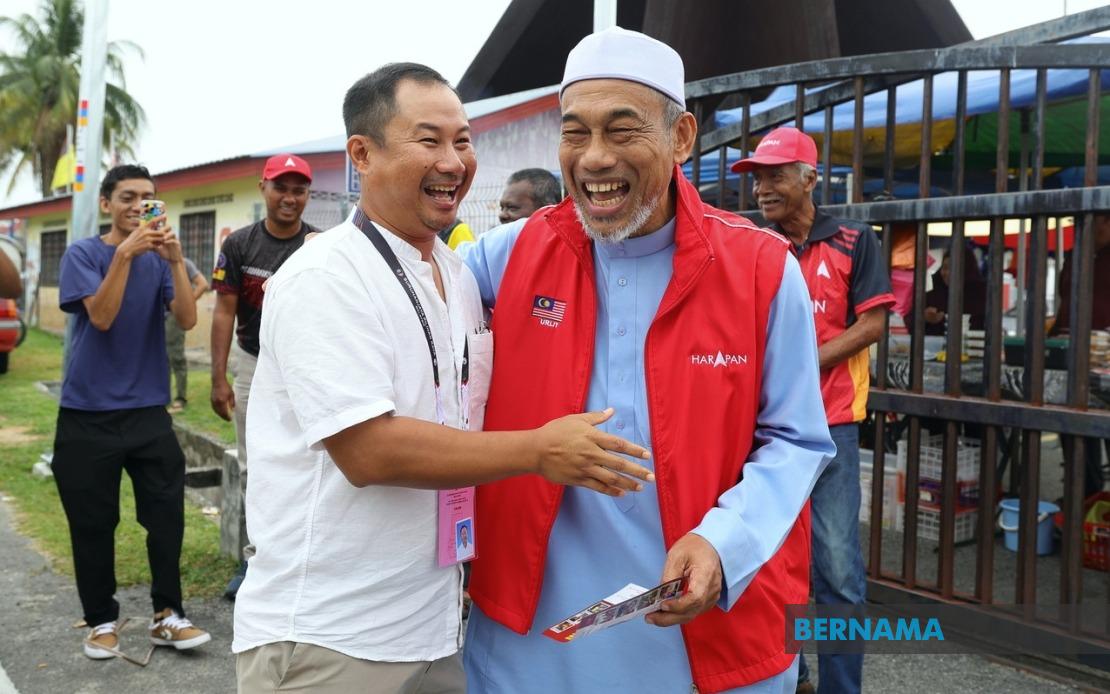
Datuk Bakri Sawir, the incumbent Pakatan Harapan assemblyman for Klawang, is mounting his third consecutive campaign bid by placing considerable weight on his established record in the Negeri Sembilan state election scheduled for August 1. The 67-year-old politician argues that his decade-long presence in the constituency since first winning office in 2018 has forged a foundation of trust that distinguishes him from challengers in what has become a three-way contest.
The Klawang state seat covers a relatively compact electorate of fewer than 14,000 registered voters, a scale that has allowed Bakri to cultivate personal connections across much of the constituency. His campaign messaging centres on accessibility and responsiveness, qualities he contends have become central to his political identity over two full terms as assemblyman. Speaking at a campaign stop at the weekly market in Pekan Kuala Klawang, Bakri articulated a philosophy of service that prioritises reaching residents in their own homes rather than expecting them to navigate bureaucratic channels.
This door-to-door methodology underpins what Bakri describes as his "people-centric approach," a strategy he has maintained consistently throughout his tenure since 2018. The assemblyman emphasises that he does not require constituents to visit his service centre for assistance; instead, he personally delivers aid and support directly to residents' homes. By maintaining his residence within the Klawang constituency, Bakri argues he remains perpetually accessible to those he represents, a factor he believes confers a competitive advantage over opponents who may have less established grassroots presence.
Balancing his emphasis on continuity and service delivery, Bakri acknowledges the reality that electoral support is never universal. He frames his approach to political opposition with philosophical composure, stating that he respects differing viewpoints and regards politics primarily as a vehicle for community benefit rather than personal advancement. His oft-stated conviction that politics should be "an act of worship and a path to paradise" reflects a value system that may resonate with voters seeking representatives motivated by principle rather than partisan calculation alone.
Beyond rhetorical positioning, Bakri's campaign platform includes several tangible development proposals reflecting his legislative ambitions if returned to office. Among his longer-term aspirations is the establishment of a higher education institution within the Jelebu district, a proposal he has championed since his initial election. The proposed Universiti Malaysia Negeri Sembilan would theoretically strengthen human capital development across the region, though Bakri acknowledges that current financial constraints render this initiative challenging to realise in the near term. Nevertheless, he signals determination to persist in advocating for this objective despite budgetary obstacles.
More immediately achievable projects comprise Bakri's nearer-term priorities. He is actively advancing plans to develop a Rest and Recreation Area at Tembun in Hulu Klawang, viewing such infrastructure as essential to attracting tourist traffic and stimulating local economic activity. The assemblyman argues that proper stopover facilities along major routes would encourage visitors to halt in Klawang, thereby generating commercial opportunities for residents engaged in retail, hospitality, and related services. This emphasis on tourism-linked development reflects broader Malaysian policy trends favouring regional economic diversification beyond primary production.
Another major component of Bakri's development agenda involves transforming Bukit Tajali into a comprehensive recreational park offering diverse attractions ranging from passive leisure activities to adventure tourism opportunities. Such projects signal an attempt to position Klawang as an emerging tourist destination within Negeri Sembilan, potentially providing alternative income sources for communities historically dependent on agricultural and industrial employment. The inclusion of active outdoor recreation options indicates awareness of contemporary tourism trends, particularly among younger demographic cohorts seeking experiential rather than passive travel experiences.
Further underpinning this tourism-centred development strategy is Bakri's proposal to capitalise on Jelebu's historical assets, specifically the British Memorial Stone, to develop the district's agrotourism sector. By integrating historical and cultural elements with agricultural operations, this approach potentially creates opportunities for farm-based tourism that educates visitors whilst generating farm income. Such initiatives reflect emerging Malaysian interest in heritage tourism and farm-to-table experiences, positioning rural constituencies as potential beneficiaries of this sector expansion.
The Klawang race itself reflects broader political fragmentation within Malaysian electoral politics. Bakri faces competition from Danni Rais, 38, representing Perikatan Nasional, and Muhammad Adib Musa, 25, standing for Parti Pribumi Bersatu Malaysia. The inclusion of a 25-year-old candidate suggests Bersatu's strategy to appeal to younger voters, potentially positioning generational change against Bakri's experience narrative. Rais's PN candidacy represents the coalition's attempt to consolidate Malay-Muslim support in what historically has been competitive terrain.
The broader Negeri Sembilan state election encompasses 889,490 registered voters across the entire state, of which 867,151 are ordinary voters alongside 16,884 military personnel and spouses and 5,455 police officers who voted early on July 28. The state assembly itself was dissolved on June 5, with August 1 established as polling day. This electoral timeline reflects standard procedures for Malaysian state elections and follows the constitutional dissolution mechanism typical of Malaysian state legislatures.
For constituencies like Klawang with relatively modest electorates, the effectiveness of grassroots engagement becomes particularly pronounced. Bakri's emphasis on personal accessibility and direct service delivery may yield measurable impact in environments where voters retain capacity to directly observe their representative's engagement level. Conversely, his tenure since 2018 also provides opponents with a record against which to benchmark performance, suggesting that voter assessment of whether Bakri has delivered on previous commitments will significantly influence the outcome.
The competition between experience and change represents a thematic tension that extends beyond Klawang to encompass broader Malaysian electoral dynamics. Bakri's positioning as an established practitioner of responsive constituency work appeals to voters prioritising continuity and demonstrated competence. His challengers, meanwhile, may attract voters seeking fresh perspectives or those dissatisfied with incumbent performance, irrespective of whether such dissatisfaction stems from service delivery failures or broader partisan preferences.

