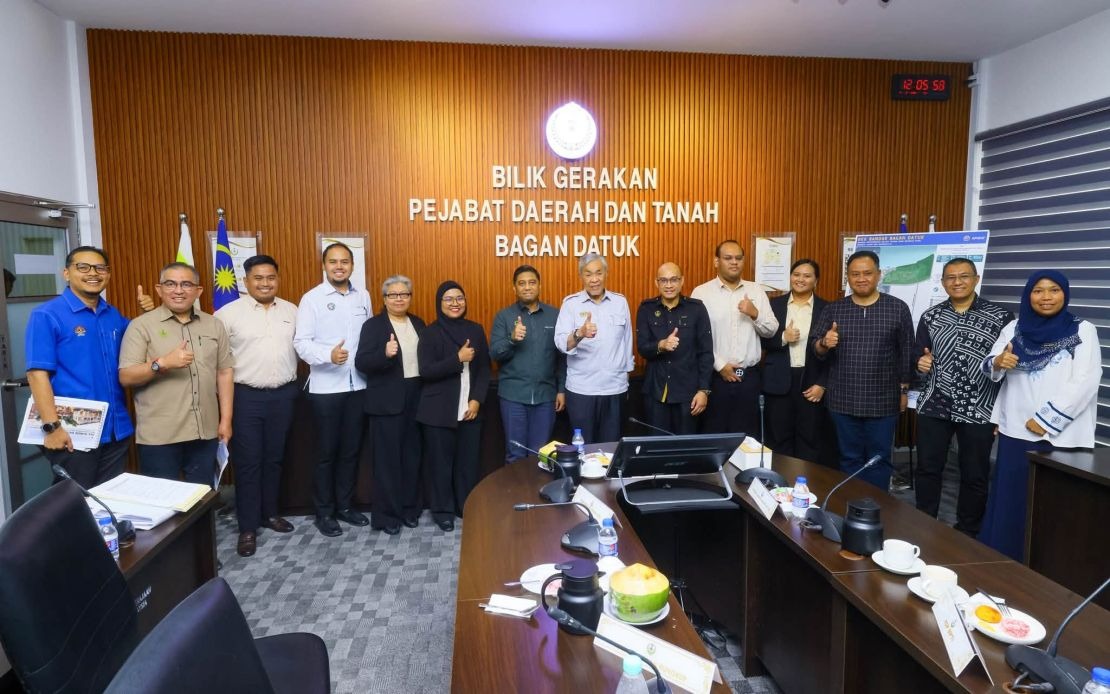
Deputy Prime Minister Datuk Seri Dr Ahmad Zahid Hamidi has articulated an ambitious vision for transforming Bagan Datuk into a well-planned administrative town that balances livability with economic competitiveness. Speaking in Ipoh, Zahid, who represents the Bagan Datuk parliamentary constituency, emphasized that the district possesses substantial untapped potential that must be systematically converted into tangible benefits for residents.
The initiative centres on developing a special area plan (RKK) for Bagan Datuk, formulated through collaborative discussions involving the Teluk Intan Municipal Council, Bagan Datuk District authorities, the Land Office, and external consultants. Zahid outlined that the envisioned development framework encompasses not merely physical infrastructure but a holistic ecosystem incorporating quality facilities, improved transportation networks, expanded employment avenues, and environmental quality that enhances residents' quality of life.
Zahid's emphasis on this constituency reflects a broader trend among Malaysian political leaders to position their home districts as models of comprehensive development. By framing Bagan Datuk as a potential administrative centre within a park setting, he articulates a contemporary approach that integrates urban functionality with environmental consciousness. This conceptualization aligns with emerging sustainable development principles gaining traction across Southeast Asian municipalities seeking to distinguish themselves within competitive regional hierarchies.
The involvement of multiple government entities and private consultants suggests a coordinated, multi-stakeholder approach rather than piecemeal development. Such structured planning mechanisms are increasingly essential in Malaysia's federal system, where coordination between municipal councils, district administrations, and state-level oversight requires sustained institutional cooperation. The Bagan Datuk initiative demonstrates recognition that transforming smaller districts into competitive administrative centres demands comprehensive master planning rather than ad hoc infrastructure projects.
From an economic perspective, Zahid's vision carries significance for Perak's development trajectory. Bagan Datuk's location within the economically productive western corridor of Peninsular Malaysia positions it favourably for strategic growth. Enhanced infrastructure and expanded economic opportunities could attract investment in manufacturing, services, and emerging sectors, potentially positioning the district as a secondary growth node within Perak's economy. This aligns with national development objectives to distribute economic activity beyond major metropolitan centres.
The administrative town concept reflects evolving patterns in Malaysian urban planning, where smaller districts are being repositioned as potential service hubs rather than merely residential satellites of larger cities. Such development would reduce commuting pressures on congested urban areas while distributing economic activity more equitably across regions. For Bagan Datuk residents, improved infrastructure and local employment opportunities could enhance living standards while reducing migration pressures toward Kuala Lumpur and other major centres.
Zahid's repeated emphasis on community engagement and responsiveness to local needs underscores an important governance principle. His assertion that development must account for the actual requirements of residents, rather than imposing external visions, acknowledges that sustainable development depends on ground-level legitimacy and social acceptance. This consultation-driven approach contrasts with historically top-down planning models that sometimes generated resistance or misalignment between planned interventions and community aspirations.
The timeline and financing mechanisms for this transformation remain unspecified. Large-scale district redevelopment typically requires sustained funding across multiple budget cycles, coordination between federal and state governments, and clear implementation roadmaps. For Malaysian readers assessing political rhetoric against actual delivery, monitoring the pace of concrete projects—land acquisition, infrastructure construction, business licensing reforms—will distinguish genuine transformation from aspirational framing.
Bagan Datuk's development also carries implications for broader Perak positioning within Malaysia's regional hierarchy. As larger metropolitan areas face congestion and environmental pressures, secondary towns with strategic locations and improved amenities become increasingly attractive for business relocation and residential migration. If successfully executed, the Bagan Datuk initiative could serve as a replicable model for other districts seeking competitive advantage.
The emphasis on distinctive character—described as a "competitive and distinctive administrative town"—signals awareness that successful secondary centres must offer genuine differentiation rather than simply mimicking larger urban centres. This might encompass specialized economic sectors, superior environmental quality, distinctive cultural identity, or particular lifestyle attributes that appeal to targeted demographic and business segments.
For investors and businesses considering Perak operations, clarity regarding infrastructure timelines, regulatory environments, and available incentives will be crucial. Political commitment alone, while necessary, requires translation into concrete fiscal allocations, legislative reforms, and institutional capacity to deliver promised facilities and services within specified timeframes.

