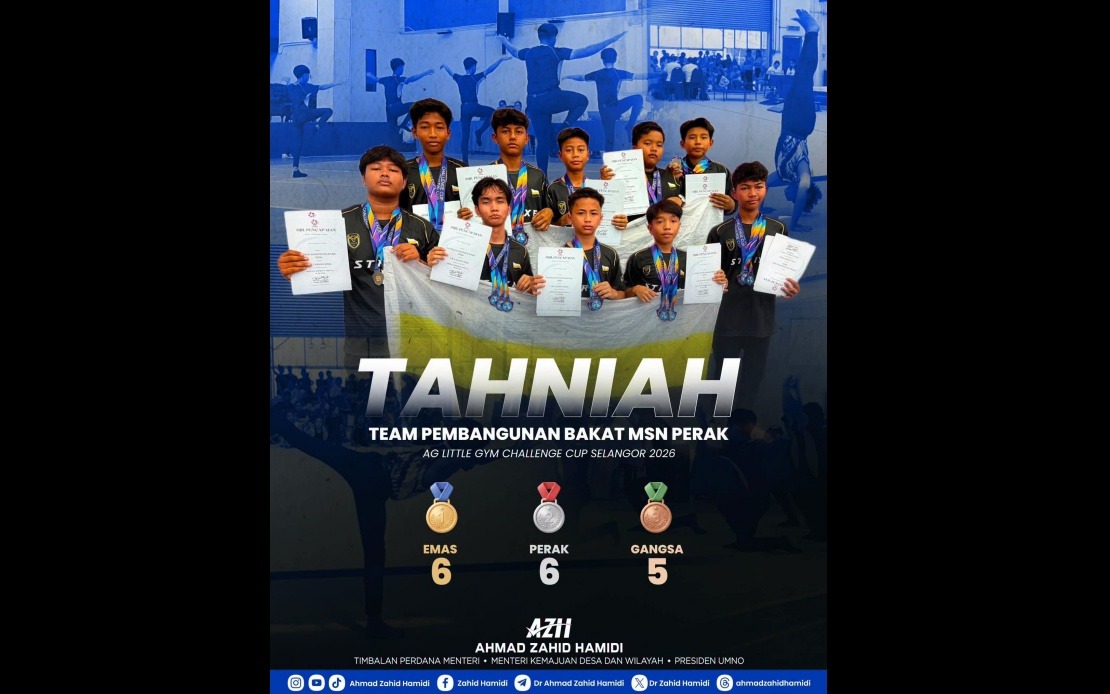
A young gymnastics team representing Bagan Datuk has etched their names into local sporting history by securing an impressive haul of six gold medals, six silver medals, and five bronze medals at the AG Little Gym Challenge Cup Selangor 2026, a significant regional competition held in Kajang on August 1. The achievement marks another milestone for the district's emerging athletic talent, drawing recognition from the highest levels of government and the wider community.
Deputy Prime Minister Datuk Seri Dr Ahmad Zahid Hamidi, who represents Bagan Datuk as its Member of Parliament, personally announced the accolade through a social media post, underscoring the national significance of the performance. His public endorsement reflects the growing emphasis on recognising sporting excellence among young Malaysians, particularly from smaller towns and districts that often lack the institutional infrastructure of major urban centres.
In his statement, Ahmad Zahid highlighted that the success transcends mere athletic accomplishment, positioning it as evidence of comprehensive youth development within the constituency. He noted that the achievement demonstrates how young people from Bagan Datuk possess not only academic prowess but also genuine competitive capability in sports disciplines when afforded appropriate resources, professional mentorship, and consistent backing. This observation carries broader implications for Malaysian sports policy, suggesting that geographical location and economic status should not be determinants of athletic potential.
The Deputy Prime Minister extended formal commendations to the entire ecosystem supporting these young athletes—the gymnasts themselves, their coaching staff, parents, and organisational personnel who collectively contributed to the competition success. This holistic acknowledgment reflects contemporary understanding that sporting achievement requires multifaceted support networks extending beyond individual talent. For many Malaysian families in secondary towns, such public recognition serves as validation that investing time and resources into children's sporting development yields tangible returns.
The Bagan Datuk Generasi Muda Gymnastics Club, the organisation responsible for training and fielding the team, further amplified the achievement through their own communications, celebrating the athletes' demonstrated commitment and resilience. The club's message emphasized the rigorous preparation underlying competitive success, recognizing the extensive hours of disciplined training, physical conditioning, and mental fortitude required for gymnasts to perform at competitive standards. Such messaging reinforces within the local community the connection between systematic effort and measurable outcomes.
The club notably positioned this success not as a final destination but as an intermediate waypoint in a longer developmental journey. This pedagogical approach, framing competitions as stepping stones rather than endpoints, aligns with international best practices in athletic development. Young gymnasts exposed to this mentality typically develop greater resilience and maintain motivation for continued improvement, contributing to sustained excellence in the discipline over time.
For Bagan Datuk specifically, the medal sweep represents validation of the district's capacity to produce competitive athletes across multiple events and age categories. Gymnastics, as a sport requiring significant technical instruction, specialized facilities, and financial investment, has traditionally been concentrated in urban centres with established clubs and coaching infrastructure. The success of a rural-district gymnastics program therefore suggests either the emergence of new facilities and expertise in Bagan Datuk or the effective mobilization of existing resources.
The competition's location in Kajang, Selangor's industrial heartland, placed the Bagan Datuk contingent in direct competition against teams from Malaysia's most developed state. This particular venue matters contextually because Selangor typically hosts larger, better-resourced sporting clubs. The performance in such a competitive environment validates the technical quality of Bagan Datuk's training and selection processes.
From a regional sports development perspective, this achievement holds significance beyond the individual medals. Southeast Asia has increasingly prioritized grassroots sports development as a strategy for identifying talent early and building sustainable pipelines of athletes. Malaysia's commitment to discovering and nurturing gymnastics talent in secondary towns contributes to this regional trajectory, potentially yielding future representation at continental and international competitions.
The public celebration of this accomplishment also carries social dimensions relevant to Malaysian sporting culture. Recognition of young athletes from non-metropolitan areas, particularly through channels involving national political leadership, helps distribute prestige and encouragement beyond traditional sporting powerhouses. This democratization of athletic recognition contributes to more equitable geographical distribution of sporting ambition and participation across the country.
Looking forward, the visibility generated by Deputy Prime Minister Ahmad Zahid's endorsement may catalyze increased support for the Bagan Datuk gymnastics program and inspire similar initiatives in comparable districts. Competitive success at visible regional tournaments frequently translates into enhanced local funding, improved facility access, and expanded recruitment, creating virtuous cycles of athletic development. The Generasi Muda club's stated commitment to intensified training suggests the organization intends to leverage this momentum for continued progression.
For Malaysian sports governance broadly, examples like Bagan Datuk's gymnastic achievement demonstrate that talent distribution is not inherently concentrated geographically, but rather emerges when supportive conditions—coaching expertise, facility access, financial backing, and inspirational leadership—converge effectively. Replicating such conditions across Malaysia's districts presents an opportunity to broaden the national talent pool and strengthen the country's competitive position in regional and international sporting forums.

