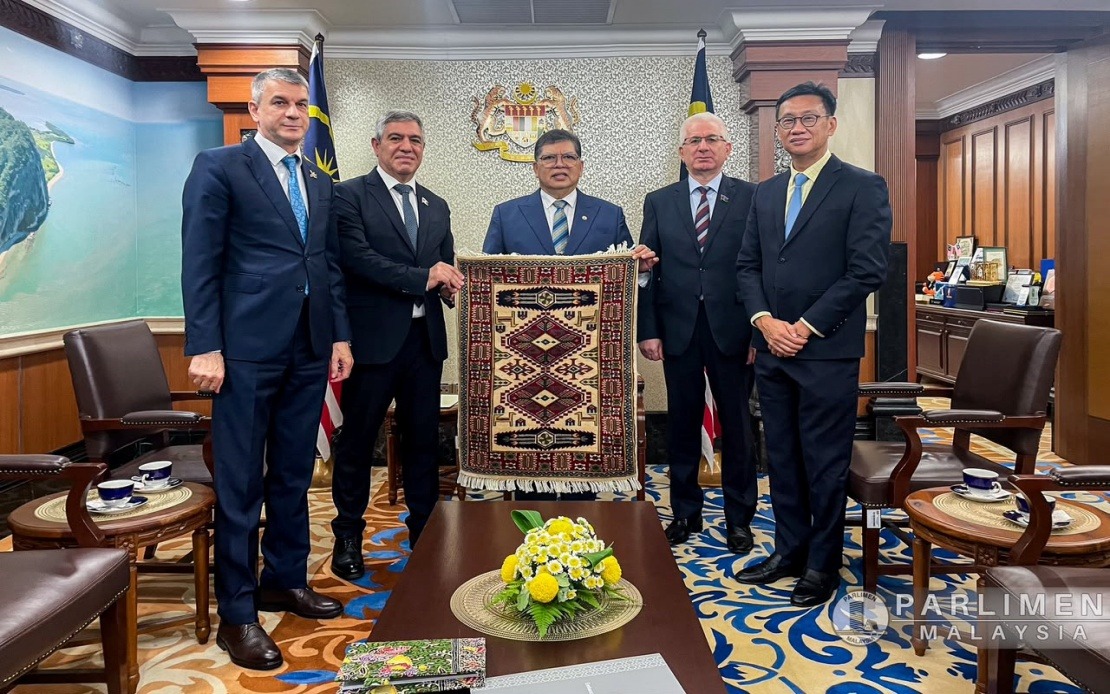
A delegation from Azerbaijan's Parliament recently concluded a working visit to Malaysia aimed at deepening bilateral parliamentary cooperation and exploring economic opportunities between the two nations. Vugar Bayramov, who heads the Working Group for Azerbaijani-Malaysian Interparliamentary Relations in the Azerbaijani Parliament, led the mission alongside fellow Member of Parliament Bakhtiyar Aliyev. The timing and composition of the visit underscore both countries' commitment to moving beyond ceremonial exchanges toward substantive institutional partnerships in an era marked by shifting geopolitical alignments across multiple regions.
The delegation's schedule reflected a carefully structured approach to engaging Malaysia's legislative and business leadership. Bayramov and Aliyev paid courtesy calls on Dewan Rakyat Speaker Tan Sri Johari Abdul, signalling respect for Malaysia's parliamentary hierarchy and demonstrating the importance Azerbaijan places on engagement with the lower house. These initial meetings served as diplomatic groundwork for more substantive discussions that followed, establishing rapport between parliamentary officials who would influence future bilateral agenda-setting.
The visiting parliamentarians also engaged with key Malaysian parliamentary figures overseeing international affairs. Wong Chen, chairman of the Malaysian Parliament's Special Select Committee on International Relations and International Trade, featured prominently in the itinerary, reflecting Azerbaijan's strategic interest in understanding Malaysia's approach to regional commerce and diplomatic positioning. Similarly, meetings with Zahir Hassan, chairman of the West Asia Friendship Group, provided an avenue for discussing shared regional interests and cultural affinities within the broader Middle Eastern and Central Asian context.
Higher-level engagement occurred when the delegation met with Dewan Negara President Datuk Awang Bemee Awang Ali Basah, expanding the scope of discussions beyond trade to encompass constitutional and institutional development. These encounters allowed both sides to exchange perspectives on parliamentary governance structures and the evolving relationship between legislative bodies in managing international relations. Such high-level exchanges carry particular significance for smaller nations seeking to amplify their diplomatic voice through institutional networking.
Beyond parliamentary circles, the Azerbaijani delegation prioritised direct engagement with Malaysia's private sector. Representatives from over twenty Malaysian business entities participated in dedicated sessions with Bayramov and Aliyev, facilitated by Malaysian National Chamber of Commerce and Industry secretary-general S. Gnanasambanthan. This breadth of business participation suggests substantial interest among Malaysian companies in exploring partnership possibilities with Azerbaijani counterparts, potentially spanning energy, manufacturing, and services sectors.
The business-focused component of the visit centred on identifying concrete opportunities for expanding Azerbaijan-Malaysia economic ties. Discussions progressed beyond general cooperation frameworks to address specific mechanisms for strengthening business-to-business connections and identifying sectors where investment collaboration could prove mutually beneficial. The emphasis on exploring new trade and investment pathways indicates both nations recognise existing commercial relationships remain underdeveloped relative to their growth potential.
Dawan Rakyat Speaker Johari provided additional context for the visit's significance through subsequent public remarks. He emphasised how parliamentary delegations and people-centred diplomatic initiatives carry particular weight during periods of international uncertainty. Johari's commentary reflected a broader recognition that formal diplomatic channels, while essential, require supplementation through human-scale engagement that builds personal relationships transcending bureaucratic frameworks and geopolitical differences.
The Azerbaijani delegation's visit arrives amid broader regional recalibration in Southeast Asia and beyond. Malaysia, as a significant economy and ASEAN member navigating complex great-power dynamics, strategically cultivates relationships across diverse regions. Azerbaijan, positioned at the intersection of Europe, Asia, and the Middle East, similarly benefits from diversifying its international partnerships. Both nations share interest in non-aligned positioning and maintaining flexible diplomatic options.
The institutional focus on working groups and parliamentary committees reflects contemporary understanding that lasting international relationships require sustained mechanism-building. Vugar Bayramov's formal position overseeing Azerbaijan-Malaysia parliamentary relations suggests both countries envision this engagement as systematic rather than episodic, potentially leading to regular exchanges and coordinated positions on international matters. Such structures typically generate follow-up visits, committee work, and capacity-building initiatives.
The visit's emphasis on economic cooperation carries particular relevance for Malaysia, which continuously seeks to diversify trade partners and investment sources. Azerbaijan's hydrocarbon resources and developing manufacturing base present complementary opportunities, while Malaysian expertise in financial services, manufacturing, and logistics could support Azerbaijani development priorities. The participation of over twenty Malaysian business entities indicates chambers of commerce and industry associations perceive commercial potential worth exploring.
Looking forward, the visit likely established groundwork for expanded cooperation across multiple domains. Parliamentary delegations frequently catalyse follow-up mechanisms, including technical exchanges, training programmes, and ongoing committee-level coordination. The involvement of Malaysia's business leadership suggests private-sector delegations to Azerbaijan may materialise, potentially resulting in concrete joint ventures or partnerships.
The bilateral engagement also positions both nations within broader regional narratives. For Malaysia, strengthening ties with Central Asian nations diversifies its geopolitical footprint and reinforces its ASEAN-centred but non-exclusive international approach. For Azerbaijan, deepening Southeast Asian connections provides counterweight to European and Middle Eastern-focused diplomacy while tapping into a dynamic economic region. Such mutual positioning reflects contemporary great power competition realities, where mid-sized nations strategically expand partnership networks to maintain autonomy and leverage.

