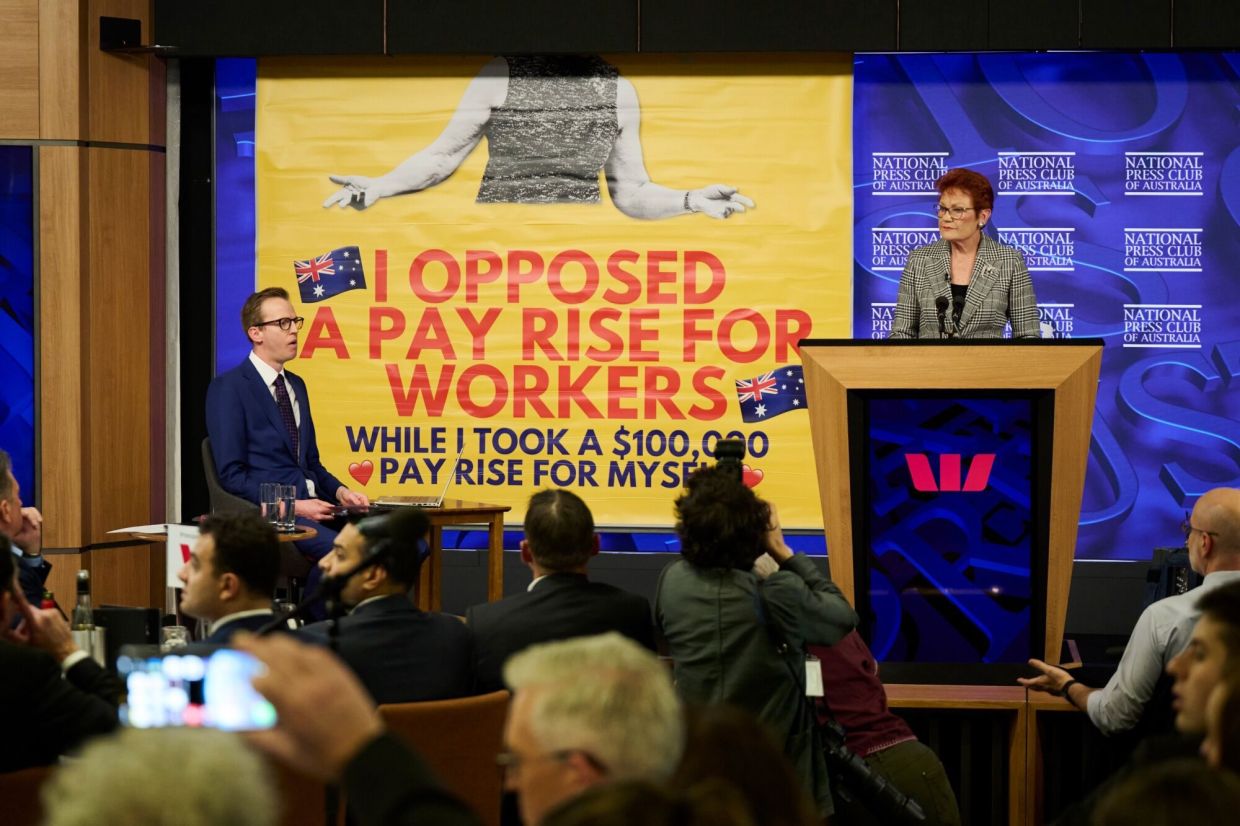
Pauline Hanson, leader of Australia's hard-right One Nation party, has made a bold pivot in the country's political debate by explicitly rejecting multiculturalism as a founding principle of Australian society. Speaking at the National Press Club in Canberra on Wednesday, Hanson outlined a vision of Australia as fundamentally monocultural, marking perhaps her most direct challenge yet to the nation's established multicultural framework that has defined policy for the past 40 years. The speech, notably her first appearance at the prestigious venue despite a three-decade political career, signals a calculated effort to reshape the national conversation around identity and immigration during a period of economic uncertainty.
Hanson's core argument rests on a distinction between racial and cultural homogeneity. While acknowledging that Australia is a multiracial society, she insisted the nation must adopt a unified cultural identity operating under what she termed "the one cultural umbrella." This formulation attempts to sidestep accusations of racial discrimination by framing the debate in cultural rather than ethnic terms, though critics argue the distinction is largely semantic. Her explicit reference to restricting immigration "from places immersed in extremism like radical Islam" removes any ambiguity about which populations she views as culturally incompatible with her vision of Australian identity.
The timing of Hanson's intervention reflects broader political circumstances in Australia. One Nation has experienced a significant surge in opinion polling over the past year, gaining momentum particularly after the centre-right coalition government's electoral collapse in May. This polling strength has given Hanson a platform to articulate her policy positions with increased confidence, knowing her message resonates with a substantial voter base. The party's rise speaks to genuine voter dissatisfaction with establishment politics, though it simultaneously raises questions about how mainstream parties have failed to address the concerns that fuel populist movements.
Hanson has strategically linked her monocultural vision to Australia's immediate economic pressures, most notably the housing affordability crisis that has emerged as a defining issue for voters across the political spectrum. By attributing housing unaffordability directly to high immigration levels, she offers voters a simple causal explanation for a complex problem involving land supply constraints, zoning regulations, foreign investment policies, and construction industry dynamics. This reductionist framing has proven politically potent, even as economists debate the extent to which immigration actually drives housing prices in major metropolitan areas.
The broader economic context amplifies Hanson's political appeal. Australians have endured resurgent inflation that has eroded purchasing power, interest rate hikes that have increased mortgage burdens, and volatile fuel costs partly driven by geopolitical tensions involving Iran. Prime Minister Anthony Albanese's Labor government has attempted to address these pressures through targeted interventions, including a temporary fuel excise reduction and proposed tax reforms aimed at improving housing affordability. Yet these measures, while economically sound, lack the narrative simplicity of One Nation's immigration-focused explanation.
Albanese has publicly identified the rise of populism and what he characterises as "simplistic grievance-based politics" as symptomatic of an economy increasingly failing ordinary Australians. His diagnosis suggests that when conventional economic management proves insufficient to address real living cost pressures, voters gravitate toward political movements offering clearer answers, even if those answers oversimplify complex policy challenges. This dynamic is hardly unique to Australia; similar patterns have emerged across developed democracies where economic anxiety has fuelled the rise of populist parties.
The significance of Hanson's monocultural pitch extends beyond Australian domestic politics. Australia's multicultural model has historically served as a template for policymakers in other immigrant-receiving democracies, including Canada and increasingly relevant countries in Southeast Asia managing their own migration pressures. Malaysia, as a country navigating complex questions of cultural integration and national identity with multiple ethnic and religious communities, may find aspects of this debate instructive, particularly regarding how political leaders can either weaponise or transcend cultural identity questions during periods of economic stress.
Hanson's explicit rejection of multiculturalism also reflects broader global trends toward ethnonationalism and cultural conservatism among populist movements. Her formulation differs from crude racial nationalism by emphasising cultural assimilation and a shared civic identity, potentially widening her appeal beyond voters motivated purely by ethnic concerns. This rhetorical sophistication makes One Nation's message more palatable to mainstream voters who might recoil from overt racism but remain concerned about rapid cultural change.
The political implications for Australia's major parties are substantial. The Labor government faces pressure to either acknowledge the legitimate concerns underlying One Nation's surge or risk further voter defection to populist alternatives. The opposition Liberal-National coalition must rebuild credibility after their electoral defeat while competing for voters now drawn to One Nation's messaging. Both parties confront the challenge of addressing genuine economic anxieties without endorsing restrictive immigration policies that would conflict with Australia's labour market needs and international standing.
Looking forward, Hanson's monocultural vision will likely become a central point of contestation in Australian political debate. The extent to which mainstream parties adopt or resist her framing will significantly influence whether immigration policy shifts toward the restrictive approach she advocates. Given Australia's reliance on skilled migration to address labour shortages and support economic growth, any substantial tightening of immigration would carry economic consequences that deserve serious scrutiny beyond campaign rhetoric.

%22%2F%3E%3C%2Fpattern%3E%3C%2Fdefs%3E%3Crect%20width%3D%22100%25%22%20height%3D%22100%25%22%20fill%3D%22url(%23ph1354vg)%22%2F%3E%3Crect%20width%3D%22100%25%22%20height%3D%22100%25%22%20fill%3D%22url(%23ph1354vp)%22%2F%3E%3Ctext%20x%3D%2250%25%22%20y%3D%2250%25%22%20text-anchor%3D%22middle%22%20dominant-baseline%3D%22central%22%20fill%3D%22rgba(255%2C255%2C255%2C0.95)%22%20font-family%3D%22Georgia%2C%20'Times%20New%20Roman'%2C%20serif%22%20font-weight%3D%22700%22%20font-size%3D%22320%22%20letter-spacing%3D%22-0.02em%22%3EGRS%3C%2Ftext%3E%3C%2Fsvg%3E)