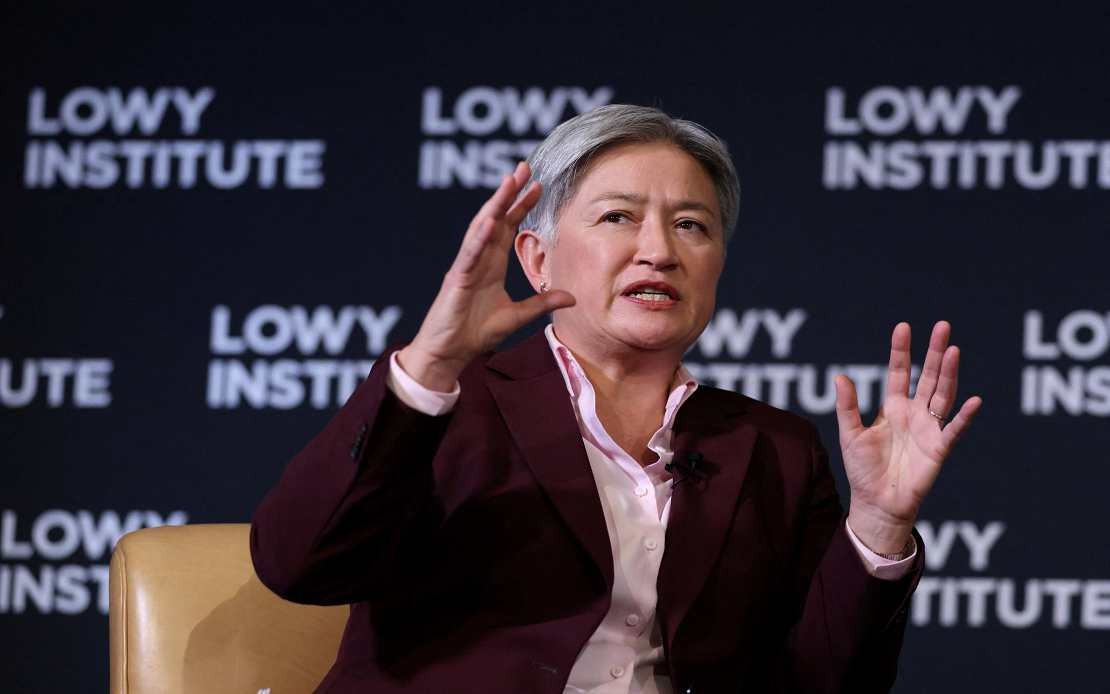
Australia's Foreign Affairs Minister Penny Wong has mounted a strong defence of the nation's multicultural foundations, warning that political pressure to transform Australia into a monocultural society would fundamentally undermine its economic and strategic interests. Speaking at a high-profile lecture at the Lowy Institute in Sydney on Friday, Wong argued that the pursuit of cultural homogeneity represents a misguided retreat from the openness that has historically defined Australian society and enabled its prosperity.
The minister's intervention directly addresses the growing political challenge posed by Senator Pauline Hanson's right-wing One Nation party, which has explicitly called for Australia to abandon multiculturalism and adopt a monocultural framework. Hanson and her party have positioned cultural restriction as a core policy platform, framing it within broader narratives about immigration control and national identity. One Nation has pledged to implement aggressive cuts to immigration numbers, substantially reduce foreign development assistance, and potentially withdraw Australia from key multilateral institutions should the party gain power in the 2028 general election.
Wong articulated a sophisticated economic and diplomatic case for cultural pluralism, contending that monocultural constraints would severely limit Australia's capacity to build productive international relationships and forge beneficial trade partnerships. Her framing moves beyond abstract cultural arguments to emphasise concrete consequences: voluntary isolation from global networks, diminished commercial opportunities, and reduced capacity to collaborate with international partners on shared challenges. The minister characterised the monocultural vision as a "melancholic fantasy," suggesting it represents nostalgic idealism disconnected from contemporary geopolitical and economic realities.
The timing of Wong's intervention reflects genuine concern within Australia's governing Labour administration about One Nation's accelerating electoral momentum. Recent polling data reveals a dramatic shift in voter preferences that presents a substantial strategic challenge for established parties. YouGov Australia's July survey found that One Nation's intended support has surged to 26 percent of the electorate, more than quadrupling the 6.4 percent vote share the party secured at the 2025 federal election. This four-year projection represents one of the most significant political movements in contemporary Australian politics.
The broader polling context demonstrates significant voter dissatisfaction with conventional political offerings. Labour's support has contracted from 34.5 percent at the 2025 election to 28 percent in current polling, while the opposition Coalition has experienced an even steeper decline, falling from 31.8 percent to 20 percent. The fragmentation of the traditional two-party system, with substantial support migrating toward populist alternatives, mirrors patterns observed across developed democracies and reflects accumulated frustrations with established governance approaches.
Immigration policy has emerged as the principal flashpoint driving electoral volatility. The Lowy Institute's annual poll, released in June 2026, documented expanding public anxiety about migration levels. A substantial majority of Australians, 55 percent according to the survey, believe the country accepts too many migrants. This represents a steady deterioration in public confidence, climbing from 53 percent the previous year and 48 percent in 2024. The trajectory suggests deepening concerns about integration capacity, labour market competition, and the pace of social change.
For Malaysian readers and policymakers monitoring regional developments, Australia's domestic political turbulence carries significant implications. Australia remains a critical regional power with substantial influence over Southeast Asian security architectures, trade relationships, and diplomatic coordination. Potential shifts toward isolationism or withdrawal from multilateral frameworks could reshape regional geopolitical balances and alter economic partnerships that benefit ASEAN economies including Malaysia. A reconfigured Australian foreign policy emphasising strategic retrenchment would inevitably reshape trade dynamics, defence cooperation arrangements, and regional forum participation.
The tension between Wong's defence of multiculturalism and rising voter scepticism about immigration reflects a fundamental challenge confronting liberal democracies globally. Policymakers must navigate between advocating for cultural openness and acknowledging legitimate public concerns about integration, labour market pressures, and social cohesion. Wong's framing attempts to reposition multiculturalism not as abstract idealism but as pragmatic national interest. However, this argument appears to have limited resonance with electorates increasingly focused on immediate, tangible impacts of demographic change rather than broader geopolitical advantages.
One Nation's policy platform extends beyond immigration restriction to encompass nationalist economic approaches and reduced international engagement. The party's commitment to substantially cutting foreign aid and reconsidering multilateral institution participation suggests a broader ideological reorientation toward national prioritisation over international cooperation. Such approaches would represent substantial departures from post-war Australian foreign policy orthodoxy and could generate significant regional consequences.
Wong's intervention illustrates Labour's determination to contest One Nation's framing of national identity and immigration policy at a substantive level rather than ceding ground to populist positioning. However, the substantial gap between the minister's endorsement of multicultural society and declining public confidence in immigration suggests that political messaging alone may prove insufficient to arrest One Nation's momentum. The electoral challenge reflected in polling data indicates that voter sentiment has shifted beyond the reach of conventional advocacy for multicultural principles.
Australia's political trajectory over the coming two years toward the 2028 election will significantly influence regional stability and cooperation frameworks. Should One Nation substantially increase parliamentary representation, the resulting constraints on international engagement and collaboration could generate spillover effects across Southeast Asia. Malaysian policymakers should monitor Australian electoral developments carefully, particularly regarding potential shifts in defence cooperation, regional security arrangements, and trade policy orientation that might emerge from any reconfiguration of Australia's international posture.

