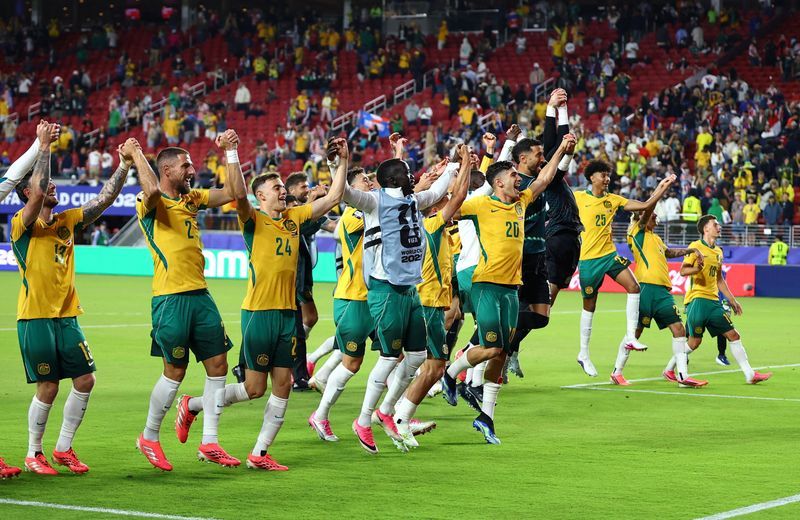
Australia has booked a spot in the World Cup's round of 32 after a tightly contested 0-0 draw with Paraguay in Santa Clara, California on Thursday, marking the national team's third appearance in the tournament's knockout phase. The match at San Francisco Bay Area Stadium proved a tense, physical affair that saw Tony Popovic's squad emerge with second place in Group D secured, though Paraguay's fate in advancing from the competition remains uncertain pending results from Friday's final group matches.
Popovic's tactical approach demonstrated attacking ambition, with the coach making six changes to his starting lineup to inject fresh impetus into the Australian side. The inclusion of livewire winger Nestory Irankunda and Cristian Volpato in the forward line signalled clear intent to break down the Paraguayan defence, while a positional shift saw Jordan Bos moved from left back to right back to accommodate the absence of injured Jacob Italiano. This reshuffle prioritised offensive opportunities over defensive solidity, a calculated gamble that reflected Australia's need for a victory rather than merely a draw.
The opening phase belonged entirely to Australia, who created several promising opportunities through their right flank where Bos and Volpato combined effectively. Jackson Irvine received a chance just minutes into proceedings when Volpato's set-up found him in space at the edge of Paraguay's penalty area, but his angled effort went directly at goalkeeper Orlando Gill without troubling the keeper significantly. Late in the first half, both Bos and Volpato generated further opportunities that drew saves from Gill, yet neither effort carried enough conviction to genuinely stretch the Paraguayan custodian.
Paraguay's first-half display was largely subdued, restricted to sporadic attempts and minimal attacking threat as they struggled to match Australia's early intensity. Gustavo Alfaro's side managed only one meaningful shot before the interval, a statistic that prompted tactical adjustments as the coach sought to revitalise his team's performance. The introduction of Brazilian-born attacker Mauricio at half-time provided immediate defensive disruption, with the substitute attempting an ambitious long-range effort within minutes of his arrival that sailed well wide of the mark.
As the second half progressed, Paraguay increasingly found their rhythm and began probing Australia's rearguard with greater purpose. Julio Enciso's energetic running created repeated problems for the Australian defence, with his pace and directness offering genuine outlet for a Paraguayan side determined to avoid the ignominy of early elimination. The influence of these fresh legs proved significant, as Paraguay seized momentum and threatened to embarrass Popovic's team during the latter stages of a contest that had transformed from one-sided dominance into a competitive struggle.
Paraguay fashioned one of their clearest openings eight minutes from full-time when Enciso unleashed a low drive that flashed agonisingly across the face of goal, missing the far post by a considerable margin. The opportunity represented Paraguay's best chance to break the deadlock, a moment that reflected their improving second-half performance despite lacking the initial control that Australia had exerted. Had the shot found the corner, Paraguay's narrative would have shifted dramatically, elevating them into a potentially more secure qualification position while eliminating Australia's first-choice scenario of advancing.
The denouement proved equally frantic, with Australia almost snatching victory through Bos's surging run from right back. In the 89th minute, the defender exploited space created by splitting two opposing players, charging into the penalty area before his shot skipped past the far post narrowly missing the target. Bos's late thrust demonstrated Australia's continued attacking intent despite Paraguay's increased threat, though his failure to convert represented another frustrating missed opportunity for Popovic's squad.
Mauricio's subsequent effort from the edge of the area proved tepid, easily gathered by Australian goalkeeper Joe Beach, allowing the Socceroos to hold firm through the closing moments and secure passage to the knockout stages. Australia's advancement comes four years after reaching the last 16 in Qatar, representing continuity in the national team's capacity to navigate the group phase against established footballing nations. The qualification is particularly significant given Paraguay's reputation as a competent international outfit, validating Popovic's preparation despite the lack of goals.
Paraguay's progression to the knockout stage, however, remains dependent on outcomes of other matches in the competition's final group round. With four points accumulated, the South Americans occupy territory that may constitute the eighth-best third-placed finish, though their advancement is not mathematically certain. As Egypt prepare to face Iran and Belgium take on New Zealand on Friday, Paraguay will await news of results that could either confirm their continuation or signal an untimely exit. The unpredictability of final group matches creates genuine tension for the 2010 quarter-finalists, whose performance against Australia, while improving as the contest developed, ultimately proved insufficient to guarantee their progression.
Australia's matchup with the second-placed team from Group G offers another significant challenge, though qualification itself represents a milestone achieved. The victor of that group stage, which remains wide open before Friday's decisive fixtures, will determine the nature of the opposition Popovic's squad will face. Australia's defensive resilience in containing Paraguay, allied to their superior organisation during the opening period, suggests the team possesses sufficient tactical sophistication to compete against quality opposition in the tournament's latter phases. The road to further advancement begins with that knockout encounter, though the immediate task of simply reaching this stage has been completed.

