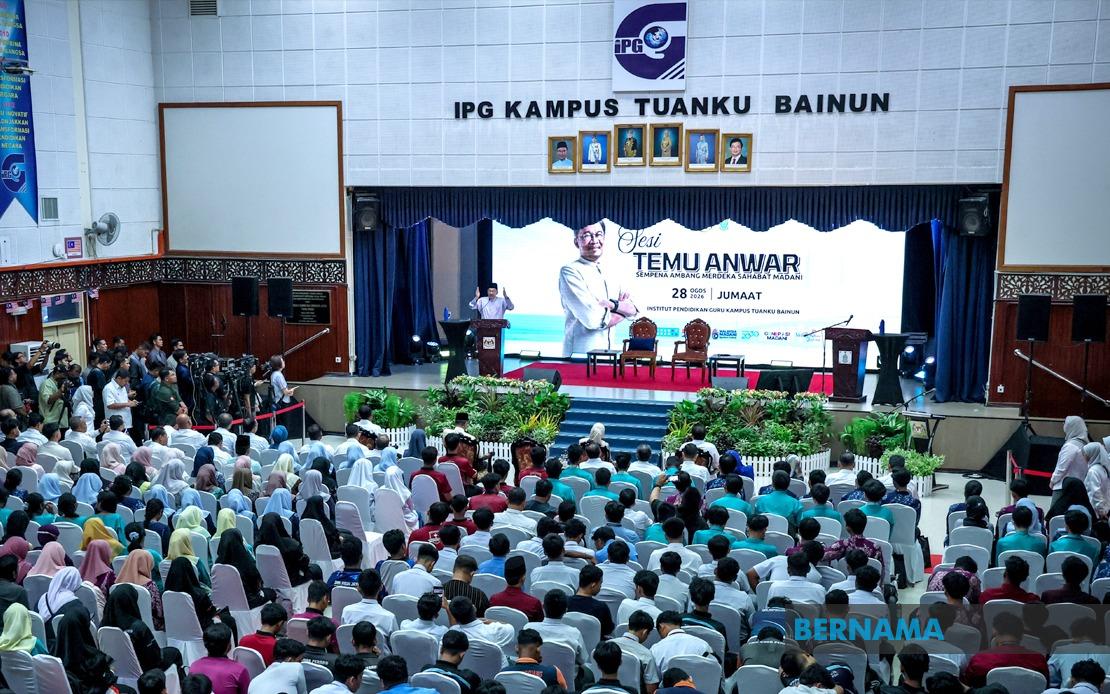
Prime Minister Datuk Seri Anwar Ibrahim has reaffirmed that the complete repeal of the Universities and University Colleges Act 1971 (AUKU) represents a fundamental shift in Malaysia's approach to student engagement, positioning the policy as essential to unlocking young people's potential for independent thought and creative expression. Speaking during a Temu Anwar session in Bukit Mertajam on August 28, Anwar articulated a vision of higher education unburdened by the restrictive regulatory framework that had governed campus life for more than five decades, arguing that contemporary young Malaysians deserve the space to develop into informed and intellectually rigorous citizens.
The Prime Minister's remarks directly challenged the paternalistic logic that underpinned AUKU since its enactment during the formative years of Malaysia's independence. Anwar highlighted a fundamental contradiction in the original legislation: that students who had attained the age of 18 and possessed full voting rights under the federal constitution were simultaneously barred from exercising basic freedoms of expression and assembly on university grounds. This apparent inconsistency formed the philosophical core of his argument for dismantling the act entirely, suggesting that denying legal adults the right to voice political opinions represented an antiquated approach divorced from democratic principles that Malaysia now aspires to embody.
At the heart of Anwar's rationale lies a conviction that censorship and intellectual constraint undermine the pedagogical mission of universities themselves. He emphasised that encouraging students to articulate their perspectives openly, even when those views may ultimately prove misguided or incomplete, creates an invaluable crucible for developing the critical faculties that characterise educated citizenship. Rather than viewing student activism or political discourse as inherently threatening to institutional stability, Anwar presented such engagement as integral to the learning process itself, positioning universities as laboratories for democratic deliberation rather than cloistered spaces insulated from the broader currents of national conversation.
The emphasis on creative and analytical development reflects a growing international recognition that rigid institutional control of student expression correlates with diminished innovative capacity and reduced graduate preparedness for complex problem-solving in professional environments. Malaysian universities have historically struggled to produce the kind of adaptable, independent-thinking talent increasingly demanded by knowledge-intensive sectors and global employers. By removing statutory constraints on campus political activity and debate, Anwar's government appears to be betting that greater intellectual freedom will translate into enhanced educational outcomes and a more competitive national talent pool over the medium to long term.
Education Minister Datuk Seri Fadhlina Sidek's attendance at the session underscored the cross-portfolio commitment to implementing this institutional transformation, signalling that the repeal enjoys backing from the ministry responsible for overseeing higher education policy implementation. The participation of government figures in direct dialogue with students on this subject matter itself represents a departure from the climate that AUKU had fostered—one in which campus-government relations were often adversarial and communications carefully mediated through formal channels rather than conducted in accessible, informal forums.
The AUKU repeal must be understood within the context of Malaysia's broader political transition over the past five years. The toppling of the Barisan Nasional regime in 2018 and subsequent shifts in governance philosophy have created openings for recalibration of policies that many observers regarded as legacies of an authoritarian impulse. Anwar's framing of the AUKU abolition as consistent with democratic maturation positions the move not merely as technical legislative housekeeping but as emblematic of a recasting of the state-society relationship, particularly as it pertains to the crucial cohort of young people navigating tertiary education.
The timing of Anwar's announcement also carries implications for Malaysia's regional standing and international reputation. Neighbouring countries, particularly in Southeast Asia, have scrutinised Malaysia's commitment to freedoms of expression and assembly, with persistent perceptions that institutional constraints remain heavy-handed by comparative standards. The removal of AUKU restrictions, if effectively implemented across all public universities, signals to international observers and prospective international students that Malaysian higher education is transitioning toward more permissive and intellectually vibrant environments.
Yet the practical realisation of this vision will depend substantially on how institutions translate the legislative change into revised policies and campus cultures. Universities accustomed to decades of state oversight and internal regulatory regimes controlling student conduct may require significant reorientation to foster the kind of uninhibited discourse that Anwar envisioned. Academic leadership, administrative staff, and faculty will need to develop new frameworks for managing campus life that permit robust debate whilst maintaining institutional integrity and preventing activities that genuinely threaten safety or obstruct educational operations.
The repeal also raises important questions about where legitimate institutional boundaries should lie in the post-AUKU era. While Anwar positioned the measure as an unambiguous expansion of freedom, the government and universities will inevitably confront scenarios requiring judgement calls about what conduct falls within acceptable bounds. Balancing the mandate for student voice against institutional autonomy and duty of care represents a nuanced governance challenge that cannot be resolved through legislative language alone but rather demands thoughtful implementation anchored in clear principles.
From a Malaysian perspective, the AUKU repeal carries particular resonance given the nation's aspirations toward becoming a higher-income, innovation-driven economy. International research consistently demonstrates correlations between permissive intellectual environments and elevated rates of entrepreneurship, patent generation, and knowledge worker productivity. If implemented successfully, liberalisation of campus speech codes could enhance Malaysia's capacity to retain talented graduates and attract international scholarly collaboration—factors increasingly central to national competitiveness in the twenty-first century knowledge economy.
Anwar's invocation of voting rights as the logical counterpart to freedom of expression also hints at deeper questions about democratic participation that extend beyond university walls. The comparison between the voting age of 18 and restrictions on campus political activity implicitly endorses the principle that democratic maturity deserves formal recognition through comprehensive rights rather than compartmentalised concessions. This philosophical positioning may foreshadow additional liberalisation measures affecting youth engagement across multiple institutional and policy domains, contingent upon successful management of the AUKU transition.
For students themselves, the repeal represents liberation from regulatory constraints that many regarded as infantilising and disconnected from the legal status they possessed as voting adults. The removal of these restrictions opens possibilities for campus-based political organisation, social activism, and intellectual contestation that had been suppressed or driven underground by the statutory framework. Whether students will mobilise these newfound freedoms to construct more robust democratic deliberative spaces within universities, or whether the absence of AUKU restrictions will fail to fundamentally alter campus political culture shaped by decades of constraint, remains an open question with significant implications for Malaysia's democratic trajectory.

