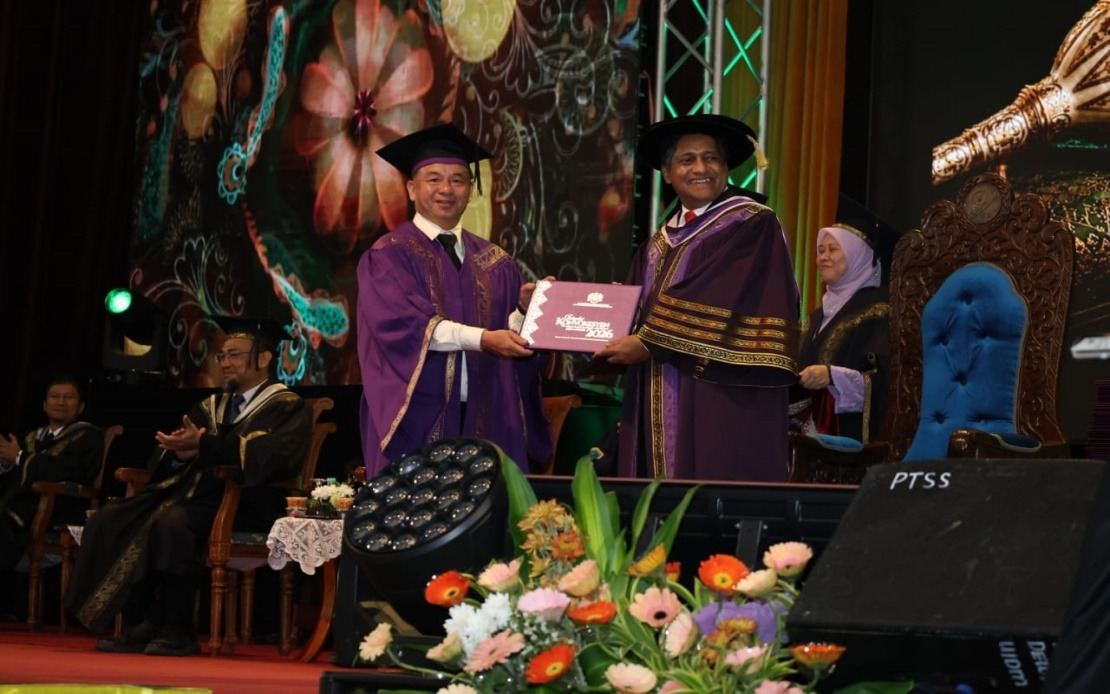
At 57 years old, Heng Meng Lai has etched his name into the annals of Seberang Perai Polytechnic's history, becoming the institution's oldest graduate after successfully completing his Diploma in Electrical and Electronic Engineering. His achievement, marked at the PSP Convocation Ceremony in 2026, represents far more than a personal milestone—it stands as a powerful testament to the possibility of educational reinvention at any stage of life, and carries profound implications for Malaysia's evolving approach to workforce development and lifelong learning.
Heng's educational journey was unconventional, interrupted by nearly five decades of competing demands that characterise the lives of many working Malaysians. His decision to pursue formal qualifications only in his mid-fifties emerged from circumstances that began in childhood hardship. When his father passed away during his formative years, Heng was merely nine years old. The loss forced his mother into the demanding work of a sewing factory operator, a role that became her means of sustaining seven children. Rather than becoming a barrier to aspiration, these early adversities crystallised within Heng a determination to improve his circumstances through education—a conviction that would ultimately guide him back to the classroom decades later.
Throughout his working life, Heng navigated practical roles that kept him tethered to immediate employment needs. His professional trajectory carried him from work as a storekeeper through to positions on production lines at an electronics manufacturing facility, then advancing to the level of production supervisor. These roles provided stability and income, yet they also represented the postponement of a deeper educational ambition. It was precisely this extended exposure to electronics manufacturing environments that eventually crystallised his academic focus. Rather than viewing his decades of practical experience as disconnected from formal study, Heng recognised the opportunity to integrate his existing knowledge with structured, credentialed learning in Electrical and Electronic Engineering.
Navigating tertiary education as the oldest student in his cohort presented significant social and pedagogical challenges that Heng had to overcome. The classroom dynamics of a polytechnic programme naturally centre on younger learners, typically in their late teens and early twenties, and the generational gap between Heng and his peers could have created isolation or discouragement. Instead, he found the lecturing staff at Seberang Perai Polytechnic remarkably accommodating and supportive. Rather than treating him as an outlier, instructors provided patient guidance and consistent encouragement, actively working to facilitate his integration into the learning community. This institutional responsiveness proved instrumental—Heng never experienced marginalisation despite the obvious age differential between himself and classmates, a reality that speaks to the professionalism of PSP's educational approach.
The significance of Heng's achievement extends beyond personal validation into the broader policy landscape of Malaysia's educational priorities. Seberang Perai Polytechnic's director, Mohd Ruzi Hamzah, framed Heng's accomplishment as emblematic of the institution's commitment to democratising access to quality tertiary education across all demographic segments, regardless of age or prior background. This positioning aligns with Malaysia's national agenda of cultivating lifelong learning cultures designed to develop a highly skilled workforce capable of adapting to technological and economic shifts. As Malaysia confronts evolving labour market demands driven by digitalisation and economic transformation, the capacity to retrain, upskill, and educate workers throughout their career spans becomes increasingly critical to competitiveness.
Heng's next steps demonstrate his understanding that formal qualification functions as a foundation rather than a culmination. Having obtained his diploma, he intends to return to employment, leveraging his newly acquired technical knowledge alongside his two decades of practical production experience. This integration of theoretical learning with applied work represents an optimal model for technical skill development in manufacturing sectors. Importantly, Heng has not plateaued at the diploma level; he explicitly articulates ambitions to pursue a Bachelor's degree, signalling that his return to formal education has fundamentally altered his trajectory and self-conception regarding continuing development.
The implications of Heng's achievement resonate particularly for Southeast Asian economies grappling with skills gaps and workforce transitions. Malaysia, like its regional neighbours, faces the challenge of preparing workers across age ranges for industries increasingly characterised by automation and advanced technical requirements. Traditional models of education that concentrate learning in early adulthood become insufficient when technological change accelerates and career spans lengthen. Heng's example demonstrates that motivation, institutional support, and thoughtful programme design can enable mature workers to access credentialed pathways even after prolonged labour force participation.
Cultural attitudes toward age and education in Malaysia are also subtly challenged by Heng's visibility. In societies where respect for age and hierarchical social structures remain culturally salient, the image of a 57-year-old sharing classrooms with teenagers might initially appear incongruous. Yet Heng's successful navigation of this environment, coupled with institutional recognition of his achievement, creates a cultural counter-narrative suggesting that educational pursuit transcends conventional life-stage expectations. This symbolic shift could gradually influence how Malaysian society conceptualises the relationship between chronological age and personal development capacity.
For Seberang Perai Polytechnic itself, Heng's graduation represents a validation of the institution's stated mission to serve diverse populations. Polytechnics occupy a crucial position within Malaysia's tertiary education ecosystem, bridging secondary schooling and university-level study while emphasising practical, industry-relevant skills. The willingness to admit and successfully graduate a student whose age and background deviate significantly from standard cohort profiles expands the institutional footprint and demonstrates flexibility in execution of educational mandates. Such inclusivity, if genuinely embedded across Malaysia's polytechnic network, could unlock substantial latent demand among mature workers seeking credentials without abandoning employment.
Heng's personal resilience and perseverance ultimately underscore a fundamental principle often obscured by age-stratified educational systems: cognitive capacity and motivation to learn do not have expiration dates. His ability to master technical subject matter in electrical engineering at 57 contradicts stereotypes about cognitive decline and older workers' capacity for complex learning. While individual variation certainly exists, Heng's demonstrated competence suggests that careful programme design, supportive pedagogy, and mature motivation can overcome age-related assumptions that educators and policymakers sometimes unconsciously harbour.
Looking forward, Heng's achievement invites reflection on how Malaysia's education and employment systems can more systematically accommodate lifelong learning pathways. Current structures often treat tertiary education as a bounded, youth-oriented phase rather than an accessible resource throughout working lives. Regulatory frameworks, funding models, and programme scheduling frequently assume full-time student status during early adulthood. As Heng's example demonstrates, alternative arrangements—potentially including part-time study, evening or weekend classes, and flexible assessment—could unlock educational opportunity for many workers constrained by employment and family obligations. The economic return on such flexibility may be substantial, as mature students often bring motivation, discipline, and practical perspective that enhance learning outcomes and workplace application.

