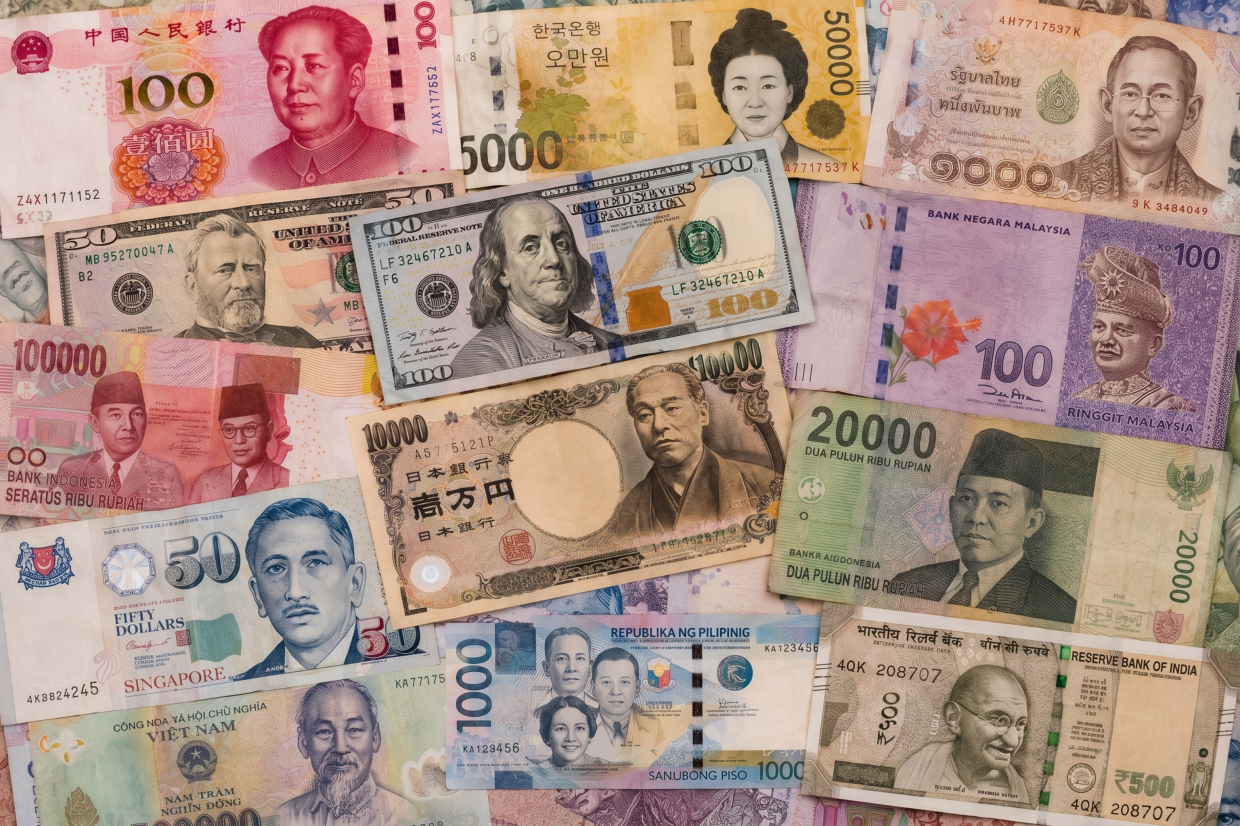
Geopolitical tensions in the Gulf have reignited financial market anxieties across Asia, with mounting conflict sending oil prices climbing 4% and prompting a broad retreat in regional currencies against the strengthening U.S. dollar. The escalation triggered fresh inflation concerns and speculation about potential interest rate hikes from major central banks, creating a risk-off sentiment that rippled through equity markets from Seoul to Kuala Lumpur on Monday.
The U.S. dollar index gained ground as investors rotated towards the relative safety of American assets in response to Middle East developments. This shift proved particularly punishing for emerging market currencies, which typically underperform during periods of elevated global risk. The Indonesian rupiah weakened substantially to 18,140 per dollar, marking its lowest point in over a month, while the South Korean won depreciated to 1,507.9 against the greenback. These moves reflect a classic pattern of capital flight from riskier regional assets during periods of international turbulence.
South Korea bore the brunt of Monday's market turmoil, with the KOSPI plunging 7.96% to a 10-week low in a dramatic reversal that triggered automatic circuit breakers designed to halt excessive selling. The benchmark index's collapse was substantially amplified by a catastrophic 13% nosedive in SK Hynix, the world's dominant artificial intelligence memory chipmaker, as investors rushed to lock in profits following a triumphant debut on Wall Street last Friday. The semiconductor giant's sharp withdrawal illustrated how quickly enthusiasm can evaporate in technology-focused markets.
SK Hynix's dramatic decline reflects broader anxieties permeating the semiconductor sector. Investor confidence in the sustainability of extraordinary earnings tied to insatiable demand for high-bandwidth memory chips has deteriorated noticeably in recent weeks, complicated by reports that major artificial intelligence companies are implementing more disciplined capital expenditure policies. Additionally, the proliferation of highly leveraged single-stock exchange-traded funds has amplified price swings in individual names, turning chipmaking shares into vehicles for speculative positioning rather than fundamental value assessment.
Despite Monday's turmoil, the KOSPI maintains impressive credentials when viewed through a longer lens. The index has generated a 63% return since the beginning of 2024, positioning it among the world's best-performing equity benchmarks despite its 25% decline from the record close achieved on June 22. This volatility highlights the challenge facing Korean policymakers and investors alike: balancing genuine strength in underlying economic fundamentals and technological competitiveness against cyclical pressures and market speculation.
Malaysia confronted its own set of complications on Monday, though the domestic equity market managed a modest advance to three-week highs even as the ringgit weakened to 4.0780 per dollar. However, underlying the surface gains lies a more troubling political dynamic that threatens to undermine investor confidence. Prime Minister Anwar Ibrahim's ruling coalition suffered a crushing electoral defeat in Saturday's Johor state election to a key coalition partner, an outcome that has revived speculation about potential fractures at the federal level and raised the possibility of an early general election.
The Johor setback carries genuine implications for Malaysia's investment outlook beyond immediate political theatre. Goldman Sachs analysts cautioned that any sustained deterioration in confidence regarding federal coalition stability could erode the "policy-stability premium" that Malaysian assets have previously enjoyed, notwithstanding the fundamentally sound macroeconomic conditions underpinning the domestic economy. The investment bank nevertheless highlighted that recent measures implemented by Bank Negara Malaysia to stimulate foreign exchange inflows should help mitigate excessive volatility and depreciation pressure on the ringgit, even if political uncertainty continues to demand a risk premium.
Across the broader emerging Asian region, market movements remained decidedly mixed. Philippine equities edged marginally higher while Indonesian stocks advanced 0.5%, suggesting that not all regional markets succumbed equally to Monday's risk-off environment. Taiwanese shares retreated modestly, while Singapore's benchmark index declined as much as 0.7%, notably snapping an impressive seven-session streak of consecutive record highs that had underscored the city-state's resilience.
The week ahead promises several important data releases and policy decisions that could substantially shift the risk narrative. Singapore is scheduled to release advance second-quarter economic growth figures, while Malaysia will publish inflation readings and preliminary economic output data. The Bank of Korea will announce its interest rate decision amid mounting pressure to consider policy adjustments in light of equity market volatility and currency weakness, while the United States will release crucial inflation statistics that could alter expectations for the Federal Reserve's policy trajectory.
These concurrent developments underscore a fundamental challenge confronting policymakers and investors throughout Asia: managing the competing pressures of domestic economic objectives against an increasingly volatile external environment. The Middle East tensions, while not directly impacting regional economies, have demonstrated that geopolitical risk transmits rapidly through global financial markets via commodity prices and currency movements. For Malaysia specifically, navigating the intersection of external financial volatility and internal political uncertainty demands careful calibration of policy responses to avoid compounding market anxieties.

