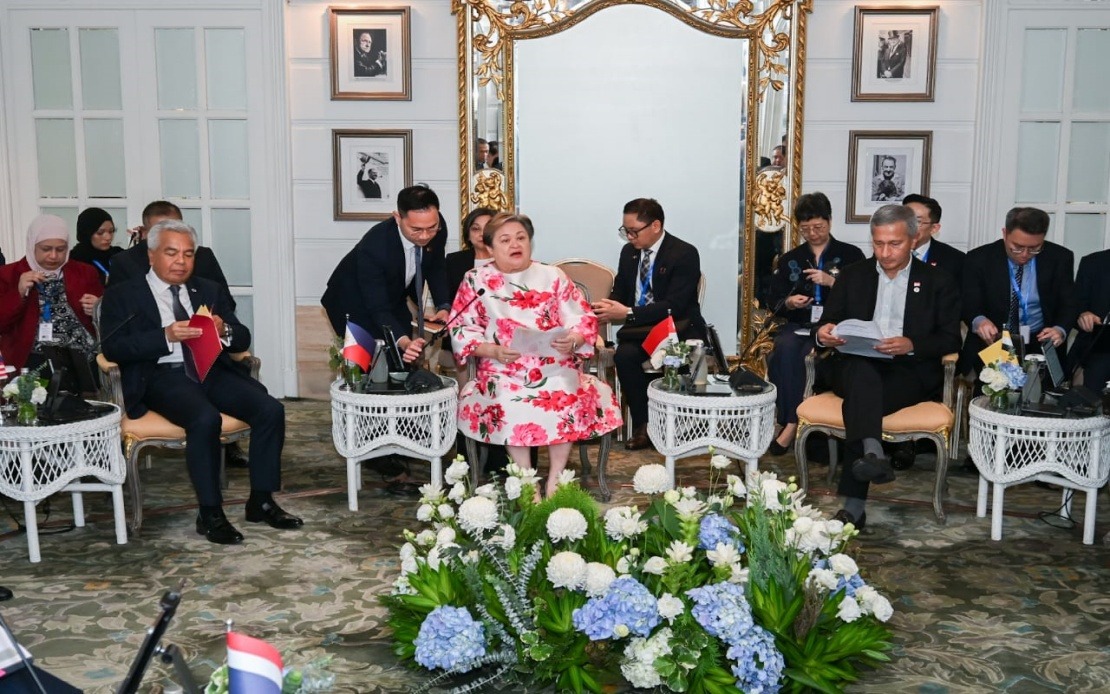
Southeast Asia's regional bloc has reinforced its commitment to the Five-Point Consensus as the cornerstone of its Myanmar strategy, even as implementation remains sluggish and Naypyidaw continues to resist international pressure. At a high-level ministerial gathering in Bangkok on Sunday, ASEAN foreign ministers gathered with their counterpart from Myanmar to emphasise three critical priorities: expanding humanitarian relief, curtailing ongoing violence against civilians, and fostering more inclusive political negotiations that could pave the way toward national reconciliation.
The reaffirmation represents ASEAN's latest attempt to maintain diplomatic momentum on an issue that has defined the bloc's credibility and cohesion since the military coup in February 2021. Philippine Foreign Secretary Maria Theresa Lazaro, serving as ASEAN Chair's Special Envoy on Myanmar, made plain that the Five-Point Consensus—which was originally adopted in April 2021—remains the sole basis upon which ASEAN will engage with all parties, including the Myanmar junta. Despite Naypyidaw's parliamentary rejection of the peace framework just days earlier, Lazaro underscored ASEAN's unwavering stance, declaring that member states stand resolute behind the consensus regardless of Myanmar's official position.
The timing of the meeting carries particular significance as it marks the first in-person encounter between ASEAN's foreign ministers and Myanmar's foreign minister since the crisis erupted nearly four years ago. This diplomatic breakthrough, while modest, signals ASEAN's determination to maintain dialogue channels even when progress appears glacial. The gathering itself—hosted by Thailand and chaired by the Philippines in its current role as ASEAN Chair—demonstrated unity among the bloc's members, with representation spanning nearly all member states. Malaysia's involvement through Foreign Ministry Secretary-General Tan Sri Amran Mohamed Zin underscores Kuala Lumpur's continued engagement with this critical regional issue, though Cambodia's absence reflects ongoing divisions within ASEAN over how assertively to pressure Myanmar.
The humanitarian dimension looms particularly large in ASEAN's current strategy, reflecting the deteriorating ground situation where millions of Myanmar's citizens face displacement, hunger, and inadequate medical care. The Philippines has announced plans for a dedicated humanitarian mission aimed at identifying fresh avenues for expanding aid delivery across Myanmar's fractured territory. This approach recognises a practical reality: even as political negotiations remain deadlocked, humanitarian access represents a less contentious arena where some concrete progress might be achievable. For Malaysia and other ASEAN capitals concerned about regional stability and the refugee burden emanating from Myanmar, expanded humanitarian engagement offers a pathway to address immediate suffering whilst diplomatic resolution remains elusive.
Violence reduction, the second priority articulated at the Bangkok gathering, remains perhaps the most urgent concern given escalating clashes between military forces and armed resistance groups across Myanmar. The continuing toll on civilians caught between warring factions has transformed what initially appeared as a political standoff into an increasingly militarised conflict. ASEAN's emphasis on protecting non-combatants reflects both humanitarian principle and strategic self-interest, as the spillover effects of prolonged instability—including refugee flows and cross-border security challenges—directly impact neighbouring countries including Thailand, Malaysia, and Bangladesh.
The inclusive political dialogue component addresses the deeper constitutional and governance questions that must eventually be resolved for Myanmar to restore stability. ASEAN has specifically flagged the need for a more conducive political environment and the release of detained political figures, understanding that durable solutions require all stakeholder participation. The junta's continued detention of opposition leaders and other activists represents a fundamental obstacle to the kind of broad-based negotiations ASEAN considers essential for genuine national reconciliation. This demand, while unlikely to secure immediate compliance from Naypyidaw, establishes a clear benchmark against which ASEAN can measure progress or lack thereof.
Thailand's Foreign Minister Sihasak Phuangketkeow articulated a crucial distinction in ASEAN's approach: the concept of calibrated engagement, which he characterised as inherently reciprocal. This framing acknowledges a reality that has frustrated ASEAN diplomacy throughout the Myanmar crisis—that regional consensus and engagement efforts require matching responsiveness from Naypyidaw. The Thai minister's emphasis on this two-way street reflects growing impatience within ASEAN about the junta's apparent intransigence, suggesting that future diplomatic initiatives will come with clearer expectations and performance metrics. The message conveyed is that ASEAN's patience, while durable, is not infinite.
Myanmar's parliamentary rejection of the Five-Point Consensus represents a deliberate rebuff that complicates ASEAN's position. Rather than adapting its framework in response to this rejection, ASEAN has chosen to reaffirm the consensus, implicitly challenging Naypyidaw to reconsider. This strategy carries risks—it may harden the junta's intransigence or be perceived as ineffectual—but it reflects ASEAN's recognition that abandoning its framework would constitute a humiliating retreat that would undermine the bloc's credibility on Myanmar and potentially embolden authoritarian actors across the region.
The question of timelines emerged as a critical point of contention during the ministerial discussions. When pressed on whether ASEAN had established specific deadlines for Myanmar to address regional concerns, Sihasak indicated that progress assessments would occur at the upcoming ASEAN Summit later in the year. This measured timeline approach contrasts sharply with the urgency that humanitarian organisations and some international partners have advocated, but it reflects ASEAN's traditional preference for patient engagement over confrontational pressure. For Malaysia and other members, this timeline suggests that expectations for dramatic breakthroughs in coming months should remain modest.
The broader regional implications of ASEAN's Myanmar strategy deserve close examination. How effectively the bloc manages this crisis will determine whether it can preserve its cohesion and relevance as a geopolitical player. Myanmar's crisis tests ASEAN's foundational principles—particularly non-interference and consensus decision-making—in ways that previous regional challenges have not. The bloc's ability to maintain dialogue with Naypyidaw whilst simultaneously pushing for substantive change on humanitarian and political fronts requires sophisticated diplomatic balancing. Malaysia, as a longstanding ASEAN member with significant stakes in regional stability, has demonstrated continued commitment to this multilateral approach despite its own challenges with refugee populations and transnational security issues stemming from Myanmar's instability.
Looking ahead, ASEAN's strategy faces a fundamental challenge: how to maintain relevance and credibility whilst dealing with a recalcitrant interlocutor that appears largely unmoved by the bloc's collective expressions of concern. The Five-Point Consensus remains sensible and comprehensive, but implementation requires reciprocal commitment from Myanmar's leadership—a commitment that has so far been forthcoming only in the most nominal sense. ASEAN's reaffirmation of this framework, whilst politically necessary for preserving bloc unity, must eventually give way to honest assessments about whether calibrated engagement can produce meaningful results or whether more assertive regional and international action becomes necessary. The answers to these questions will emerge gradually, likely across the remainder of this year's ASEAN calendar and beyond.

