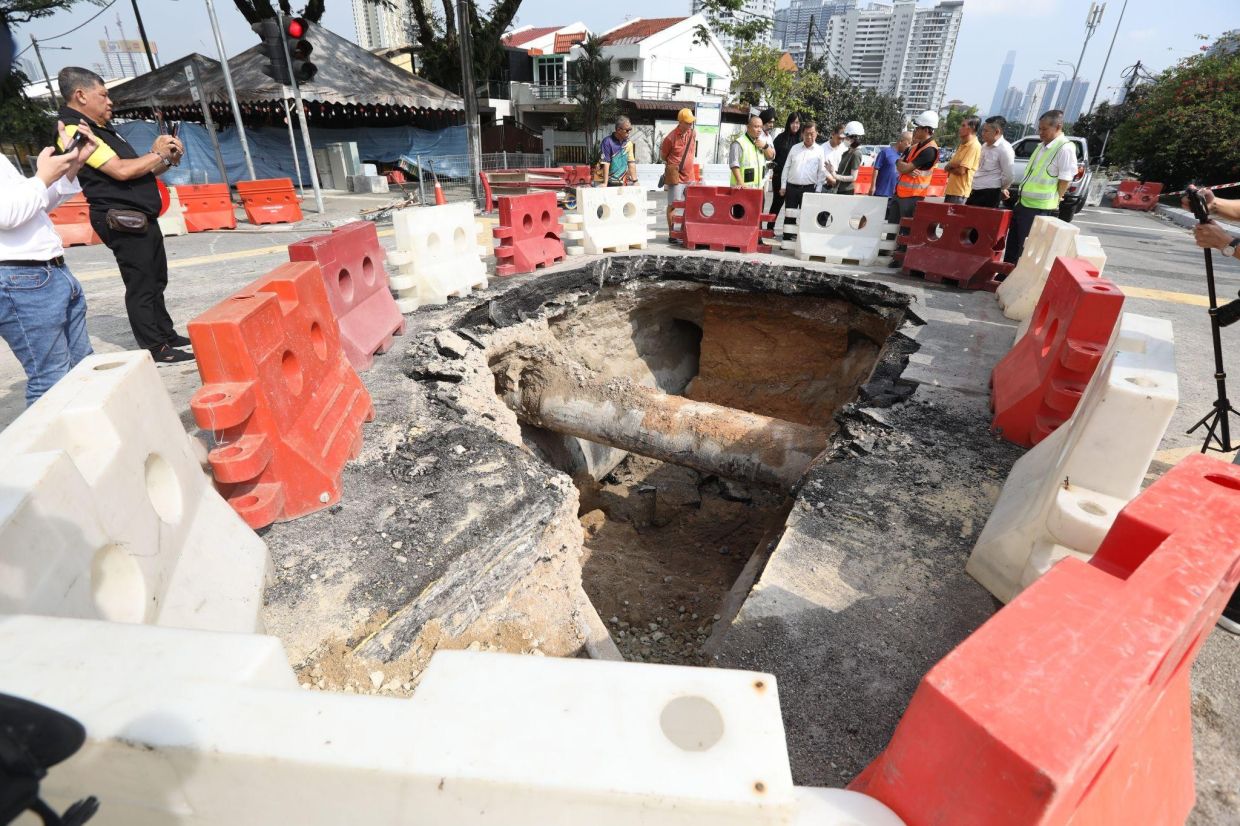
Sinkholes are becoming an increasingly visible hazard across Malaysia as the country grapples with more intense and unpredictable rainfall patterns. These dramatic collapses, which can damage roads, buildings and pose serious public safety risks, result from a complex interplay of geological, hydrological and infrastructural factors. While each incident has unique characteristics requiring detailed technical investigation, the underlying cause often traces back to the deterioration of underground sewerage systems under pressure from extreme weather conditions.
The formation of sinkholes linked to sewer infrastructure typically follows a predictable sequence, according to Indah Water Konsortium (IWK) chief executive officer Narendran Maniam. When heavy rainfall saturates the ground, the soil loses structural strength at precisely the moment when water pressure surges through ageing sewer pipelines. This combination forces vulnerable pipes to shift, crack or rupture entirely. Once breached, sewage escapes into surrounding soil layers, which gradually wash away, creating increasingly larger underground voids. Eventually, the ground above these cavities becomes too thin to support its own weight, and catastrophic collapse occurs. This mechanism transforms what might initially seem like a localised pipe failure into a serious infrastructure emergency.
IWK manages approximately 22,500 kilometres of public sewer pipelines across Malaysia, making it custodian of one of Southeast Asia's most extensive sewerage networks. However, much of this infrastructure has aged considerably, with critical reinforced concrete trunk sewers—those measuring 600mm in diameter and above—now facing mounting stress. These major conduits typically operate at or near full capacity during wet seasons, which means they must handle surging volumes of sewage moving at high velocities. The combination of constant structural stress and chemical degradation from hydrogen sulphide gas, which accumulates in these pipes and corrodes concrete walls over decades, creates ideal conditions for accelerated deterioration.
Recognising these vulnerabilities, IWK has shifted toward proactive rather than reactive maintenance strategies. The corporation now conducts periodic condition assessments using sophisticated inspection technologies including Ground Penetrating Radar (GPR), which can detect subsurface anomalies without excavation, alongside Closed-Circuit Television (CCTV) crawler inspections that capture detailed footage of pipe interiors. Push rod and pole cameras supplement these methods depending on site accessibility and operational constraints. This multi-layered inspection approach allows IWK to identify structural weaknesses before they develop into public emergencies. Based on findings from these assessments, the corporation then implements targeted rehabilitation measures, primarily through trenchless sewer lining techniques that reinforce pipes without requiring extensive excavation, or in severe cases, complete pipeline replacement.
The relationship between extreme weather and underground infrastructure failure has become impossible to ignore for Malaysian water authorities. Narendran explained that heavy rainfall destabilises ground through saturation, which simultaneously weakens soil while increasing hydrostatic pressure within sewer networks. This dual pressure mechanism proves particularly damaging to ageing systems where joints, cracks and access points have already begun to fail. When pipes shift or break under this strain, surrounding soil migrates into the sewer system, leaving hollow spaces beneath the surface. As these voids expand—sometimes reaching several metres across—surface layers gradually subside until the ground suddenly gives way. The process can occur over weeks or months, or sometimes catastrophically within hours, presenting unpredictable risks to traffic and nearby infrastructure.
Beyond direct pipe failure, extreme weather affects sewerage system operations in ways that many Malaysians may not fully appreciate. Intense rainfall drives enormous volumes of stormwater into sewer networks through cracks, deteriorated joints and maintenance access points. This infiltration dramatically increases pressure within systems already strained from normal sewage flows, effectively overloading infrastructure designed for pre-climate change rainfall patterns. Older pipe sections prove especially vulnerable to this additional burden, as their materials have already weakened over decades. The combination of structural fatigue and excessive pressure creates cascading failures—one breach triggering others along vulnerable stretches of pipeline.
To strengthen its capacity to respond when such crises occur, IWK recently conducted a comprehensive Crisis Simulation Exercise at its Asian Sewerage Training, Research & Innovation Centre of Excellence (ASTRICE). The drill simulated a major sinkhole event involving multiple casualties and suspected damage to a large trunk sewer pipeline. Rather than simply testing individual teams, the simulation integrated emergency response from the Fire and Rescue Department, Royal Malaysia Police and other relevant government agencies. This collaborative approach revealed coordination gaps, clarified communication protocols and identified procedural adjustments needed for genuine emergencies. Narendran highlighted how the exercise enabled IWK to evaluate its decision-making speed, assess the effectiveness of team mobilisation and verify that all stakeholders understood their respective roles.
The findings from ASTRICE's simulation have proven instrumental in refining IWK's crisis management standard operating procedures. The exercise helped the corporation document detailed SOPs that leave no ambiguity about employee responsibilities during emergencies. When major incidents occur, this clarity proves invaluable—personnel respond according to predetermined protocols rather than improvising under pressure. The simulation also strengthened horizontal coordination between IWK departments and vertical coordination with external agencies, establishing relationships and communication channels that become activated immediately when actual emergencies strike. Beyond immediate response capability, the exercise reinforced among IWK staff the psychological reality that major sewer-related disasters could happen to Malaysia's infrastructure.
The broader context driving this intensified focus on sewerage resilience involves Malaysia's shifting climate patterns. The country now experiences rainfall that is not simply heavier in absolute terms, but also more concentrated and less predictable in timing. Monsoon seasons that previously followed reliable cycles have become erratic, and extreme downpours that might have occurred once per decade now strike multiple times annually. Infrastructure designed and built during previous decades of more moderate rainfall simply lacks capacity for this new reality. IWK's proactive approach recognises that Malaysia cannot immediately replace its entire 22,500-kilometre sewer network, but it can systematically upgrade the most critical sections while improving its capacity to detect and respond to failures before they endanger public safety.
The implications for Malaysian households and businesses extend beyond abstract concerns about infrastructure integrity. Sinkhole formations disrupt traffic, damage property, and occasionally cause injury or death. Sewer system failures create environmental contamination and can disrupt water quality in surrounding areas. From an economic perspective, emergency repairs to major trunk sewers prove far more expensive and disruptive than preventive maintenance conducted during planned inspections. As Malaysia continues densifying urban areas and expanding built environments, the pressure on underground infrastructure only intensifies. IWK's commitment to continuous planning, interagency training and investment in diagnostic technologies represents a necessary evolution in how Malaysia manages its essential services during an era of climate volatility.
Looking ahead, the corporation has signalled that preparedness will remain central to its strategy. Through regular simulation exercises, employees gain familiarity with emergency protocols and develop muscle memory for high-stress crisis response. Collaboration with fire and police authorities ensures that when incidents occur, all responding agencies operate from shared situational awareness and coordinated action plans. Meanwhile, the ongoing assessment and rehabilitation of critical sewer pipelines gradually reduces the probability that preventable failures will occur in the first place. This multi-front approach—combining inspection technology, targeted rehabilitation, emergency training and interagency coordination—reflects contemporary best practices for managing critical infrastructure in an era of climatic uncertainty. For Malaysians concerned about the risks posed by increasingly extreme weather, IWK's visible efforts to strengthen sewerage resilience offer some reassurance that the nation's water authorities are taking the challenge seriously.

