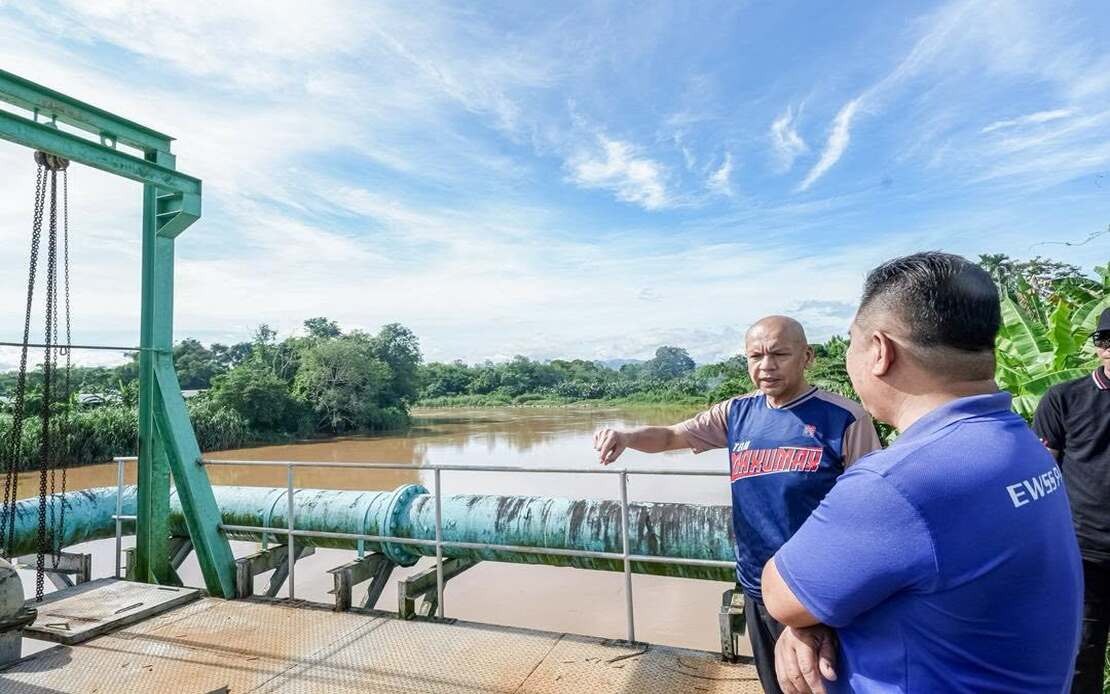
Domestic Trade and Cost of Living Minister Datuk Armizan Mohd Ali conducted a field inspection of Papar district's water infrastructure on June 19, assessing the progress of multiple water supply stabilization initiatives designed to resolve persistent supply challenges affecting residents across the region. The visit, undertaken in his capacity as the Member of Parliament for Papar, followed a comprehensive meeting held on June 15 to evaluate implementation status and identify obstacles delaying project completion.
The focal point of current infrastructure development centres on two major undertakings that represent a significant commitment to expanding the district's water distribution network. The Kogopon Water Treatment Plant is undergoing an ambitious upgrade programme that will nearly double its production capacity from 40 million litres per day to 80 million litres per day, substantially increasing the volume of treated water available to households and businesses. Concurrently, improvements to the Kampung Kabang intake facility are progressing to enhance the collection and preliminary treatment of raw water before it enters the main processing systems.
These capacity expansion projects address a fundamental challenge facing Papar: escalating water demand that has consistently outpaced existing infrastructure capabilities. The district, like many developing regions in Sabah and beyond, has experienced rapid population growth and increased commercial activity that have strained water supply systems designed for smaller populations. By investing in these dual projects, the state aims to create a more resilient water network capable of meeting current consumption patterns while accommodating future growth without recurring shortages.
However, the timing of Armizan's inspection highlighted an immediate operational crisis affecting two critical treatment facilities. Both the EWSS Plant and the JETAMA Limbahau Plant encountered significant disruptions during the week preceding his visit, resulting in complete or partial shutdown of operations when raw water quality deteriorated. The technical problem involved elevated nephelometric turbidity unit values at the inlet points, a measurement that quantifies the cloudiness and suspended particle concentration in untreated water drawn from natural sources.
Turbidity fluctuations present a persistent challenge in tropical water treatment environments, where seasonal weather patterns, upstream land-use changes, and natural erosion all contribute to variable raw water quality. When NTU values exceed treatability thresholds—the standards beyond which existing chemical coagulation and filtration processes cannot reliably produce safe drinking water—plant operators must shut down operations temporarily until upstream conditions normalize. These disruptions cascade immediately downstream to consumers, causing supply interruptions that compound frustrations with the underlying capacity constraints.
Armizan emphasized that physical field inspections provided irreplaceable insights into operational realities that cannot be captured through administrative reports alone. Direct observation of treatment facility conditions, consultation with technical staff, and assessment of system vulnerabilities enabled him to identify potential solutions more effectively than remote analysis could accomplish. This on-the-ground approach reflected recognition that water infrastructure challenges typically demand context-specific interventions rather than standardized responses.
The minister's inspection methodology signals an important governance principle for Malaysian infrastructure management: that ministerial oversight should extend beyond budgetary approval to encompass active monitoring of project execution and problem-solving. By visiting treatment facilities and intake points, senior officials can understand the practical constraints facing engineers and operators, appreciate the complexity of maintaining service continuity amid technical challenges, and make informed decisions about resource allocation and policy adjustments.
For Papar residents, the combination of long-term capacity improvements and immediate operational problems creates an ambiguous situation. The expansion projects promise substantial relief from chronic shortages, suggesting that patient households will eventually benefit from substantially increased water availability. Yet the recent plant closures underscore that infrastructure development timelines remain uncertain, and interim periods may still witness supply disruptions as older systems strain under peak demand and encounter deteriorating raw water quality.
The broader implications extend across Sabah's water security landscape, where multiple districts face similar challenges of aging treatment infrastructure, variable raw water sources, and rapidly expanding populations. Papar's experience with both capacity constraints and treatment quality issues mirrors conditions in other developing regions, suggesting that successful solutions here could inform policy approaches throughout the state. The dual focus on expansion and operational reliability—rather than choosing between them—represents a pragmatic strategy for regional water authorities managing competing pressures.
Successful completion of both the Kogopon upgrade and Kampung Kabang intake improvements could transform Papar's water landscape by the conclusion of their implementation timelines. However, sustained attention to raw water quality management, preventive maintenance of treatment equipment, and investment in backup systems will remain essential to preventing recurrence of disruption patterns. Minister Armizan's continued engagement suggests political commitment to monitoring progress and addressing emerging obstacles, a factor that could prove decisive in ensuring these infrastructure projects deliver the promised benefits to Papar's population.

