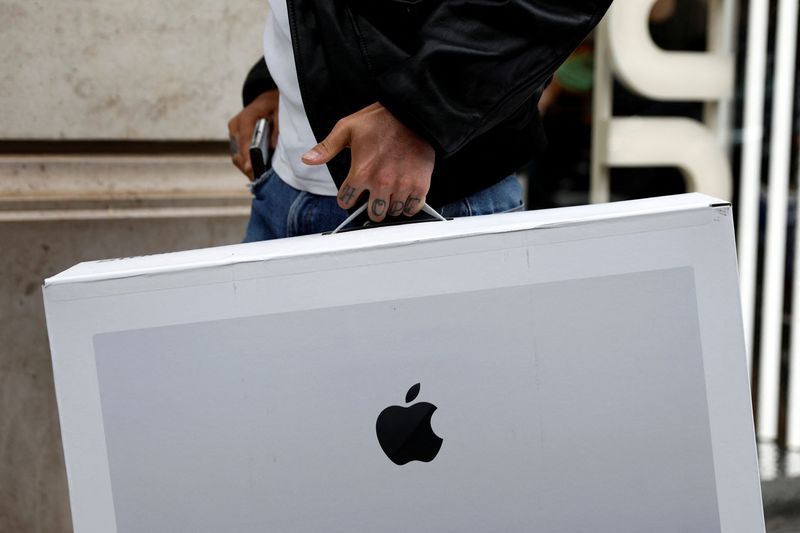
Apple has reclaimed the position of world's most valuable company, displacing semiconductor powerhouse Nvidia from the top spot in a significant reshuffling of the technology sector's hierarchy. On Friday, Apple's market capitalization reached $4.88 trillion as its share price remained steady, while Nvidia's valuation fell to approximately $4.86 trillion following a 3.5 percent decline. This changing of the guard marks a notable pivot in how institutional investors are evaluating technology companies' exposure to the artificial intelligence revolution that has captivated global markets over the past year and a half.
The leadership transition underscores a fundamental reassessment of what constitutes genuine competitive advantage in the AI era. Nvidia had dominated the rankings for nearly a year, driven by its essential role supplying graphics processing units that power most generative AI systems globally. Yet the company's unprecedented rise masked an underlying question about the sustainability of such valuations and whether other technology firms might capture greater value from emerging AI applications. Apple's ascent to the top reflects investor acknowledgment that multiple pathways exist to profit from artificial intelligence, beyond simply manufacturing the silicon that underpins it.
Investment strategists attribute Apple's outperformance to a fundamental reorientation of market thinking about AI monetization models. Toni Meadows, head of investment at BRI Wealth Management, explains that Apple's perceived weakness in the AI race has transformed into a strategic advantage in investor eyes. Rather than pursuing capital-intensive development of proprietary AI models, Apple is positioned to extract value through existing ecosystems, service offerings, and hardware sales. This approach requires far lower capital expenditure than the chip industry's relentless spending on manufacturing capacity and research facilities, while potentially delivering more predictable earnings streams.
Central to Apple's repositioning is the company's vast repository of personal data residing on over two billion active devices worldwide. This information represents an untapped resource that could substantially enhance Siri's functionality compared to rivals' offerings. However, Apple faces a critical constraint: the company has built its brand partly on privacy commitments, with data deliberately segregated within device operating systems rather than centralised on company servers. Extracting commercial value from this data while maintaining privacy standards remains one of the company's most complex technical and strategic challenges.
Apple's recent product announcements have begun addressing its historical lag in AI capability development. Last month, the company unveiled a substantially redesigned Siri interface following years of stagnation, signalling management's determination to compete effectively against both established technology giants and nimble artificial intelligence startups. The timing of this initiative coincides with leadership transition planning within Apple's executive ranks, as long-serving Chief Executive Officer Tim Cook prepares to hand operational control to John Ternus, a veteran of Apple's hardware engineering divisions, in September. Cook's final months leading the company are now inextricably linked with Apple's credibility in the AI sector.
Nvidia's displacement from the top position should not be interpreted as a harbinger of diminished relevance within the AI infrastructure ecosystem. The semiconductor manufacturer fundamentally transformed the computing landscape by developing specialised processors ideally suited for machine learning applications, a technological advantage that remains undiminished by recent market movements. Nvidia's products continue powering the vast majority of data centres deploying large language models and other sophisticated AI systems. Competitive shifts in valuation rankings often reverse as market sentiment fluctuates, and Nvidia retains every capability required to reclaim the most valuable company designation if investor sentiment swings once more.
Apple's current position contains inherent vulnerabilities that could rapidly undermine its valuation premium. The company has pursued a pricing strategy emphasising premium positioning across most product categories, allowing it to offset manufacturing cost increases while maintaining profitability. This approach, however, depends on sustained consumer demand for increasingly expensive devices despite macroeconomic headwinds affecting purchasing power in many developed and developing markets. Benjamin Hall, vice president for alpha research at Segal Marco Advisors, notes that investment analysts struggle to discern meaningful operational distinctions between the two companies' long-term prospects, suggesting Nvidia will remain integral to whatever technological developments emerge in coming years.
The competitive landscape for AI-related investment has expanded substantially beyond the traditional binary focus on Nvidia and Apple. Memory chip manufacturers have emerged as significant beneficiaries of AI infrastructure buildouts, with Micron Technology crossing the $1 trillion market capitalisation threshold in May as investors recognised the critical role memory systems play in supporting large AI models. South Korea's SK Hynix, a formidable competitor in memory chip manufacturing, strengthened this trend by listing on the Nasdaq exchange earlier this month, introducing fresh capital and international investor participation into the sector.
This diversification of investment opportunities has begun fragmenting attention away from the so-called Magnificent Seven technology stocks that captured investor imagination throughout 2023 and early 2024. Market analysts observe that opportunities in supporting industries such as memory chip fabrication, semiconductor manufacturing equipment, and AI software platforms are attracting capital that previously concentrated exclusively on the most prominent technology corporations. This broadening investment thesis suggests that the AI boom's benefits will disperse across a substantially wider industrial base than many observers initially anticipated.
Recent market turbulence in semiconductor equities has tempered some enthusiasm from the extraordinary heights reached earlier in 2024. The Philadelphia Stock Exchange Semiconductor index declined nearly 19 percent from all-time highs during July as investors fundamentally reassessed sustainability assumptions underlying the artificial intelligence investment thesis. Despite this pronounced correction, semiconductor stocks have nevertheless outperformed the broader market year-to-date, indicating that conviction regarding technology sector leadership remains intact despite acknowledged risks. The question confronting investors is whether current valuations reflect genuine technological transformation or transient euphoria that will eventually normalise.

