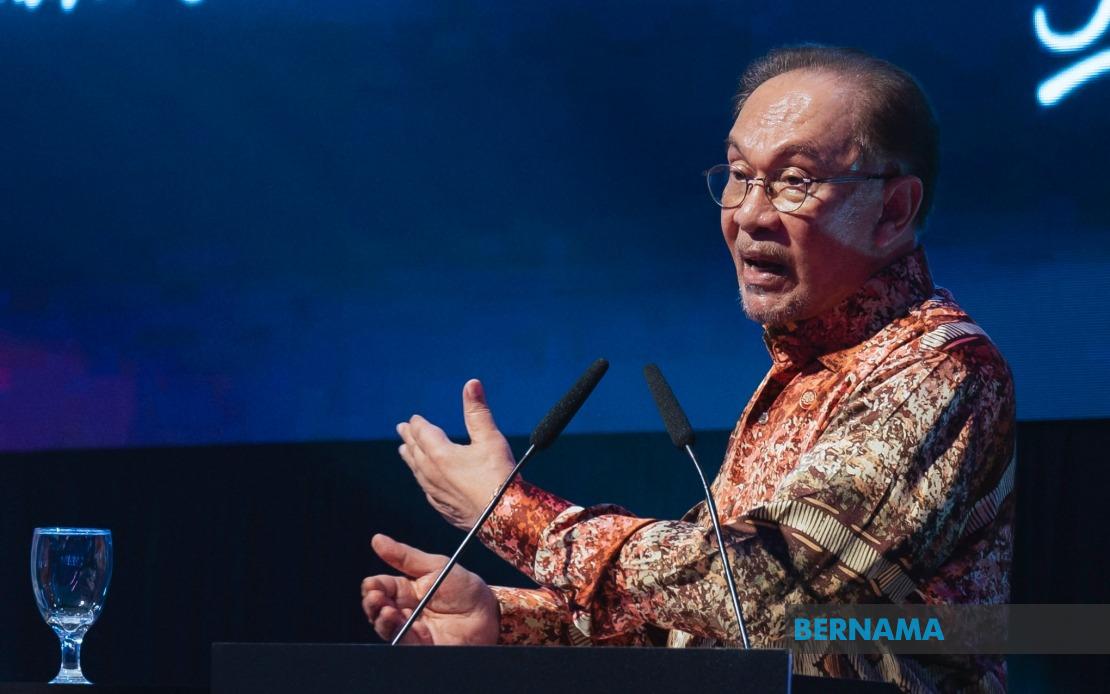
Prime Minister Datuk Seri Anwar Ibrahim's recent statements regarding Taiwan have generated considerable debate over their implications for Malaysia's foreign policy and regional stability. However, a closer examination reveals that his remarks, while acknowledging China's position on the potential use of force should peaceful reunification efforts fail, do not constitute an endorsement of military conflict. Instead, they articulate a sophisticated argument grounded in principles of sovereignty, territorial integrity, and classical deterrence theory—concepts that have long shaped how states manage their geopolitical interests.
Anwar's core proposition draws an analogy to Malaysia itself. He suggested that no government would acquiesce to the dissolution of its federation without mounting resistance. This framing acknowledges a fundamental reality in international relations: states possess an inherent interest in preserving their territorial cohesion. By extension, the Prime Minister argued, it would be inconsistent to dismiss Beijing's concern over Taiwan's separation as somehow illegitimate while Malaysia itself would defend its own territorial integrity under identical circumstances. The analogy does not presume judgment on whether Taiwan constitutes a valid subject of Chinese sovereignty claims—a deeply contested question—but rather illustrates the universal principle that states regard territorial dissolution as an existential challenge.
The distinction between reserving the capacity for force and actually employing it lies at the heart of deterrence doctrine, a strategic concept that has underpinned major power relationships for decades. Anwar's argument positions force as a final recourse, not a preferred instrument. Negotiation, legal frameworks, and political settlement occupy the primary tier of dispute resolution. However, entirely renouncing force as an option—a posture sometimes advocated by peace advocates—can paradoxically weaken deterrence by signalling that the status quo is indefensible. When adversaries perceive no credible risk of armed resistance, they may calculate that challenging the existing arrangement carries minimal cost. Deterrence functions precisely because the possibility of consequence exists, even if it remains eternally unused.
Malaysia's one-China policy provides the essential context for understanding these remarks without distortion. Malaysia formally recognises the People's Republic of China as the legitimate government of China and does not accord diplomatic status to Taiwan as a sovereign entity. Simultaneously, Malaysia maintains robust economic partnerships and extensive people-to-people exchanges with Taipei. This dual framework has served Malaysia's interests by avoiding forced choice between Beijing and Taiwan while preserving practical engagement with both sides. Within this architecture, Anwar's observation suggests that acceptance of Beijing's One China position necessarily implies accepting that China views Taiwan reunification as a legitimate state interest, even if disagreement exists about methods or timelines.
Taiwan's perspective presents a fundamentally different foundation for the dispute. Taipei contends that Taiwan constitutes a functioning democratic state, politically and administratively separate from the mainland for over seven decades, and deserves recognition as a sovereign entity. From this vantage, any reference to Beijing's potential military options appears to legitimise coercion and threatens the very autonomy Taipei seeks to protect. This tension cannot be resolved through rhetorical reframing; it represents a genuine conflict between competing visions of legitimate statehood and self-determination. Malaysia's balancing act requires acknowledging both perspectives while maintaining its own principled position rather than becoming an advocate for either side's maximalist claims.
The deterrence logic underpinning Anwar's remarks reflects how China itself views the Taiwan question strategically. Beijing maintains that uncertainty regarding the costs of separatism—including the possibility of military response—discourages independence movements and reinforces the incentive for cross-strait dialogue. Whether international observers find this reasoning persuasive or concerning, it represents orthodox deterrence thinking traceable to Cold War strategic theory. Many analysts contend that deterrence, when functioning effectively, prevents conflict by raising the anticipated price of aggression. Conversely, critics argue that deterrence rhetoric on territorial disputes can become self-fulfilling, triggering arms races and reducing diplomatic flexibility. Malaysia must navigate between these competing analyses while protecting its own interests.
A conflict in the Taiwan Strait would inflict catastrophic consequences across Southeast Asia, with Malaysia bearing substantial exposure. The strait represents one of the world's most critical maritime passages for global commerce, and disruption would reverberate through Malaysian ports, manufacturing, and financial markets. Supply chain dependencies on Taiwan semiconductors and components would create immediate economic shocks. Regional stability, already challenged by competing claims in the South China Sea and tensions between major powers, would deteriorate sharply. Malaysia's ASEAN partners would face impossible pressures to choose sides, fracturing the regional consensus that has provided diplomatic coherence and economic benefits since the bloc's founding.
Anwar's positioning should therefore be understood not as warmongering but as a realist assessment of how states navigate existential questions. Malaysia itself has never unilaterally renounced force regarding Sabah and Sarawak, despite international treaties governing those territories and no realistic military threat to possession. Similarly, no Malaysian government would accept formal dissolution of the federation without mobilising all available instruments of statecraft to prevent it. The Prime Minister applied this universal principle to explain China's calculations without endorsing Beijing's vision of appropriate resolution mechanisms or timelines. This represents sophisticated statecraft: acknowledging adversary concerns as comprehensible while refusing to endorse their preferred solution.
Malaysia's balanced positioning requires continued emphasis on restraint, dialogue, and peaceful resolution mechanisms. Support for conflict would contradict Malaysia's fundamental interests and regional responsibilities. However, acknowledging that deterrence logic underpins Beijing's stance does not constitute such support. Instead, it creates space for realistic diplomacy that recognises the motivations driving all parties without accepting any single perspective as determinative. ASEAN's own long-standing position of non-alignment and dialogue remains Malaysia's most appropriate framework for engagement on this deeply contested question.
The core principle underlying Anwar's remarks reflects enduring truths about international order. States maintain capacity for force not because they eagerly await opportunities to deploy it, but because accepting disarmament invites vulnerability to coercion or disintegration. This does not morally justify any particular use of force, nor does it preclude negotiated settlements that modify territorial claims through mutual agreement. Rather, it acknowledges that territories, sovereignty, and state survival represent concerns that governments cannot permanently renounce without paradoxically weakening their negotiating position. Malaysia's challenge lies in supporting this fundamental principle while working tirelessly to ensure that deterrence functions as intended—preventing conflict through credible commitment to defence rather than actually requiring armed confrontation.

