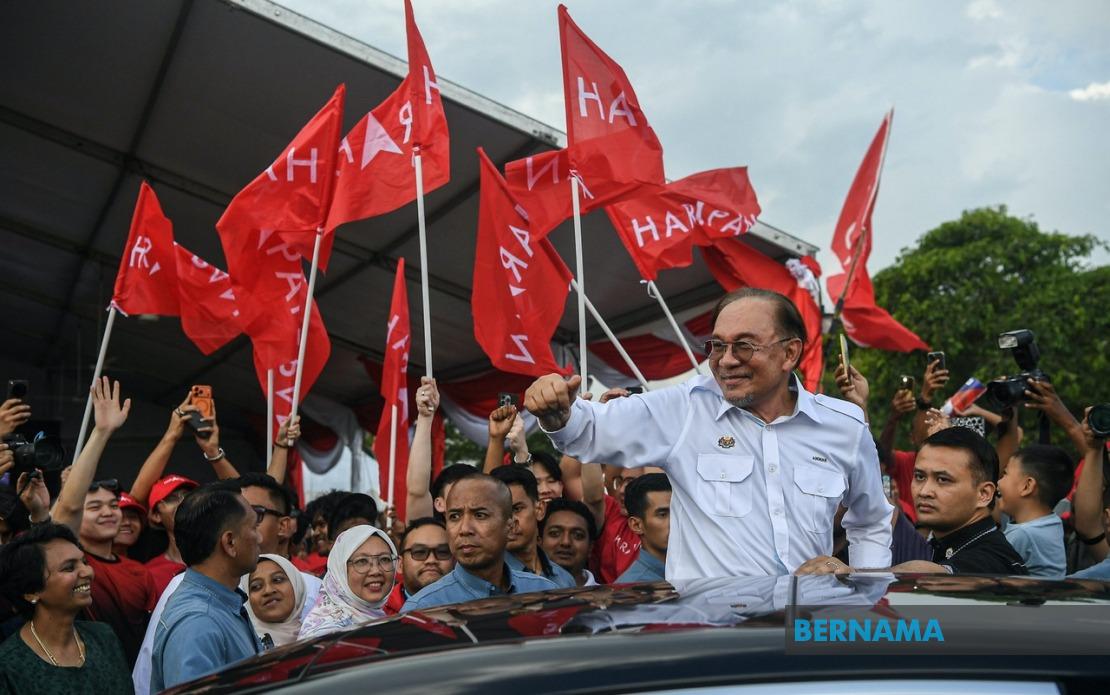
Prime Minister Datuk Seri Anwar Ibrahim's direct involvement in Pakatan Harapan's campaign strategy for the Johor state election is delivering tangible momentum on the ground, according to the coalition's leadership. Communications Minister Datuk Fahmi Fadzil highlighted the unusually positive reception that has greeted the Prime Minister's presence at campaign events, particularly noting spontaneous displays of public enthusiasm during visits to constituencies in the Batu Pahat district.
Fahmi, who accompanied Anwar during recent campaign stops in Senggarang and Semerah, underscored the significance of grassroots engagement in determining the overall trajectory of PH's bid to retain control of Malaysia's second-largest state by population. The minister recounted an anecdote that captured the essence of the public mood, describing an elderly resident who made the effort to travel with his wife by trishaw specifically to greet the Prime Minister. Such instances, according to Fahmi, suggest deeper currents of public interest extending beyond routine electoral participation.
The PH Communications director framed these ground-level reactions as evidence of broader acceptance of the coalition's campaign messaging throughout Johor. Rather than viewing enthusiasm as a fleeting phenomenon, Fahmi suggested that spontaneous community responses reflect genuine interest in PH's policy platform and the party machinery's connection with local concerns. He argued that this receptiveness translates into measurable political advantage, whether through direct voter conversion or sustained engagement with the coalition's agenda.
Anwar's campaign schedule underscores the centrality of his role within PH's electoral strategy. Over a 48-hour period spanning July 4 and 5, the Prime Minister participated in 15 separate campaign programmes distributed across Johor, a deployment of high-level political capital that signals the coalition's determination to mobilise support at every level of the state. This intensive itinerary reflects PH's recognition that state elections, despite being technically local contests, carry implications for federal coalition dynamics and Anwar's own political standing.
The breadth of PH's candidacy in this election demonstrates organisational confidence. The coalition is contesting all 56 State Legislative Assembly seats—a full slate that contrasts with more cautious approaches in previous elections or other coalition partners' strategies. This decision to field candidates everywhere reflects both PH's structural capacity and its assessment that the political climate favours expansion rather than consolidation of its existing base.
The electoral landscape itself remains competitive. A total of 172 candidates are vying for the 56 assembly seats, indicating significant three-cornered and multi-cornered contests in numerous constituencies. This fragmented field potentially benefits PH if the opposition vote splits across multiple parties, though it also creates uncertainty about seat distribution and final seat counts. The mathematics of a fragmented ballot environment reward parties with the strongest organisational discipline and highest voter mobilisation capacity.
Polling day is scheduled for Saturday, July 11, with early voting having commenced immediately prior to the formal campaign conclusion. This condensed electoral calendar means that the campaign momentum Fahmi described becomes increasingly important as voting nears. The window for converting public interest into actual ballots is narrowing, placing emphasis on PH's ground machinery to translate the enthusiasm documented at PM Anwar's appearances into actual electoral results.
For Malaysian political observers, Anwar's direct campaign engagement raises questions about the federal government's bandwidth and whether intensive involvement in state elections affects capacity to manage national governance. Yet from a tactical perspective, PH's leadership clearly views the Johor election as consequential enough to justify high-level executive participation. State governments control significant resources and shape local policy priorities; losing Johor would carry psychological impact for a coalition government that has emphasized inclusive, consultative governance.
The reception Anwar has received also carries implications for PH's coalition dynamics. Younger or less-established component parties within the alliance benefit from association with the Prime Minister's political capital and public recognition. His campaign participation thus serves coalition cohesion functions beyond simple vote mobilisation. By demonstrating that the federal government prioritises the Johor campaign, Anwar reinforces PH's commitment to shared electoral success.
Fahmi's commentary suggests PH campaign organisers have detected a shift in voter sentiment compared to previous electoral cycles. Whether this reflects genuine policy endorsement, retrospective judgement on the Anwar government's first year in office, or simply the normal advantages of incumbent governments cannot be determined from available evidence. However, the narrative of community acceptance provides PH with positive momentum entering the final phase of campaigning.
The wider Southeast Asian context adds another dimension. Malaysia's electoral competitiveness and peaceful transfers of power between competing coalitions represent democratic strengths in a region where such practices vary considerably. The Johor election, while local in formal terms, contributes to this broader pattern of competitive democracy. PH's ability to mobilise support effectively demonstrates that opposition parties can transition into governing coalitions through electoral competition rather than extra-constitutional means.
As Johor voters prepare for July 11 polling, the immediate question concerns whether the grassroots enthusiasm Fahmi documented will translate into decisive electoral outcomes. More broadly, this election tests whether PH can consolidate support in a major state while managing complex national governance challenges. The Prime Minister's personal campaign involvement indicates high stakes are perceived by coalition leadership, suggesting they view this election as consequential for PH's political future and Anwar's personal authority within the government he leads.

