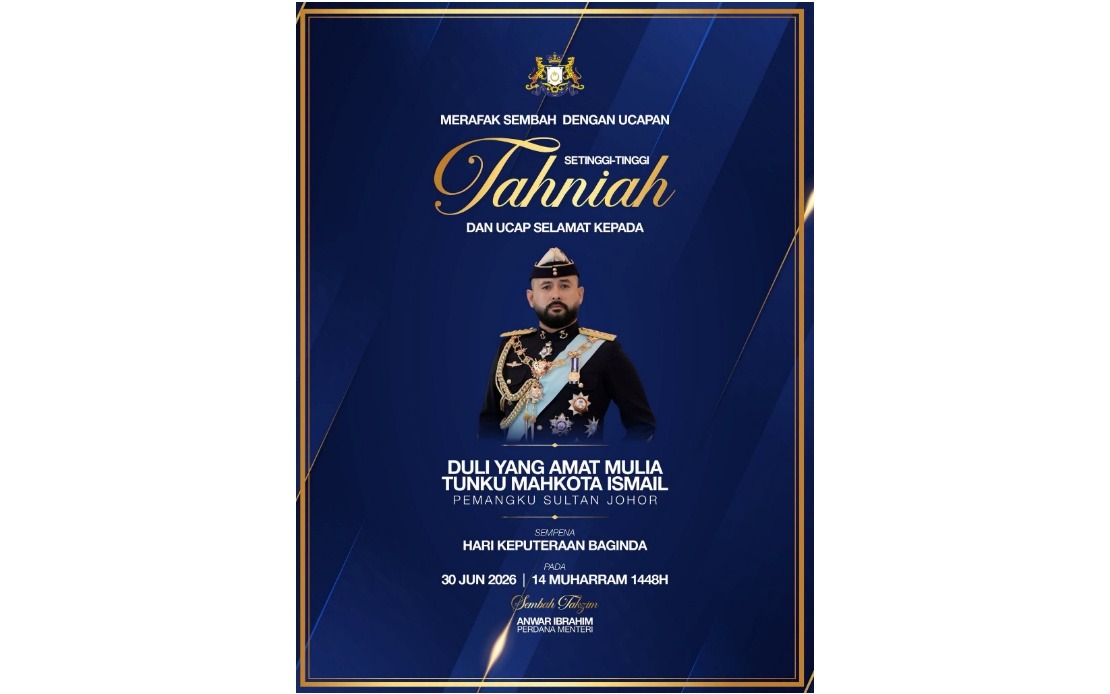
Prime Minister Datuk Seri Anwar Ibrahim marked the birthday of Johor's Regent, Tunku Mahkota Ismail, with a Facebook tribute expressing warm felicitations and spiritual wishes for the royal figure. Through his social media message released on June 30, Anwar conveyed hopes that the Regent would enjoy sustained good health, personal wellbeing, and divine favour as he continues his role serving the people of Johor Darul Ta'zim.
Deputy Prime Minister Datuk Seri Dr Ahmad Zahid Hamidi similarly chose the occasion to publicly honour the Regent through a Facebook post of his own. In his message, Zahid offered prayers for Allah SWT to grant Tunku Mahkota Ismail enduring good health alongside divine mercy and protection. The Deputy Prime Minister further prayed that the Regent would continue to receive wisdom in his governance of Johor Darul Ta'zim and his stewardship of the Bangsa Johor people.
The dual public tributes from the nation's top two political leaders underscore the ceremonial respect traditionally afforded to the royal household in Malaysia's constitutional framework. Such gestures, delivered through modern digital platforms, reflect how contemporary political figures engage with traditional protocols while adapting to social media-driven communication channels. The timing and tone of these messages demonstrate the routine diplomatic courtesies maintained across Malaysia's federal and state political spheres.
Tunku Mahkota Ismail holds a significant position within Johor's governance structure as the designated successor to the throne and an active participant in state affairs. His role extends beyond ceremonial functions to encompass responsibilities that connect him to the broader development and welfare initiatives undertaken in one of Malaysia's most economically vibrant states. The birthday recognitions from federal leadership acknowledge this dual standing within both the royal and administrative hierarchies.
For Malaysian readers, such public expressions of goodwill between federal and state political actors carry subtle implications about the health of centre-state relations. Johor, as Malaysia's southernmost peninsula state with significant economic and strategic importance, maintains distinctive governance traditions alongside its constitutional integration within the federation. The visibility of federal leaders acknowledging the state's regent demonstrates continuity in respecting these established protocols despite the complex political dynamics that occasionally emerge between Putrajaya and Kota Iskandar.
The ceremonial dimension of birthday greetings within Malaysia's political culture serves purposes beyond mere politeness. Such occasions provide opportunities for political figures to reaffirm institutional respect and demonstrate awareness of the separate but interlocking spheres of royal, federal, and state authority that characterise Malaysia's system of governance. The consistency with which such tributes are offered reflects the embedded nature of these protocols within the nation's political consciousness.
Tunku Mahkota Ismail's public profile has grown in recent years through his visible engagement in state-level initiatives and his articulate representation of Johor's interests at national forums. His birthday recognitions from the Prime Minister and Deputy Prime Minister acknowledge his role as a significant stakeholder in Malaysia's subnational governance landscape. The respectful tone of these messages reinforces the understanding that cooperation between federal leadership and state institutions remains a foundational expectation within Malaysia's constitutional order.
Facebook has emerged as the preferred platform for such official announcements, reflecting how traditional protocols of state have adapted to contemporary communication channels. The choice to broadcast these birthday greetings on social media extends their reach beyond traditional press circles to the broader Malaysian public, including international observers monitoring the country's political dynamics. This democratisation of ceremonial communication demonstrates how digital tools have transformed the dissemination of official state messages.
For Southeast Asian observers tracking Malaysia's political stability, such routine courtesies between federal and state leaders carry analytical weight. The regularity and warmth of such exchanges provide baseline indicators that fundamental institutional respect persists even amid broader political contestations. When senior federal figures publicly acknowledge the significance of state-level royalty, they reinforce constitutional legitimacy across the federation's multi-layered governance structure.

