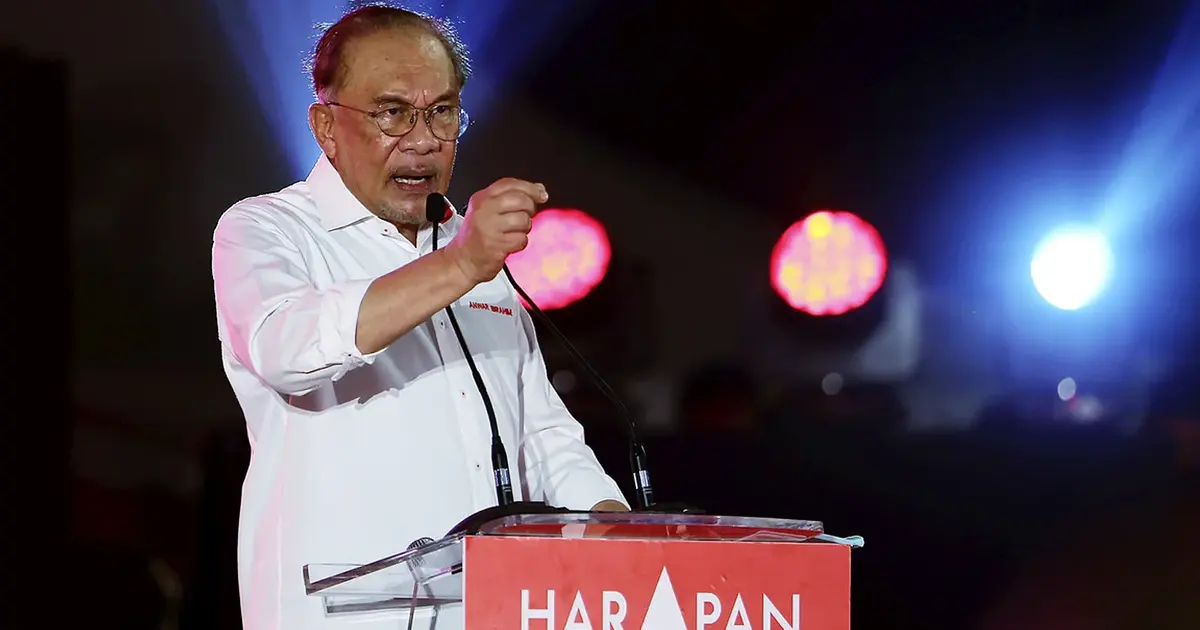
Prime Minister Anwar Ibrahim has issued a direct appeal to all political parties preparing for the Negeri Sembilan state election, urging them to maintain the sanctity of the state's royal institution by keeping it separate from electoral politics. Speaking as Pakatan Harapan chairman, Anwar stressed that matters touching on the monarchy should remain beyond the bounds of partisan political contestation, reflecting the delicate constitutional balance that governs Malaysia's system of government.
The call underscores growing concerns within leadership circles about the potential for campaign rhetoric to veer into sensitive constitutional territory during state-level contests. Negeri Sembilan, as a federally constituted state with its own established royal household, has historically maintained distinct protocols regarding the monarchy's role in state affairs. Anwar's intervention signals that the incoming election cycle risks becoming a flashpoint for such sensitivities if party operatives and campaigners do not exercise restraint and propriety.
Malaysia's constitutional framework places the institution of monarchy at the apex of national and state governance structures. The Yang di-Pertuan Agong at the federal level and state rulers command profound reverence enshrined in law, and any attempt to politicise their roles or influence crosses into legally and culturally problematic terrain. For Negeri Sembilan specifically, the Duli Yang Maha Mulia holds constitutional prerogatives that, while ceremonial in many respects, remain foundational to the state's legitimacy and governance architecture.
Political parties in Malaysia have occasionally found themselves navigating murky waters when it comes to discussing royal matters. Previous election cycles have witnessed isolated instances where campaign messaging strayed into commentary on palace politics or constitutional roles, prompting strong rebuttals from palace officials and political leadership. Anwar's preemptive warning reflects a desire to establish clear boundaries before the campaign machinery fully engages, ensuring all contenders understand that such territory is off-limits regardless of electoral advantage.
For Pakatan Harapan itself, the directive carries additional weight given the coalition's own experience navigating palace relations during its 2018-2020 tenure in government. The alliance spent considerable political capital managing the expectations and involvement of the monarchy in cabinet selection and governance matters. By articulating this principle now, Anwar positions his coalition as the custodian of institutional respect and constitutional propriety, a posture that may resonate with voters who value stability and tradition.
The broader context involves competing visions for Malaysian politics held by various parties contesting the Negeri Sembilan election. While most mainstream parties acknowledge the monarchy's constitutional role, their respective approaches to state governance and national direction sometimes create tensions that could theoretically surface in discussions about royal prerogatives. By establishing this clear red line, Anwar aims to forestall attempts to leverage such divisions for electoral gain.
Negeri Sembilan presents a particularly complex political landscape, with multiple coalitions and individual parties vying for representation and state government control. The state's relatively tight electoral margins in recent cycles mean that campaign intensity tends to rise sharply, increasing the risk that political actors might transgress into sensitive areas in pursuit of competitive advantage. Anwar's statement serves as an early reminder that such overreach will be met with institutional disapproval.
The international dimension of this caution, though secondary, merits consideration. Malaysia's stability in the eyes of regional and global observers partly reflects the strength of its constitutional institutions, including the monarchy. Election campaigns that respect institutional boundaries reinforce the impression of a mature, functioning democracy where even fierce political competition observes certain guardrails. Conversely, campaigns that drag royal matters into partisan debate risk projecting an image of institutional fragility.
For political operatives and campaign strategists in Negeri Sembilan, Anwar's directive demands careful vetting of all messaging. Any reference to state governance, policy direction, or historical grievances must be calibrated to avoid even the appearance of commentary on the royal institution's role or preferences. This requires discipline and foresight, as statements made in the heat of campaigning can acquire unintended implications when scrutinised by opponents and civil society watchdogs.
The statement also reflects broader recognition within Malaysian political circles that institutional respect constitutes a shared interest transcending party affiliation. Whether or not all parties formally endorse Anwar's specific framing, few can afford to be seen as defenders of royalty-baiting or institutional disrespect. By articulating this principle, Anwar claims the moral high ground while creating political cover for other parties to follow suit without appearing weak or accommodating.
Looking ahead, the real test will come in the campaign's execution. Party activists, candidates, and grassroots organisers operate with varying degrees of discipline and sophistication. Anwar's warning will be effective only if it filters down through organisational hierarchies and takes root in campaign culture. Negeri Sembilan's political establishment will bear responsibility for ensuring that enthusiasm for electoral contest does not translate into institutional transgression that could undermine the very foundations of state governance and national stability.

