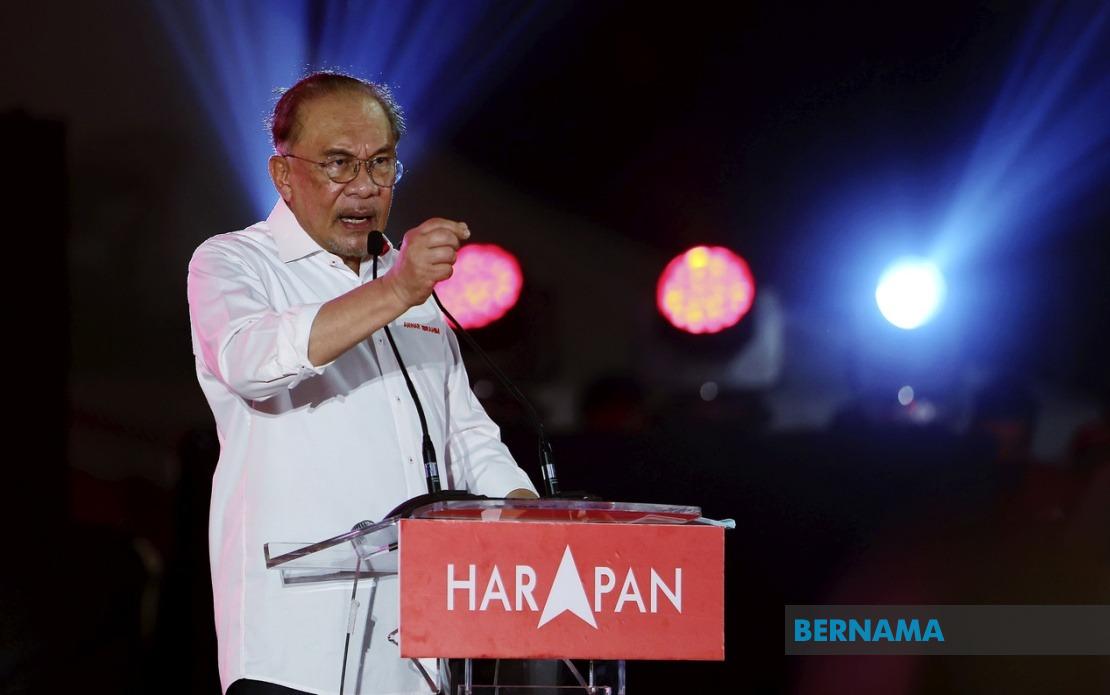
Prime Minister Datuk Seri Anwar Ibrahim has cautioned all stakeholders participating in the 16th Negeri Sembilan State Election to exercise restraint when addressing matters related to royal institutions and the Federal Constitution. Speaking at the Pakatan Harapan candidate announcement ceremony in Kuala Pilah, the coalition chairman drew a distinction between vigorous political competition—a hallmark of democratic systems—and campaigns that resort to defamation or actions likely to fracture community cohesion. His intervention comes as the state prepares for polling that will test the governing coalition's performance at subnational level, a critical barometer for federal political dynamics.
The Prime Minister's message stressed the importance of maintaining institutional integrity even as parties engage in electoral battles. Anwar acknowledged that differing political perspectives are natural and necessary within a democratic framework, but urged participants to ensure such differences do not translate into attacks on foundational structures that undergird national stability. His remarks reflected growing concern among federal leadership about campaign rhetoric that might veer into sensitive constitutional territory or undermine respect for established institutions, particularly the monarchy—a constitutionally protected pillar of Malaysian governance.
Anwar's statement carries particular weight given Malaysia's constitutional architecture, which reserves certain matters affecting royal prerogatives from ordinary legislative amendment. Any campaign messaging that questions or challenges these institutional arrangements risks triggering broader political instability and public division. The Prime Minister's call for responsible competition thus serves as both a practical campaign guideline and a reaffirmation of the government's commitment to constitutional governance. This framing allows Pakatan Harapan to project itself as the guardian of institutional stability while simultaneously positioning opposition parties as potentially reckless actors.
The coalition's slate for Negeri Sembilan represents a calculated blend of continuity and renewal, with 36 candidates drawn from PKR, DAP, and Amanah. The decision to renominate Menteri Besar Datuk Seri Aminuddin Harun for the Linggi seat signals confidence in his track record, while DAP secretary-general Anthony Loke's candidacy for Chennah underscores the coalition's intention to maintain its organizational strength. For Pakatan Harapan, success in Negeri Sembilan would validate its governance model and provide momentum ahead of subsequent state contests, whereas poor performance could embolden opposition narratives about federal-level fatigue.
Anwar's endorsement of Aminuddin's leadership framing him as collaborative and development-focused reflects the coalition's strategy of emphasizing economic progress and administrative competence over ideological confrontation. This positioning attempts to shift the electoral conversation away from abstract constitutional debates toward concrete issues of infrastructure, service delivery, and job creation—areas where incumbent administrations typically enjoy informational and implementation advantages. The focus on development also allows the coalition to appeal to urban and rural voters alike, constituencies that often prioritize material improvements over political philosophy.
The presence of senior coalition figures including DAP's Loke, Amanah president Datuk Seri Mohamad Sabu, and PH communications chief Datuk Seri Fahmi Fadzil underscores the central importance of this election to federal political calculations. Negeri Sembilan, with its relatively compact electorate and mixed urban-rural composition, serves as a microcosm of broader Malaysian political trends. A decisive coalition victory would validate Anwar's narrative of stable governance and institutional management, whereas a narrow win or surprise opposition gains could reignite internal coalition tensions and provide ammunition to critics questioning the government's electoral durability.
Anwar's call for clean leadership emphasizing integrity represents an implicit contrast with opposition governance models, a recurring theme in Pakatan Harapan messaging since the 2023 general election. By tying ethical administration to development outcomes, the Prime Minister frames the election not merely as a competition for state assembly seats but as a choice between competing visions of how government should function. This approach allows the coalition to occupy higher moral ground while simultaneously addressing voter concerns about corruption and malfeasance—persistent anxieties in Malaysian politics.
The Prime Minister's emphasis on preventing Negeri Sembilan from being "left behind" articulates a federal-state integration argument central to coalition strategy. This framing suggests that opposition governance would result in reduced federal investment, diminished access to central government resources, and exclusion from development planning. For voters in states without coalition governments, this messaging carries particular resonance, as they may perceive genuine resource disparities between opposition-led and federal-aligned administrations. Anwar's confidence that the state can "move forward in tandem with the federal government" thus operates simultaneously as a campaign promise and an implicit threat.
The broader context of Anwar's intervention reflects the delicate balance Malaysian political leadership must maintain between democratic competition and constitutional stability. Unlike Westminster systems where attacks on fundamental institutions occur within a context of settled constitutional arrangements, Malaysia's federal-state relationships and royal prerogatives remain subjects of occasional political contestation. The Prime Minister's cautionary remarks serve notice that the current government will not tolerate campaigns that weaponize constitutional ambiguities or seek to mobilize voters through institutional attacks.
For Negeri Sembilan voters, the election presents a choice between consolidating coalition governance or introducing opposition alternatives. The coalition's emphasis on development and administrative continuity appeals particularly to constituencies prioritizing economic stability, while opposition messaging typically emphasizes state autonomy and alternative development models. Anwar's pre-campaign intervention attempting to establish boundaries around acceptable rhetoric suggests coalition concern that opponents might adopt more confrontational messaging strategies.
The inclusion of fresh candidates alongside experienced figures within Pakatan Harapan's slate indicates an attempt to balance organizational renewal with proven leadership. This approach mirrors successful coalition strategies in previous state elections, where new candidates attracted voters seeking change within a familiar political framework, while established figures provided continuity and institutional memory. The decision to field such balanced slates reflects sophisticated understanding of electoral dynamics in semi-competitive systems where multiple factors beyond pure party preference influence outcomes.
As Negeri Sembilan heads toward polling, Anwar's intervention will likely establish the tone for subsequent campaign phases. Opposition parties will need to navigate carefully between mounting effective critiques of coalition governance and adhering to the Prime Minister's implicit boundaries around constitutional rhetoric. The outcome will provide important signals about the durability of the coalition's electoral coalition and the effectiveness of governance-focused messaging strategies in Malaysia's current political environment. For regional observers, the election outcome may offer insights into whether the coalition's post-2023 consolidation strategy remains viable or whether new political fault lines are emerging.

