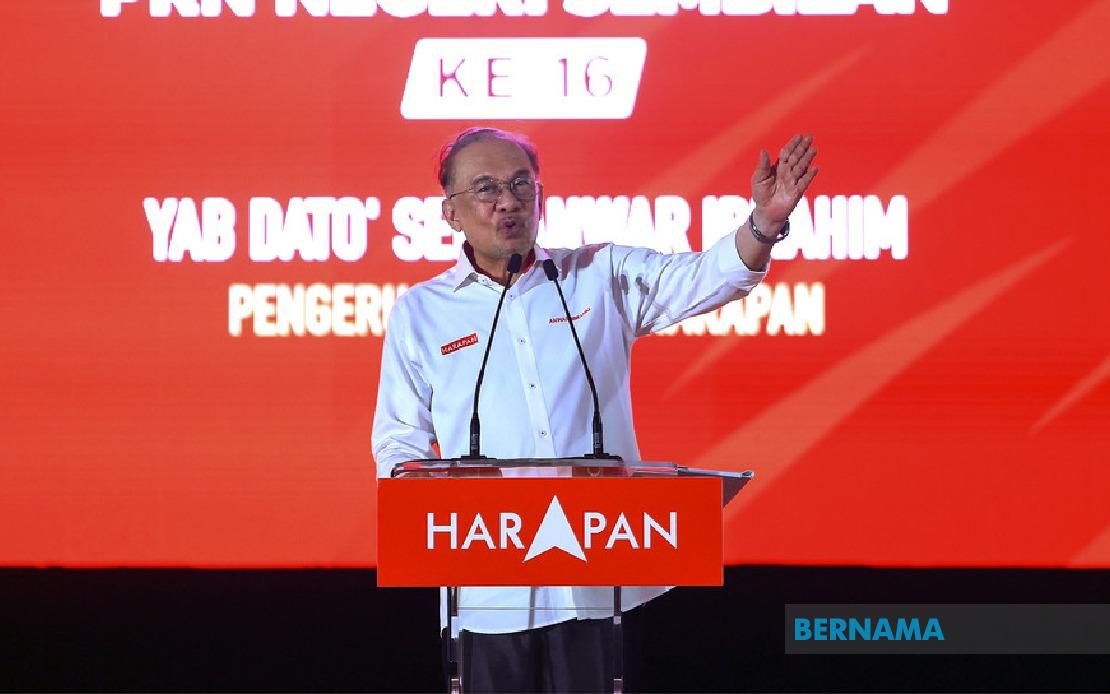
Prime Minister Datuk Seri Anwar Ibrahim has made a direct appeal to voters in Negeri Sembilan to sustain their backing for Pakatan Harapan (PH) in the 16th state election, framing the vote as crucial to preserving momentum on development initiatives that have already begun transforming the state. Speaking through a Facebook post released in Seremban on July 16, Anwar emphasised that the collaborative relationship between state and federal administrations has created conditions for meaningful progress, yet acknowledged that the work of developing the state remains incomplete.
As both Prime Minister and chairman of Pakatan Harapan, Anwar positioned himself at the centre of a broader narrative about political stability and good governance. He specifically commended Menteri Besar Datuk Seri Aminuddin Harun—who has held office since 2018—for leading the state with what he characterised as integrity, humility, and strong accountability. This endorsement carries weight in Malaysian politics, where federal-state alignment historically determines the flow of development funds and resources. By publicly backing the incumbent leadership, Anwar signalled that a continued PH government in Negeri Sembilan would maintain access to federal resources and policy coordination essential for infrastructure, healthcare, and educational expansion.
Negeri Sembilan has occupied a relatively secure position within PH's coalition, unlike more volatile states such as Selangor or Penang. However, Anwar's intervention suggests the party recognises the need to actively mobilise voters rather than assume complacency among supporters. The explicit appeal not to allow "progress to come to a halt halfway" acknowledges the reality that electoral momentum cannot be taken for granted, and that opposition parties may be presenting themselves as viable alternatives. In Malaysian state politics, such messaging often reflects internal polling data indicating either competitive margins or soft support among certain demographics.
The timing of Anwar's statement reflects the formal campaign period beginning with nominations scheduled for Saturday, July 22, with early voting on July 28 and the main polling day set for August 1. This compressed timeline—roughly two weeks between nominations and election day—requires parties to crystallise their messaging early. For PH, the strategy appears centred on continuity and developmental outcomes rather than on attacking opposition parties or dwelling on internal coalition tensions. This approach suits a governing party but requires demonstrable results on the ground.
For Malaysian observers, the Negeri Sembilan election carries broader implications for PH's ability to maintain federal-state cooperation in a period when coalition cohesion has faced significant tests. The state's economy depends substantially on manufacturing, automotive components, and small-scale agriculture, sectors vulnerable to global economic fluctuations and domestic policy shifts. Development initiatives in housing, transportation, and rural infrastructure therefore matter materially to residents' quality of life. Anwar's framing essentially asks voters to assess whether the past six years under Aminuddin have delivered tangible improvements and whether PH offers the best stewardship going forward.
The appeal to voters to maintain faith in the administration invokes religious language—"Alhamdulillah" (praise be to Allah) and "Insya-Allah" (God willing)—reflecting the cultural and religious dimensions of political messaging in Malaysia. Such language is conventional in Malaysian political discourse but serves functional purposes, signalling piety and moral governance. It also implicitly positions PH as morally grounded, a claim that resonates in a electorate that has expressed concerns about corruption and accountability in government.
Negeri Sembilan's electoral significance extends beyond the state itself. With 36 state seats, the election provides the first direct test of voter sentiment since the 2022 general election and the subsequent government formation. Results will offer insight into whether PH's federal coalition remains popular, whether government performance has strengthened its standing, or whether economic difficulties and policy disagreements have eroded support. This information becomes valuable ahead of other state elections and potential parliamentary by-elections.
The emphasis on federal-state cooperation underscores a fundamental reality of Malaysian governance: states depend heavily on federal revenue allocations and policy coordination to deliver services. Anwar's presence in the campaign, despite not contesting in Negeri Sembilan himself, amplifies the message that a PH state government operates within a supportive federal framework. This contrasts with opposition-ruled states, where federal-state relations have historically been more contentious. For Negeri Sembilan voters evaluating their options, this dynamic—whether implicit or explicit—factors into calculations about which party can best serve local interests.
The campaign ahead will reveal how effectively PH mobilises support and whether opposition parties—whether Barisan Nasional, Perikatan Nasional, or other formations—can gain traction by presenting governance alternatives or capitalising on dissatisfaction. Anwar's early intervention demonstrates PH's determination to defend a state it currently controls and retain it as part of a broader coalition majority that extends to federal level. His call for continuity essentially asks voters to validate six years of stewardship and grant another mandate to the same leadership.
Negeri Sembilan's voters will ultimately determine whether maintaining the current administration outweighs any desire for change. The outcome will matter not only for the state's governance trajectory but also for signalling the broader health of PH's political coalition and the appetite among Malaysian voters for continuity or change in the post-2022 era.

