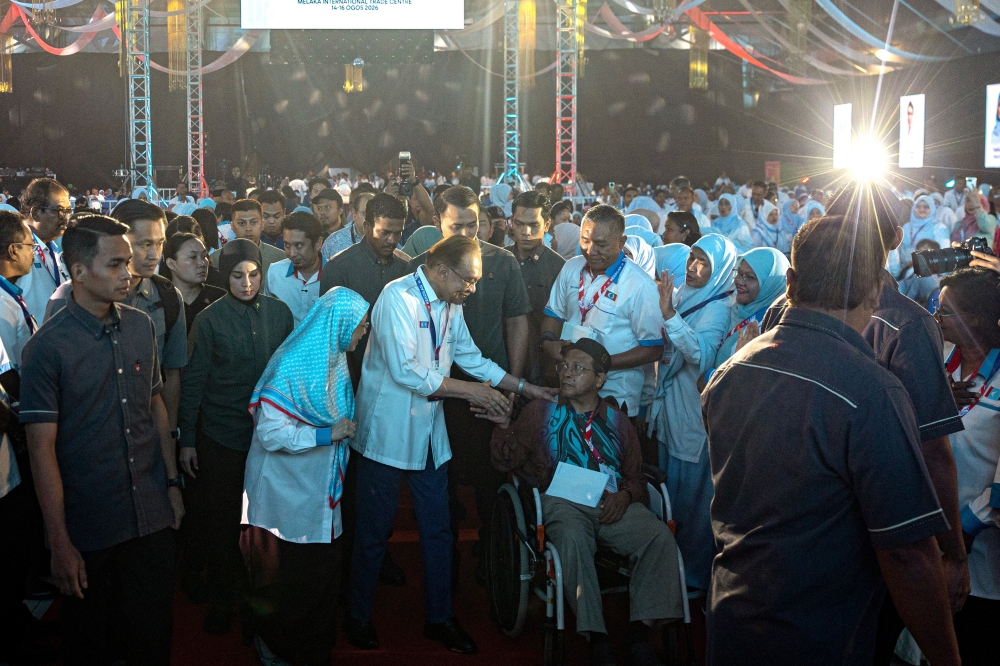
Prime Minister Datuk Seri Anwar Ibrahim has issued a forthright reminder to his PKR party that strategic decisions involving the country's largest Malay-Muslim political organisation must be grounded in pragmatism rather than sentiment. Speaking to party delegates in Melaka, the PKR president stressed that whichever course the party adopts toward Umno should be measured by a single criterion: whether it serves the interests of ordinary Malaysians rather than satisfying emotional impulses within the coalition.
Anwar's remarks come at a pivotal moment in Malaysia's political landscape, where the unity government coalition that has anchored stability since 2022 faces persistent questions about its durability. The relationship between PKR and Umno, historically adversarial but now cooperative within the same administration, represents one of the most delicate balancing acts in contemporary Malaysian politics. Tensions periodically surface, driven by competition for electoral advantage, disagreements over policy implementation, and lingering distrust rooted in decades of rivalry.
The Prime Minister's intervention reflects an understanding that internal party dissent over coalition strategy could undermine governmental effectiveness. Many PKR grassroots members harbour deep reservations about working alongside Umno, viewing the arrangement as a betrayal of the party's reform credentials established during the Reformasi movement. Conversely, some party strategists recognise that Umno's organisational machinery and rural voter base are indispensable for the coalition's continued electoral competitiveness against the opposition Perikatan Nasional bloc.
By explicitly cautioning against anger-driven decision-making, Anwar appears to be signalling that PKR must resist the temptation to prioritise short-term political satisfaction over long-term governance stability. This framing suggests he recognises that members may be frustrated with compromise inherent in coalition politics, yet insists that such frustration cannot become the basis for disruptive actions. The emphasis on "people's welfare" simultaneously recentres political debate away from internal party dynamics toward substantive outcomes that voters care about—economic growth, cost of living, service delivery.
The timing of these comments also carries significance for Southeast Asian observers monitoring Malaysia's institutional stability. Unlike several regional neighbours experiencing democratic backsliding, Malaysia has maintained competitive electoral contests and coalition flexibility. However, that flexibility depends on maintaining internal discipline across partnering parties. If either PKR or Umno allows intra-party divisions to dictate coalition behaviour, the resulting unpredictability could destabilise policy implementation across crucial areas including economic management, infrastructure development, and social programmes.
For Malaysian businesses and investors, Anwar's statement provides reassurance that the government prioritises continuity over factional warfare. The prolonged political instability of the 2018-2022 period damaged investor confidence and economic growth. Markets tend to reward clarity and stability, even when they involve seemingly counterintuitive partnerships. A PKR membership convinced that coalition management serves national interests rather than betraying party principles will prove more cooperative than one consumed by ideological grievance.
The broader Malaysian electorate faces a different consideration. Many voters supported the unity government specifically because it promised escape from zero-sum political competition that had characterised previous years. Anwar's message implicitly acknowledges this, suggesting that ordinary Malaysians neither care about internal party resentments nor expect politics to be driven by emotional responses. Instead, governance should be evaluated on tangible metrics: inflation management, job creation, infrastructure progress, and social stability. By framing coalition decisions within this welfare-focused paradigm, Anwar attempts to reorient political discourse away from sectarian competition.
However, the very need for such exhortations also suggests underlying fragility. If PKR members required reminding that people's welfare should supersede partisan anger, it implies such anger exists at significant levels. This reflects genuine tension within the coalition between those who view cooperation with Umno as necessary realpolitik and those who see it as moral compromise. These worldviews cannot be easily reconciled through speeches alone; they require demonstrable policy achievements that make the coalition's existence seem worthwhile to sceptical party members.
For regional stability, Malaysia's coalition management represents a model worth monitoring. Indonesia's fractious coalition politics, Thailand's recurrent instability, and the Philippines' personalised political dynamics all illustrate how difficult democratic governance becomes when partisan emotions override institutional considerations. Malaysia's ability to maintain a government encompassing ideological competitors depends precisely on the kind of restraint Anwar is advocating—the subordination of internal frustrations to collective institutional interests.
Looking forward, Anwar's intervention suggests PKR will continue pursuing this cooperative approach despite membership ambivalence. However, this trajectory cannot persist indefinitely without tangible deliverables. Umno members harbour their own misgivings about partnership with PKR, viewing it as constraining their party's independence and electoral prospects. For the unity government to endure beyond the next election cycle, both parties must produce governance successes sufficiently impressive that their respective grassroots can justify continued cooperation to themselves and their supporters.
The PM's emphasis on welfare-focused decision-making ultimately reflects a sophisticated political understanding: that emotional authenticity, while politically gratifying, cannot substitute for effective governance. Malaysian voters increasingly demand practical results—economic opportunity, affordable housing, improved healthcare—over ideological purity. By insisting that PKR decisions reflect this priority hierarchy, Anwar positions the party to claim credit for stability-enabled progress while subtly warning that emotional indulgence risks squandering both coalition capital and public patience.

