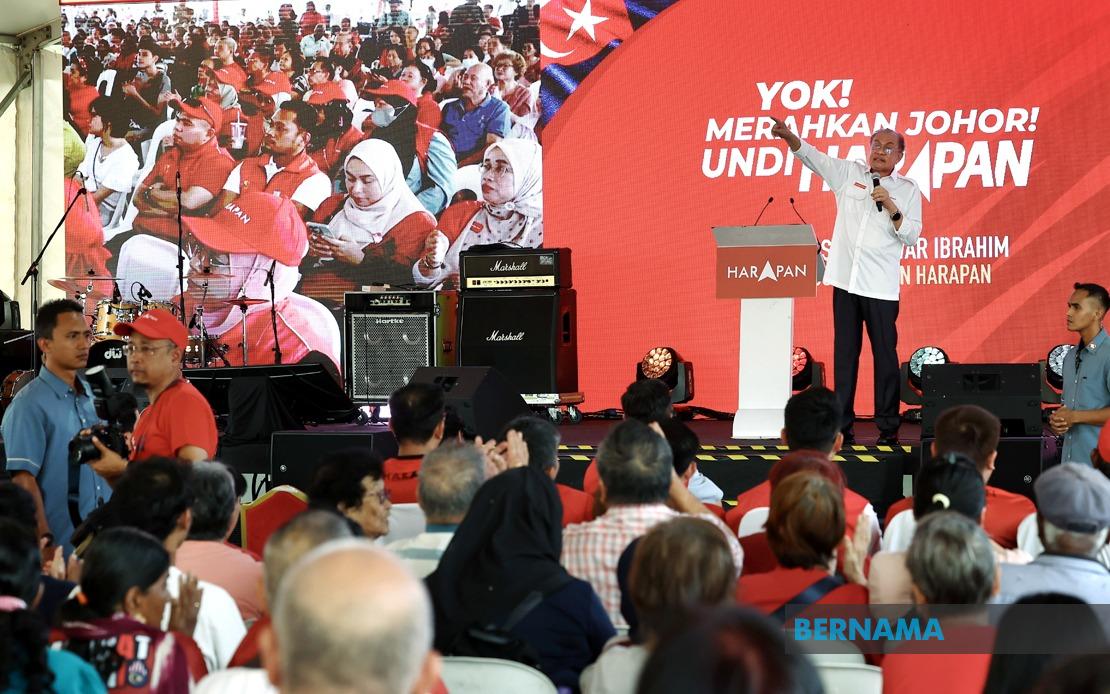
Prime Minister Datuk Seri Anwar Ibrahim has called on political parties contesting the Johor state election to stop leveraging the status of former Prime Minister Datuk Seri Najib Razak's imprisonment as campaign material, arguing that the focus should pivot instead toward genuine governance priorities. Speaking at a campaign event in Kulai on July 10, Anwar framed the plea as a matter of political maturity and fiscal responsibility, emphasising that the nation faces far more pressing challenges than ongoing debate about Najib's legal situation.
Anwar's intervention reflects growing tension within Malaysia's political landscape, where the question of Najib's detention has become a flashpoint in election campaigns across multiple states. By explicitly stating "enough is enough," the Prime Minister signalled frustration with what his administration views as opportunistic politicisation of a settled judicial matter. Najib remains incarcerated while serving his sentence, a status that fundamentally differs from scenarios where imprisonment might be pending or reversible through electoral outcomes. This context is crucial for understanding why Anwar emphasises that Najib should simply be left out of campaign narratives entirely.
The economic argument underpinning Anwar's position carries particular weight for Malaysian voters. He highlighted that the government currently carries a 1MDB debt obligation totalling RM51 billion, representing funds that could have been directed toward critical public services instead. This figure serves as a concrete reminder of the scale of the financial misappropriation that occurred during Najib's tenure as Prime Minister. By anchoring his criticism in fiscal reality rather than political rhetoric, Anwar frames the Najib issue not as a partisan score to settle but as a persistent economic burden affecting resource allocation for ordinary Malaysians.
The implications of this debt burden resonate across Malaysian society in tangible ways. Schools, hospitals, roads and social welfare programmes all compete for limited budgetary allocations, and Anwar's assertion that these sectors remain underfunded due to 1MDB legacy costs strikes at voter concerns about quality of life and public service provision. For Malaysian citizens facing daily pressures around healthcare access, education quality and infrastructure maintenance, the connection between historical financial crimes and present-day constraints on government capacity becomes immediately relevant. Anwar essentially reframes the Najib conversation from abstract legal and political territory into the concrete realm of household budgets and community needs.
The Johor state election campaign context adds regional significance to this intervention. Johor represents Malaysia's second-largest economy and a politically diverse state where multiple coalitions compete vigorously. The presence at Anwar's event of Youth and Sports Minister Mohammed Taufiq Johari, Deputy Investment, Trade and Industry Minister Sim Tze Tzin, PKR Youth chief Muhammad Kamil Abdul Munim, and Pakatan Harapan candidate Arthur Chiong Sen Sern for Bukit Batu indicates organisational mobilisation to convey a unified message. This coordination suggests that the federal government is actively working to shift campaign narratives away from Najib-focused arguments across its slate of candidates.
Anwar's statement also carries implications for inter-coalition dynamics within Malaysian politics. Opposition parties have occasionally invoked Najib's situation in campaign messaging, and his directive implicitly criticises this strategy as counterproductive to serious governance discourse. By positioning focus on welfare and economic management as the proper domain for electoral debate, Anwar attempts to establish a standard for campaign conduct that privileges substantive policy discussion over personalised attacks on imprisoned figures. Whether other parties accept this implicit challenge remains uncertain, but the articulation of such standards reflects an attempt to elevate campaign culture.
The 1MDB scandal's continued shadow over Malaysian politics cannot be understated. The fund, established during Najib's premiership, became synonymous with one of the world's largest financial crimes, with billions allegedly misappropriated through networks spanning multiple countries. International investigations, asset recoveries and ongoing legal proceedings continue, making 1MDB not merely historical but an active component of Malaysia's financial and reputational landscape. Anwar's reference to unfinished debt repayment obligations underscores that 1MDB consequences extend far beyond Najib's personal legal situation into the structural challenges facing Malaysia's economy.
For Southeast Asian observers, Anwar's intervention reflects broader patterns of how post-scandal democracies attempt to rebalance public discourse. Malaysia's experience with large-scale financial crime and subsequent leadership transitions shares elements with other regional nations navigating similar challenges around accountability, legacy costs, and political renewal. Anwar's framing suggests a calculation that continuous litigating of past crimes in present campaigns ultimately prevents forward movement and constructive policy engagement. This philosophical stance has implications for how Malaysian politics might evolve as the immediate shock of 1MDB fades and longer-term economic consequences require sustained attention.
The timing of Anwar's remarks during active campaign season indicates strategic intent to shape how political competitors frame their messages to voters. By establishing an expectation that Najib's case should not be campaign material, the Prime Minister attempts to prevent opposition forces from gaining traction through personalised attacks or revenge-oriented rhetoric. This approach assumes that voters will respond positively to candidates focusing on forward-looking governance rather than backward-looking recriminations, though this assumption remains empirically contestable across different constituencies and demographic groups.
Looking forward, Anwar's call for campaign discipline around the Najib issue may influence how parties approach messaging in other upcoming electoral contests beyond Johor. The establishment of a norm against using a former Prime Minister's imprisonment as campaign fodder could reshape political culture in ways that privilege substantive policy debate, though enforcement of such norms depends on voluntary acceptance rather than institutional mechanisms. Whether the directive proves effective ultimately rests on how Malaysian voters themselves judge campaign content and whether they reward candidates adhering to Anwar's prescribed standards of electoral discourse versus those who persist with Najib-focused messaging.

