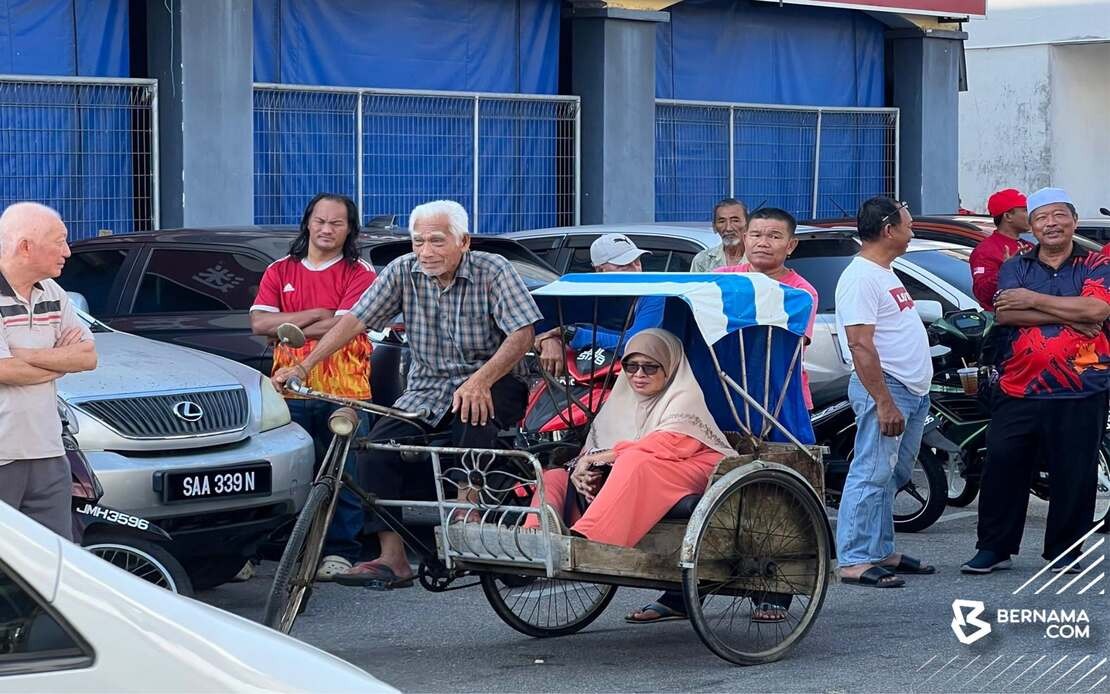
Prime Minister Datuk Seri Anwar Ibrahim took to social media to express heartfelt appreciation for an elderly resident's determination to catch a glimpse of the country's leader during a recent visit to Johor. The incident occurred when Abdul Razak Pelangga, an 86-year-old imam, made an extraordinary effort to bring his wife to witness the Prime Minister's appearance, demonstrating a touching display of civic commitment that resonated with Anwar despite the pair ultimately missing their opportunity to meet.
The remarkable encounter unfolded in Senggarang, a locality within Batu Pahat in Johor, where Anwar had stopped for breakfast at Kedai Kopi Hailam Sri Medan as part of a broader campaign programme for the Johor State Election. Word had circulated through the community that Malaysia's top political leader would be present, prompting Abdul Razak and his wife, Jamilah Samsudin, aged 64, to make their way from Kampung Parit Bugis. Rather than relying on motorised transport, the septuagenarian decided to pedal his family's trishaw across nearly a kilometre of distance, a decision that spoke volumes about the couple's desire to participate in this rare moment of direct engagement with the nation's premier.
In his Facebook response, Anwar acknowledged the symbolic weight of the gesture while expressing genuine disappointment at the timing constraints that prevented a personal meeting. He extended an invitation for a future encounter, writing that by God's will they would have another opportunity to connect. His message balanced political courtesy with authentic warmth, thanking the couple for their encouragement and support while invoking religious blessings upon them—a tone that reflected both his position as Prime Minister and his recognition of the personal sacrifice involved in their journey.
The circumstances surrounding Abdul Razak's choice reveal practical reasoning alongside emotional determination. Though he possessed alternative means of transportation, including access to an automobile and motorcycle, the elderly resident deliberately selected the trishaw to circumvent the anticipated parking challenges that would arise during the Prime Minister's visit. This calculated decision—prioritising attendance over convenience—suggested a deep commitment to witnessing the occasion, even if it meant undertaking a physically demanding journey by pedal power.
Abdul Razak's role as imam at Masjid Raudhatul Jannah Parit Bugis added another dimension to his eagerness to attend. Religious leaders within Malaysian communities often view opportunities to engage with national figures as moments of broader significance, connecting personal faith practice with civic participation. His willingness to shepherd his wife through this experience underscored the communal importance both individuals placed on the event, transforming a simple breakfast stop into a meaningful symbolic encounter—or attempted encounter—that transcended ordinary campaign appearances.
The Prime Minister's itinerary in Senggarang reflected the intensive engagement approach typical of state election campaigns. Anwar spent approximately 50 minutes at the kedai kopi establishing direct contact with local constituents, moving beyond formal speeches to conduct informal meet-and-greet interactions. This accessible style of political engagement, where leaders immerse themselves in neighbourhood settings rather than maintaining distance, creates the conditions where stories like Abdul Razak's become possible. Such grassroots-level visibility generates emotional connections that resonate far beyond the immediate locality.
For Malaysian observers, the exchange exemplifies the intergenerational interest in governance and political participation that persists despite broader debates about voter engagement and democratic participation. An 86-year-old man's determination to pedal nearly a kilometre reflects genuine enthusiasm for connecting with national leadership, a sentiment that challenges narratives of widespread political apathy or disengagement. The couple's effort, however modest it may appear, carries significance as an indicator of continuing interest in direct democratic participation among older Malaysians.
Anwar's public acknowledgment through social media amplified the incident's reach, transforming what could have remained a localised story into a nationally visible moment. By highlighting the couple's effort and expressing sincere regret at missing them, the Prime Minister demonstrated attentiveness to the sacrifices ordinary Malaysians make to engage with leadership. This approach to political communication—acknowledging individual gestures publicly rather than allowing them to pass unnoticed—reinforces a particular vision of democratic governance rooted in reciprocal respect between leaders and citizens.
The broader context of the Johor State Election provided the framework for Anwar's campaign visits, with his presence in constituencies like Senggarang representing attempts to maintain coalition momentum in a state where political competition remains significant. Campaign appearances serve multiple functions beyond immediate electoral calculation: they establish the Prime Minister's accessibility, demonstrate investment in regional concerns, and create opportunities for organic voter interactions. Abdul Razak's trishaw journey represents precisely the kind of grassroots engagement that campaigns seek to cultivate.
Though the Prime Minister and the elderly couple never managed to meet face-to-face, the incomplete encounter arguably gained more resonance through Anwar's social media response. His message invoked religious language and future possibility, extending hope beyond the missed moment while validating the couple's effort. For observers, the exchange illustrated how contemporary Malaysian political culture increasingly operates through digital platforms where moments of human interest acquire national significance through selective amplification and emotional framing.

