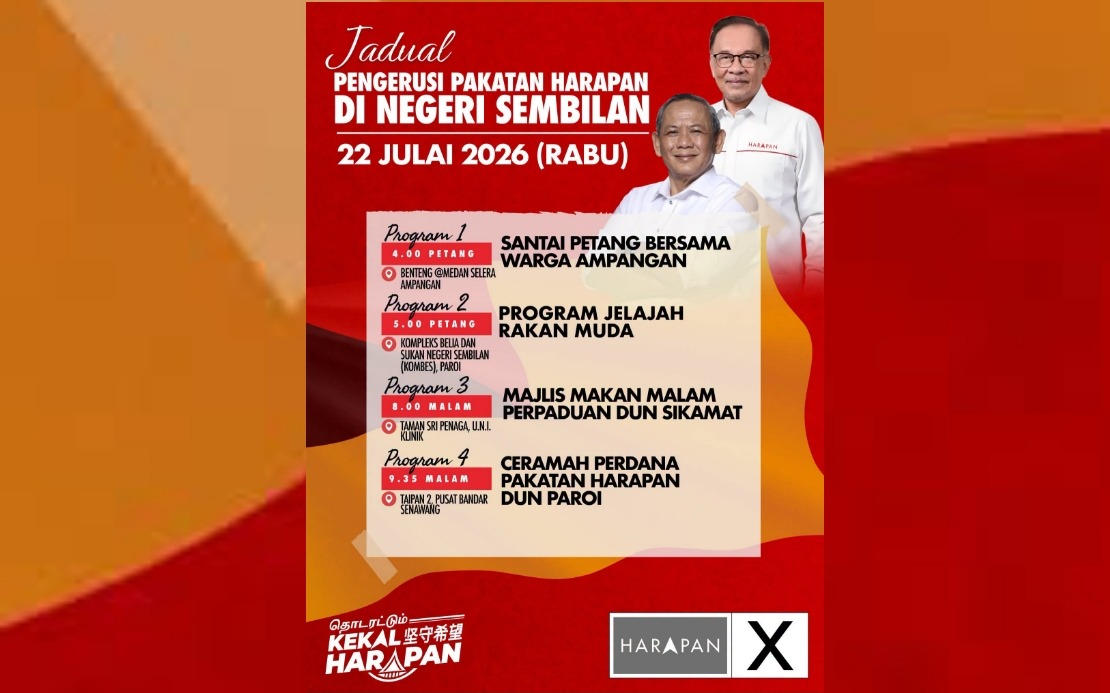
Prime Minister Datuk Seri Anwar Ibrahim will embark on an extensive campaign itinerary spanning four locations across Negeri Sembilan tomorrow, marking his inaugural visit to the state since the commencement of the 16th Negeri Sembilan State Election campaign. The Pakatan Harapan chairman and Parti Keadilan Rakyat president has scheduled a series of engagements throughout the afternoon and evening in the Seremban and Paroi constituencies, according to an announcement posted on his Facebook account.
Anwar's campaign schedule commences at 4 pm with events in Seremban, establishing momentum for the coalition's ground operations in a state where the political landscape remains highly competitive. The decision to concentrate multiple stops within a single day reflects the intensity of Pakatan Harapan's final-stage mobilisation efforts, with party leadership seeking to energise grassroots supporters and secure voter commitments in key battleground areas. As head of Malaysia's largest opposition coalition and sitting Prime Minister, Anwar's personal appearance carries significant symbolic weight, signalling the coalition's commitment to contesting vigorously across diverse electoral zones.
The evening schedule includes a unity dinner at Sikamat State Legislative Assembly constituency, which commences at 8 pm at Taman Sri Penaga. This intimate gathering format allows for direct interaction with party machinery, local candidates, and community leaders, providing opportunities to address concerns specific to the Sikamat area. Unity dinners have become standard campaign fare in Malaysian electoral contests, serving as occasions for consolidating internal party support whilst projecting cohesion to external observers.
Following the Sikamat engagement, Anwar transitions to the Paroi constituency for a grand rally scheduled at Taipan 2 in Senawang Town Centre. This flagship event represents the crescendo of the evening's activities, designed to draw larger crowds and generate grassroots enthusiasm. Grand rallies serve multiple strategic functions within electoral campaigns, functioning simultaneously as voter mobilisation exercises, media opportunities, and symbolic assertions of organisational capacity and public backing.
The timing of Anwar's visit carries particular significance given the electoral calendar established by the Election Commission. Early voting has been set for July 28, with the actual polling day scheduled for August 1, providing a compressed campaign window of approximately eleven days from the announcement date. This condensed timeline means each campaign event becomes proportionally more consequential, as candidates and party machinery possess limited opportunities to reach undecided voters and reinforce messaging amongst committed supporters.
Negeri Sembilan represents strategically important electoral terrain for Pakatan Harapan's national political positioning. The state has experienced considerable political volatility in recent years, with shifting coalitions and changing voter preferences reflecting broader patterns of dealignment affecting Malaysian electoral behaviour. By deploying his personal profile as Prime Minister in the state, Anwar effectively signals that Pakatan Harapan contests the election with serious intent and mobilises senior leadership resources toward achieving competitive results.
The constellation of four campaign stops across Seremban and Paroi constituencies demonstrates a targeted geographical strategy. Both constituencies carry different demographic and socioeconomic profiles, requiring calibrated messaging and engagement approaches. Seremban encompasses urban and semi-urban areas with diverse voter bases, whilst Paroi possesses distinct community compositions warranting separate strategic attention. This differentiated approach reflects sophisticated campaign planning that recognises heterogeneity within seemingly singular electoral zones.
Anwar's dual role as Prime Minister and coalition chairman creates distinctive campaign dynamics. His participation simultaneously advances national coalition interests and serves Negeri Sembilan-specific objectives, though these priorities may occasionally diverge. His Prime Ministerial status affords platform access and media attention exceeding ordinary candidates, yet simultaneously invites scrutiny regarding whether his campaign involvement represents appropriate use of executive prominence during a state-level election contest.
The coalition's campaign intensity across multiple venues throughout a single day reflects broader competitive dynamics shaping this election. Opposition parties, particularly Perikatan Nasional, have undertaken parallel mobilisation efforts, necessitating intensified Pakatan Harapan counter-activity to maintain electoral competitiveness. This mutual escalation characterises contemporary Malaysian electoral contests, where campaign sophistication and resource deployment have expanded substantially compared to earlier electoral cycles.
For Malaysian voters and political observers, Anwar's Negeri Sembilan itinerary provides indicators regarding broader coalition priorities and resource allocation decisions. The decision to invest premium leadership time in this state rather than concentrating efforts elsewhere suggests assessed strategic importance or recognised vulnerability requiring reinforcement. Subsequent election outcomes will retrospectively validate or question these resource allocation judgments.
The Election Commission's determination to hold early voting on July 28 creates additional campaign dynamics, as parties must prioritise mobilising committed supporters to participate in the advance voting process. Anwar's campaign schedule implicitly addresses this imperative by generating enthusiasm and reinforcing voting intention amongst attendees, translating rally participation into actual ballot-box participation on August 1.
For Negeri Sembilan residents considering their electoral preferences, Anwar's visit provides direct opportunity to assess Prime Ministerial performance, absorb coalition messaging regarding state-level governance objectives, and make final determinations regarding their voting intentions. Campaign events simultaneously serve informational functions for voters and reinforcement functions for existing coalition partisans, creating multifaceted engagement opportunities.
As Malaysia's political environment continues evolving, state-level elections assume heightened significance within the broader competitive context. Negeri Sembilan's August 1 polling consequently carries implications extending beyond state boundaries, potentially influencing national political momentum and coalition positioning for subsequent electoral contests. Anwar's personal campaign involvement underscores these broader stakes, positioning tomorrow's events within larger strategic considerations shaping Malaysian political trajectory.

