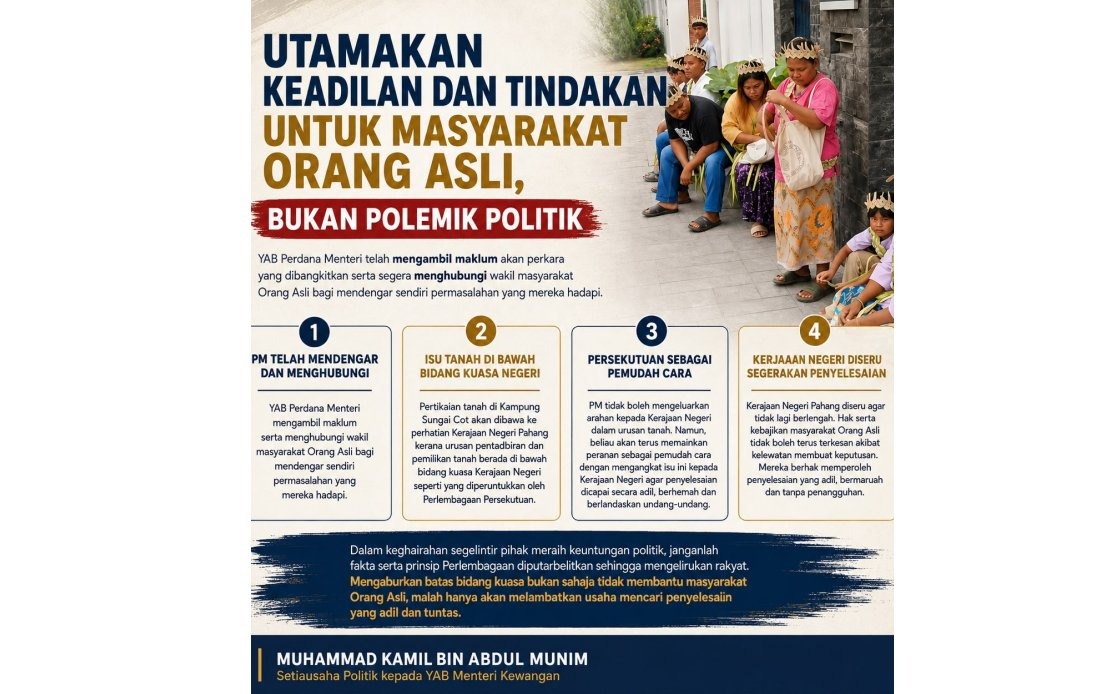
Prime Minister Datuk Seri Anwar Ibrahim has committed to playing an active facilitating role in resolving a contentious land dispute affecting the Orang Asli community in Kampung Sungai Cot, located in Maran, Pahang. According to Muhammad Kamil Abdul Munim, political secretary to the Finance Minister, Anwar intends to escalate the matter directly to the Pahang State Government to expedite a resolution that upholds both fairness and legal principles. This intervention underscores the Prime Minister's acknowledgement of the indigenous community's grievances and represents an attempt to cut through bureaucratic delays that have prolonged the dispute.
The statement clarifies that Anwar has already taken preliminary steps to engage with the situation, having personally contacted representatives from the Orang Asli community to understand the specific hardships they are enduring. This direct outreach signals a departure from purely administrative handling and reflects a recognition that land disputes involving indigenous communities carry significant social and political dimensions that warrant high-level attention. The Prime Minister's personal involvement, even within constitutional limits, carries symbolic weight that can encourage faster movement through government channels.
A critical point articulated by Muhammad Kamil concerns the constitutional framework governing land administration in Malaysia. Under the Federal Constitution, land ownership and administration fall squarely within state government jurisdiction rather than federal authority. This demarcation means that while the Prime Minister lacks the legal power to unilaterally direct state governments to take specific actions on land matters, the federal government retains considerable diplomatic and political influence. Anwar's decision to channel the matter through formal state-level mechanisms respects these constitutional boundaries while still positioning federal leadership as an advocate for resolution.
The statement emphasises that the Prime Minister's commitment does not equate to silence or indifference on the matter. Rather, Anwar maintains that federal involvement through facilitation and coordination represents a substantive contribution to addressing indigenous land grievances. This distinction matters considerably, as it pushes back against potential criticism that the federal government has abandoned responsibility for indigenous welfare despite the constitutional limitations on direct intervention. The framing suggests an interpretation of the Prime Minister's role as encompassing moral and political leadership on equity issues, even when direct regulatory authority lies elsewhere.
Muhammad Kamil's statement also contains a pointed rebuke to political actors attempting to weaponise the Kampung Sungai Cot dispute for electoral advantage. The reference to "certain parties" seeking to score political points serves as a warning against opportunistic engagement with indigenous land issues. By cautioning against distortion of facts and constitutional principles, the statement implicitly criticises those who might exaggerate the Prime Minister's capacity to resolve such disputes unilaterally or who misrepresent the constitutional allocation of powers. This rhetorical move protects the government against claims of inaction while simultaneously suggesting that politicisation of the issue itself obstructs genuine progress.
The emphasis on avoiding further delays reflects mounting frustration within government circles regarding the prolonged nature of the dispute. The statement positions the Pahang State Government as the body responsible for swift action, urging it to expedite decision-making processes. This allocation of accountability effectively places pressure on state-level officials to move beyond procedural lethargy. For the Orang Asli community in Kampung Sungai Cot, this federal-level endorsement of urgency may provide leverage in dealings with state authorities, though the ultimate outcome remains dependent on Pahang's political will and administrative capacity.
The statement's invocation of dignity and fairness as core principles suggests that any eventual resolution must move beyond mere legal compliance to encompass genuine justice for the indigenous community. This rhetorical framing acknowledges that land disputes involving Orang Asli communities are not purely technical property matters but touch upon historical injustices, economic marginalisation, and cultural survival. By emphasising these dimensions, the Prime Minister's office signals receptiveness to indigenous claims while remaining within constitutional parameters that require state-level implementation.
For Malaysian readers and observers, this situation exemplifies the structural tension between national equity commitments and federal-state power distribution. The Orang Asli constitute one of Malaysia's most economically and socially vulnerable populations, yet land disputes affecting them often languish in state administrative systems that lack either resources or political incentive to resolve them swiftly. Federal intervention through facilitation represents a practical workaround, though one that ultimately depends on state cooperation. The success or failure of Anwar's approach will provide important signals about whether federal leadership can meaningfully shape state-level outcomes on indigenous rights without formal constitutional authority.
The Kampung Sungai Cot case also carries implications for Southeast Asia's broader indigenous governance landscape. Malaysia's experience in navigating federal-state jurisdictions while attempting to advance indigenous welfare offers lessons and warnings for neighbouring nations grappling with similar structural challenges. The extent to which high-level federal engagement can catalyse state-level action on indigenous issues remains an empirical question that this case will help illuminate.
Political observers will closely monitor whether the Prime Minister's intervention produces concrete movement from Pahang authorities in coming weeks. The statement's explicit call for swift action, combined with the Prime Minister's personal involvement, creates a political context in which indefinite delays become increasingly untenable. For the Orang Asli community in Kampung Sungai Cot, federal facilitation offers both hope that their grievances have reached senior leadership and uncertainty about whether high-level commitment translates into actual resolution of their land claims. The coming months will test the effectiveness of facilitation-based approaches to entrenched land disputes within Malaysia's constitutional framework.

