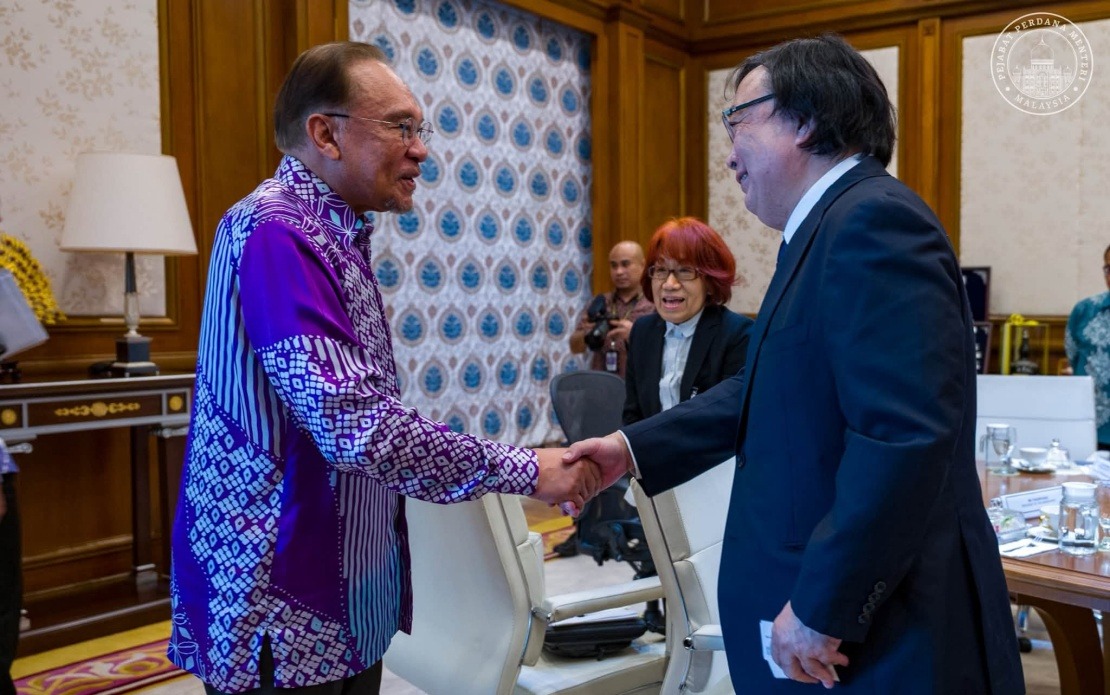
Prime Minister Datuk Seri Anwar Ibrahim received Genron NPO President Yasushi Kudo at his office in Kuala Lumpur on July 23, underscoring Malaysia's commitment to deepening institutional engagement with Japan through both governmental and civil society channels. The meeting centred on expanding the Asia Leaders Roundtable, a strategic dialogue platform designed to tackle complex regional and global challenges with sustained intellectual input from across the continent's leadership circles.
The Genron NPO, based in Tokyo, operates as an independent non-profit think tank that has positioned itself as a bridge-building institution within Asia's policy landscape. Its involvement in convening leaders and facilitating candid discussions on matters ranging from security architecture to economic integration reflects the growing importance of track-two diplomacy in an era when traditional state-to-state channels sometimes struggle with political sensitivities. For Malaysia, engaging with such organisations allows policymakers to participate in informal networks where frank conversations about regional tensions and opportunities can occur without immediate diplomatic repercussions.
Anwar's appreciation for Japan's hospitality during his June official visit suggests that the bilateral relationship has entered a particularly warm phase. Official visits by prime ministers are carefully orchestrated diplomatic events, and the Prime Minister's public acknowledgment of Japan's reception indicates satisfaction with how Malaysia was treated during high-level engagements in Tokyo. This matters considerably for regional observers because Malaysia's relationship with Japan carries implications for broader Southeast Asian-Japanese cooperation, given Malaysia's influence within ASEAN and Japan's critical economic presence throughout the region.
Malaysia's designation of Japan as among its most significant strategic and economic partners reflects decades of accumulated investment, technology transfer, and security cooperation. Japanese corporations dominate key sectors of Malaysia's manufacturing economy, while Japanese tourists and investors represent substantial economic inputs. Beyond commerce, Japan's technological prowess in semiconductors, automotive engineering, and renewable energy aligns with Malaysia's own economic diversification priorities. The articulation of a Comprehensive Strategic Partnership formalises this multifaceted relationship, moving beyond transactional arrangements to encompassing shared long-term objectives.
The Prime Minister's expression of gratitude for invitations to both the 2026 and 2027 Tokyo Conferences indicates Malaysia's intention to maintain visible presence in Japan's intellectual and policy forums. These conferences serve as venues where Asia-Pacific leaders convene to discuss global challenges, and Malaysia's participation ensures that Southeast Asian perspectives—particularly on issues affecting maritime security, trade governance, and regional development—are represented in conversations that shape international thinking. The opportunity to deliver a video message at the 2026 gathering suggests that Malaysian positions on critical issues merit wider circulation among conference participants and the broader policy community that monitors these proceedings.
For Southeast Asian analysts, this engagement pattern reflects a deliberate strategy by the Malaysian government to strengthen partnerships beyond ASEAN, recognising that association with established middle powers and developed economies enhances Malaysia's own standing in regional hierarchies. Japan, as Asia's most developed economy and a significant military power, offers Malaysia access to advanced technology, manufacturing expertise, and influence within trilateral or multilateral frameworks that also involve the United States, Australia, and European partners.
The Asia Leaders Roundtable itself deserves examination as an institutional mechanism. Unlike formal organisations with fixed membership and binding commitments, roundtables allow flexibility in participation and agenda-setting while still generating substantive policy dialogue. For countries like Malaysia that balance relationships across multiple great powers and regional blocs, such platforms offer valuable venues to project influence without appearing to align exclusively with any single power.
Anwar's emphasis on pursuing shared peace, stability, and prosperity through strengthened Malaysia-Japan cooperation speaks to contemporary regional anxieties. The South China Sea remains contested, supply chain vulnerabilities have become apparent through recent global disruptions, and the strategic competition between China and Western powers creates pressure on middle powers to maintain balanced relationships. Japan, having navigated similar positioning challenges given its alliance with the United States and its geographic proximity to China, offers a potential model for Malaysia's own strategic management.
The courting of Malaysia by senior Japanese officials and think tank leaders also reflects Japan's broader pivot toward deeper Southeast Asian engagement. As Tokyo seeks to sustain its economic relevance and strategic influence amid rising Chinese regional activity, cultivating relationships with individual ASEAN member states becomes strategically important. Malaysia, with its geographic position on critical sea lanes and its role within ASEAN decision-making, represents a particularly valuable partner for Japan's Indo-Pacific vision.
Looking forward, the continuation of such high-level exchanges and expanded participation in Japanese-led forums positions Malaysia to extract maximum benefit from its partnership with Tokyo. Whether through technology partnerships, investment frameworks, or coordinated positions on regional security matters, the institutional relationships being cultivated through meetings like this one create lasting channels for cooperation that can prove invaluable when crises or major policy shifts occur.

