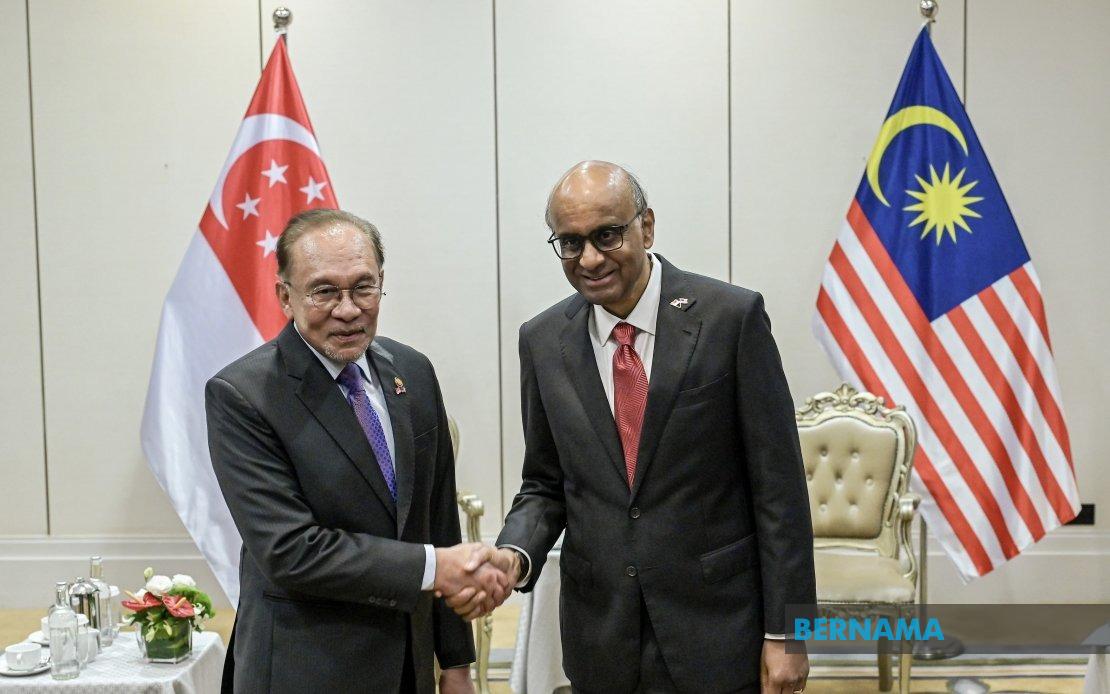
Prime Minister Datuk Seri Anwar Ibrahim held substantive discussions with Singapore President Tharman Shanmugaratnam on Monday as part of the city-state's three-day state visit to Malaysia, underlining the continued importance both nations place on their bilateral relationship. The 40-minute meeting at Kuala Lumpur reflected the high-level engagement characteristic of Malaysia-Singapore relations, with senior economic and diplomatic officials from both countries in attendance, including Foreign Minister Datuk Seri Mohamad Hasan, Investment, Trade and Industry Minister Datuk Seri Johari Abdul Ghani, and Entrepreneur and Cooperatives Development Minister Steven Sim Chee Keong.
President Tharman arrived in Malaysia on an invitation from the Yang di-Pertuan Agong Sultan Ibrahim, having been accorded the full ceremonial honours of a state visit at Istana Negara. The three-day visit, scheduled from July 13 to 15, serves as a reciprocal gesture following His Majesty's own state visit to Singapore in May 2024, demonstrating the mutual commitment both governments maintain toward deepening institutional and people-to-people ties.
The timing of this visit carries particular significance for Southeast Asia's economic landscape. Singapore occupies a critical position in Malaysia's broader trade architecture, functioning as the nation's second-largest trading partner globally whilst simultaneously holding the distinction of being Malaysia's most substantial trading partner within the ASEAN bloc. This dual importance reflects the integrated nature of the Malaysian and Singaporean economies, with decades of cooperation spanning manufacturing, financial services, energy, and digital innovation sectors.
Recent trade data underscores the momentum in the bilateral commercial relationship. Total bilateral trade between the two countries reached RM402.35 billion in 2025, representing a modest increase of 1.5 per cent compared with the previous year's figures. More encouraging are the year-to-date statistics, which reveal stronger growth trajectory during the opening months of 2025. From January through May, bilateral trade expanded 14.5 per cent to RM189.90 billion, substantially outpacing the 2024 comparative period when the corresponding five-month figure stood at RM165.93 billion.
These growth rates warrant careful analysis within the Malaysian context. The acceleration in bilateral trade during the first half of 2025 suggests that economic relationship between the two nations is gaining traction despite global trade uncertainties. For Malaysian businesses, Singapore represents both a crucial market and a critical distribution hub for accessing broader regional and international supply chains. The sustained growth in trade volumes indicates that Malaysian exporters continue finding competitiveness in Singaporean and third-country markets.
The economic dimensions of the visit extend beyond simple trade accounting. Both nations have invested substantially in complementary economic ecosystems. Singapore's position as a financial and logistics centre meshes with Malaysia's growing role as a manufacturing and agricultural hub. The Iskandar Malaysia development in Johor, located directly across from Singapore, exemplifies how geographical proximity has been leveraged for mutual economic benefit, with thousands of Singaporean workers commuting daily across the Causeway and Second Link.
During such high-level visits, substantive conversations typically encompass not merely current trade performance but also future opportunities and sectoral collaboration. Discussions between Anwar and President Tharman would naturally touch upon infrastructure connectivity, digital economy initiatives, green energy transitions, and regional security considerations. These domains represent areas where Malaysian and Singaporean expertise and resources can be pooled for mutual advancement.
The state visit also carries diplomatic weight beyond commerce. Malaysia and Singapore, despite being neighbours with inevitable points of contention, have historically maintained pragmatic relations anchored in economic interdependence and shared regional interests. High-level visits of this calibre serve as important moments to reaffirm commitment to cooperative frameworks and to address any outstanding bilateral matters in an atmosphere of mutual respect.
For Malaysian readers and businesses, the visit signals continuity in the government's engagement with Singapore as a priority partner. The strong trade growth figures provide concrete evidence that Malaysia remains competitive within the regional economy and capable of deepening its integration with one of Asia's most developed economies. This integration has demonstrable benefits for Malaysian workers, consumers, and enterprises across multiple sectors.
Looking forward, the momentum evident in Malaysia-Singapore trade and the high-level political engagement demonstrated through this state visit suggest both governments remain committed to sustaining and expanding their economic partnership. As Malaysia pursues its development ambitions and attempts to navigate shifting global trade patterns, the relationship with Singapore will continue serving as an important anchor for regional stability and economic growth. The visit thus represents not merely ceremonial protocol but a substantive reaffirmation of ties that remain vital for Malaysia's prosperity.

