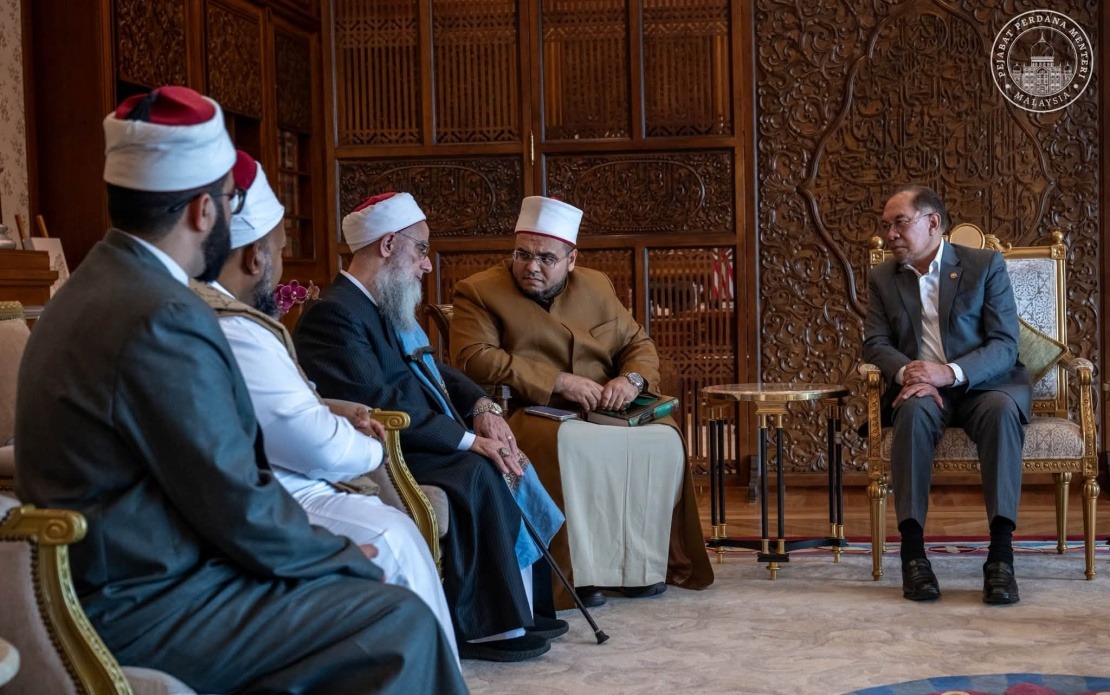
Prime Minister Datuk Seri Anwar Ibrahim met with prominent Egyptian Islamic scholar Sheikh Dr Mustafa An-Nadwi Al-Hasani Mansurah at his Putrajaya office on July 20, according to a statement the premier shared on social media. The encounter brought together two figures with significant influence in Islamic intellectual and political circles across their respective regions, marking another instance of Malaysia's engagement with leading Islamic scholars from the Arab world.
The Egyptian scholar, based in Mansurah, commands considerable respect within Islamic academic circles for his extensive contributions to hadith studies and Islamic jurisprudence. Sheikh Dr Mustafa's scholarly lineage traces directly to the internationally acclaimed Islamic preacher and thinker Sheikh Abul Hasan Ali al-Nadwi, whose influence shaped Islamic intellectual discourse across multiple continents throughout the twentieth century and beyond. This connection underscores the significance of the visitor's mission to Malaysia and the gravity with which the Prime Minister treated the engagement.
Anwar's characterisation of the scholar emphasised particular dimensions of Islamic learning that appear to resonate with the Prime Minister's broader vision for Malaysia's development. In his account of the meeting, Anwar highlighted Sheikh Dr Mustafa's unwavering commitment to moral foundations, philosophical depth, and the rigorous study of hadith—the documented practices and teachings of the Prophet Muhammad. These commitments, Anwar suggested, embody an intellectual approach increasingly vital in contemporary society.
The Prime Minister articulated a concern that appears to shape much of his recent public messaging: the erosion of substantive knowledge and wisdom under the weight of sensationalism and superficial discourse. In an era dominated by rapid information cycles and viral content, Anwar noted, scholars like Sheikh Dr Mustafa serve as important counterweights, demonstrating through their work and example that genuine learning proceeds quietly and methodically. Using evocative language, he compared authentic knowledge to morning dew—unobtrusive in its arrival yet profoundly life-giving in its effects. This metaphorical framing suggests Anwar views such scholarly engagement not merely as diplomatic courtesy but as part of a larger project to elevate intellectual standards within Malaysian society.
Beyond ceremonial pleasantries, the two leaders utilised their meeting for substantive discussion on pressing contemporary issues. Anwar indicated that he and Sheikh Dr Mustafa exchanged perspectives on current affairs, though the Prime Minister's statement did not specify which particular matters occupied their conversation. Given Sheikh Dr Mustafa's background and influence, such discussions likely touched upon theological responses to modern challenges, Islamic approaches to governance, or regional developments affecting the Muslim world. The breadth of the scholar's knowledge sessions scheduled throughout his Malaysian visit suggests his engagement extended well beyond this single high-level meeting.
During his time in Malaysia that week, Sheikh Dr Mustafa conducted multiple knowledge-sharing sessions, creating opportunities for Malaysian Islamic intellectuals, students, and community members to benefit from his expertise. These sessions represented a form of intellectual exchange increasingly important for Southeast Asia's Muslim societies, which frequently look toward Egyptian and Arab Islamic scholarship for guidance on complex theological and social questions. Malaysia's institutional facilitation of such visits reflects both a commitment to deepening Islamic thought within the country and a strategic effort to maintain strong cultural and intellectual ties with prominent figures in the broader Islamic world.
Anwar's gratitude extended beyond the immediate conversation, encompassing Sheikh Dr Mustafa's prayers for Malaysia's continued national cohesion and prosperity. This reference to spiritual petition reflects the traditional importance of scholars' intercession in Islamic culture, where the supplications of the pious are believed to carry particular weight. That the Prime Minister publicly acknowledged and valued this dimension of the encounter illustrates the integration of spiritual and political concerns within his worldview.
The Prime Minister reciprocated with his own invocations, praying for Sheikh Dr Mustafa's sustained health, the continued flourishing of his scholarly endeavours, and his ongoing capacity to guide his communities with wisdom, moderation, and compassion. This reciprocal blessing demonstrates the mutual respect characterising the relationship and positions both figures as united in their commitment to these particular Islamic virtues. The emphasis on moderation proves especially significant given Malaysia's efforts to position itself as a centre for moderate Islamic thought in Southeast Asia, contrasting its approach with more rigid or extreme interpretations.
For Malaysian observers, this encounter carries multiple implications. It signals Anwar's continued prioritisation of engagement with international Islamic intellectual leaders, a pattern evident throughout his premiership as he seeks to enhance Malaysia's standing within broader Islamic civilisational networks. It reinforces the government's investment in Islamic knowledge production and dissemination as central to national development. Additionally, the meeting illustrates how Malaysia leverages its position as a multicultural Muslim-majority nation to host and facilitate dialogue among global Islamic thinkers, potentially influencing how contemporary Islamic thought addresses questions of governance, social cohesion, and adaptation to modernity.
The strategic timing of such visits also deserves consideration. As Malaysia navigates complex questions about national identity, religious pluralism, and social harmony, engagement with revered international scholars like Sheikh Dr Mustafa provides intellectual resources and moral authority that can strengthen the government's positioning on these critical issues. Such visitors lend credibility to particular approaches to Islamic teaching emphasising compatibility with modern governance, rule of law, and interfaith cooperation—positions Anwar has championed throughout his political career.
The broader context of this meeting reflects deeper currents within Malaysian politics and society. In an environment where Islamic discourse occasionally becomes polarised between modernist and traditionalist camps, the reception of a scholar rooted in classical Islamic tradition yet engaged with contemporary questions suggests an attempt to chart a middle course. Sheikh Dr Mustafa's scholarly work in hadith studies, an authentically traditional Islamic discipline, combined with his apparent willingness to address modern issues, exemplifies the kind of synthesis Anwar's government appears to promote.
Looking forward, such high-level receptions of international Islamic scholars likely represent an ongoing pattern rather than an isolated occurrence. They reflect Malaysia's growing confidence in its role as a convener of Islamic intellectual discourse and a serious partner in conversations shaping how Islamic societies respond to twenty-first-century challenges. For Malaysian Muslims and broader regional audiences, these encounters promise continued access to world-class Islamic education and thought leadership, resources that remain central to the country's soft power and cultural influence within Asia and the Muslim world.

