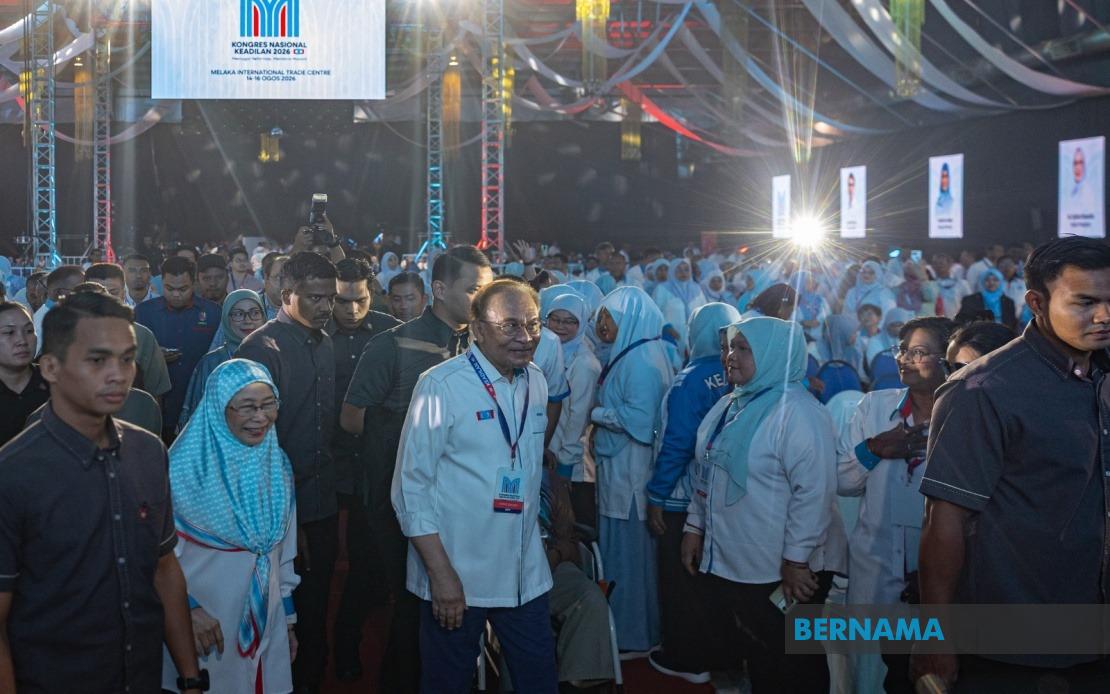
Prime Minister Datuk Seri Anwar Ibrahim has firmly restated his government's determination to preserve the coalition arrangement with UMNO-Barisan Nasional, declaring that strategic partnership and national interests should outweigh individual political grievances. Speaking at the PKR National Congress 2026 in Melaka, Anwar underscored that the Unity Government's stability remains the foundation upon which economic growth and public welfare can be achieved, positioning this stance as a principled choice rather than mere tactical necessity.
The timing of Anwar's declaration carries significant weight, arriving amid recent developments that have prompted speculation about potential fractures within the governing coalition. By publicly reaffirming the partnership, the Prime Minister appears intent on preempting any internal doubts or external pressures that might destabilise the delicate political equilibrium established when Pakatan Harapan and Barisan Nasional formed their alliance following the 2022 general election. This deliberate messaging suggests concern that recent events could embolden rival factions or create openings for political opportunism.
Central to Anwar's argument is the subordination of ego and positional advantage to collective national benefit. He explicitly cautioned against allowing political decisions to be driven by personal ambitions, hierarchical rivalries, or emotional responses to contemporary disputes. This framing reflects an implicit acknowledgment that maintaining such coalitions requires constant management of competing interests and personalities, where the temptation to pursue short-term political advantage could easily undermine the broader arrangement. By articulating this principle publicly, Anwar establishes a benchmark against which his government's future actions can be judged.
The emphasis on economic growth as a linchpin of the administration's legitimacy reveals how Anwar intends to justify continued partnership with UMNO despite their historical enmity. For Malaysian voters weary of perpetual political drama, the promise of sustained development and rising living standards offers a compelling counterweight to ideological or identity-based divisions. This approach echoes the pragmatism that increasingly characterises Southeast Asian governance, where performance legitimacy often supersedes other political narratives.
Anwar's position as PKR president adds complexity to his remarks. The coalition's junior partner must balance enthusiasm for partnership with its own party members, many of whom harbour deep reservations about working alongside UMNO. By framing cooperation as a conscious strategic choice made in parliament's interest rather than an enforced compromise, Anwar attempts to dignify the arrangement in the eyes of potentially sceptical PKR supporters. This narrative work remains perpetual, as each new political incident threatens to reignite internal party doubts.
The Melaka setting itself carries symbolic weight. The southern state has witnessed significant shifts in political dynamics over recent years, experiencing both Pakatan and BN administrations at different points. Selecting this venue for such a statement about federal-level coalition stability may reflect an attempt to ground national political messaging in regional realities, where voters have witnessed multiple governing arrangements and can evaluate their practical consequences.
Historically, Malaysian political coalitions of this magnitude have rarely survived intact beyond a single electoral cycle. The ability of Anwar's administration to maintain UMNO-BN partnership through multiple potential crises would constitute a notable achievement in modern Malaysian politics. However, such arrangements depend not merely on public rhetoric but on sustained institutional mechanisms, resource distribution, and conflict resolution protocols that function effectively when tested by genuine disputes over power or policy.
The broader regional context also influences this stance. Southeast Asian governments increasingly recognise that political instability carries substantial economic costs, particularly in an era of intense global competition and economic uncertainty. Malaysia's recovery trajectory and medium-term growth prospects depend partly on investor confidence in governance continuity. Anwar's deliberate messaging to the business community—through and beyond his party congress remarks—signals that despite the nation's complex political landscape, fundamental institutional stability endures.
Looking forward, this declaration establishes parameters for how the Prime Minister will navigate future coalition management challenges. By publicly anchoring his government to the principle of stability through partnership, Anwar creates rhetorical space to resist pressure from elements within PKR or allied parties who might otherwise demand more aggressive posturing against UMNO. Simultaneously, it signals to UMNO leadership that despite occasional friction, the federal administration remains committed to the arrangement's continuation.
The sustainability of such coalitions ultimately depends on whether constituent parties perceive genuine mutual benefit and whether mechanisms exist to resolve disputes without threatening the entire structure. Malaysia's experience across multiple administrations suggests that explicit restatements of commitment, while necessary, prove insufficient alone. The real test comes when genuine policy differences or resource disputes arise, requiring both principals to demonstrate through action that their commitment to cooperation transcends momentary tensions.

