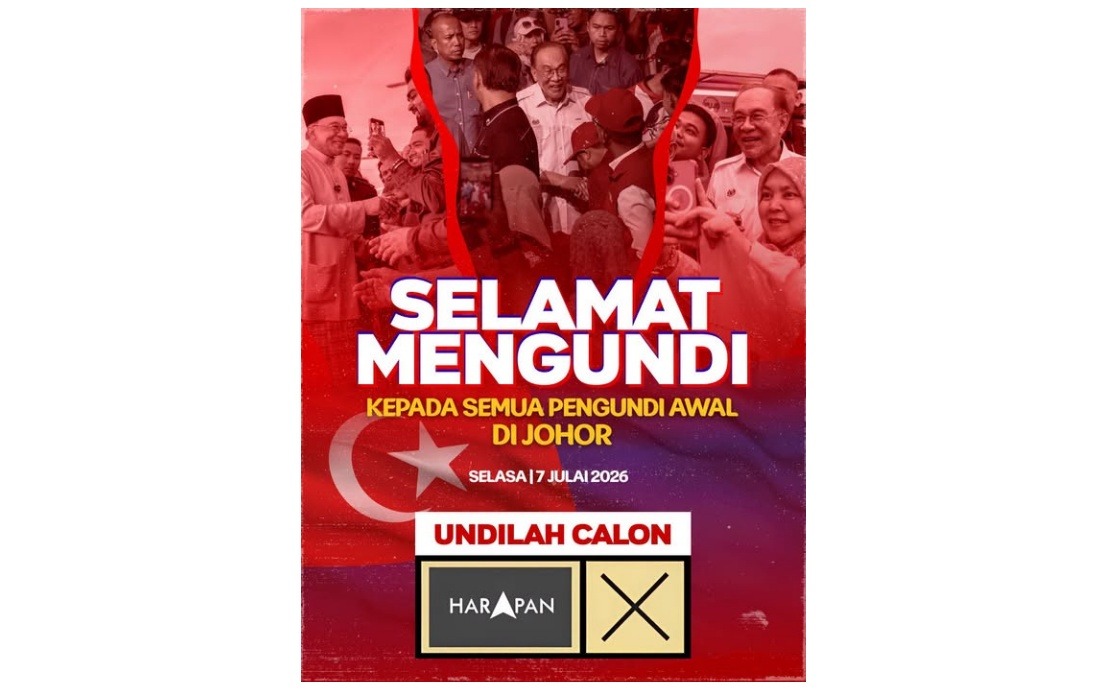
Prime Minister Datuk Seri Anwar Ibrahim has stepped up the campaign momentum for Pakatan Harapan in the 16th Johor state election by directly appealing to early voters taking part in the initial polling phase on July 7. Through a Facebook post, the PH coalition leader addressed the thousands of uniformed personnel and their families who were among the first to exercise their voting rights, framing the election as a pivotal moment for the state's development trajectory. His message centred on the importance of collective action to improve Johor's governance and economic prospects under Harapan stewardship.
The early voting phase saw substantial participation from security and enforcement personnel, reflecting the structured approach Malaysia takes in accommodating the unique voting needs of those in uniform. A total of 24,751 eligible early voters participated across 64 designated polling centres throughout Johor, a significant cohort that could influence momentum heading into the main election day. The composition of these voters underscores the military and police's substantial representation in any state electoral exercise, with 12,041 Malaysian Armed Forces personnel and their spouses joined by 12,710 Royal Malaysia Police and General Operations Force members and their families. This bifurcated voting system allows security forces to participate without disrupting operational capacity during the main polling day.
The logistical coordination required for early voting demonstrated the Election Commission's capacity to manage multiple simultaneous polling operations. The 53 polling centres designated for PDRM personnel and their spouses operated in tandem with 11 centres established for MAF voters, all commencing operations at 8 am. Closing times varied between noon and 6 pm depending on individual centre circumstances and the number of registered voters at each location, allowing flexibility while maintaining security and procedural integrity. This staggered approach reflects the reality that military and police installations across Johor span diverse geographical zones with varying personnel concentrations.
Anwar's intervention in the campaign through direct appeals to early voters carries symbolic weight beyond the immediate voting bloc involved. As Pakatan Harapan's chairman, his personal engagement signals the coalition's prioritisation of the Johor contest and recognition that security force voters represent a meaningful portion of the electorate. The explicit call to "vote Harapan" and choose Harapan candidates was framed not as a partisan demand but as a civic contribution to Johor's advancement, a rhetorical strategy common in Malaysian electoral politics. His message attempted to position PH as the vehicle for positive change while implicitly questioning the incumbents' stewardship of Southeast Asia's southernmost state.
Pakatan Harapan's deployment across all 56 state seats demonstrates a comprehensive challenge to the incumbent administration, with the coalition fielding a balanced slate combining PKR's 20 candidates, Amanah's 19, and DAP's 17. This distribution reflects internal coalition calculations regarding constituency viability and demographic alignment, ensuring representation across Malaysia's major peninsular political blocs. The decision to contest every seat signals confidence in the electoral environment and a rejection of any strategic retreat, contrasting with earlier coalition negotiations that sometimes involved seat-sharing arrangements limiting competition.
The broader electoral landscape encompasses 172 candidates competing for the 56 state assembly seats, indicating multiple three- and four-way contests in many constituencies. This fragmented field creates complex voting calculations for the 2.7 million registered voters preparing for the main polling day on Saturday, potentially benefiting candidates with strong localized machinery and community networks. The proliferation of candidacies suggests that no single party monopolises the competitive space, though incumbent and major opposition parties typically dominate seat captures despite candidate proliferation. For Johor specifically, a state with significant swing constituencies and shifting demographic patterns, the 2.7 million voter base represents a substantial prize in Malaysian federal politics.
Johor's electoral significance extends beyond state politics into national calculations. The state's 26 federal parliament seats make it a kingmaker in national politics, and state election results often prefigure shifts in federal voting patterns. A decisive Harapan victory would provide momentum for the coalition ahead of any future federal election, while an incumbent government retention would consolidate what many analysts view as growing Malay-Muslim voter consolidation around Umno-led coalitions. The stakes are therefore amplified beyond state governance issues, encompassing questions about coalition viability and the trajectory of Malaysian politics more broadly.
Anwar's public encouragement of early voters reflects PH's broader strategy of maximising turnout among perceived sympathetic constituencies. Military and police voters have historically shown varying partisan preferences depending on economic conditions and perceived governance competence, making them persuadable rather than locked into any particular bloc. By investing personal capital in appealing to these voters, Anwar demonstrated PH's assessment that security force personnel represent genuinely competitive ground rather than already-decided territory. The coalition's willingness to contest comprehensively and campaign visibly in multiple constituencies suggests confidence in their messaging resonance among ordinary Johorians.
The timing of the early voting phase and subsequent main election on Saturday compressed the campaign period, limiting voters' exposure to sustained messaging and debate. Media coverage becomes particularly significant in such condensed cycles, with early voting developments often setting narratives that influence perceptions during remaining campaign days. Anwar's Facebook post capitalised on this dynamic, generating news coverage and social media amplification that extended his campaign reach beyond direct voter contact. In the context of Malaysian electoral communication, political leaders' direct engagement with voters through social platforms has become standard, though the penetration and persuasive effectiveness vary considerably across demographic groups.
Looking forward, the early voting results would be scrutinised carefully by political analysts and party strategists seeking early indicators of the main election's trajectory. Exit polls and preliminary reporting on early voter preferences could shape subsequent campaign tactics and resource allocation in the week remaining before Saturday's main polling. For Anwar and Pakatan Harapan, strong early voting support would validate their campaign positioning and energise grassroots mobilisation, while disappointing results in this cohort might necessitate strategic adjustments in targeting and messaging aimed at remaining voter groups.

