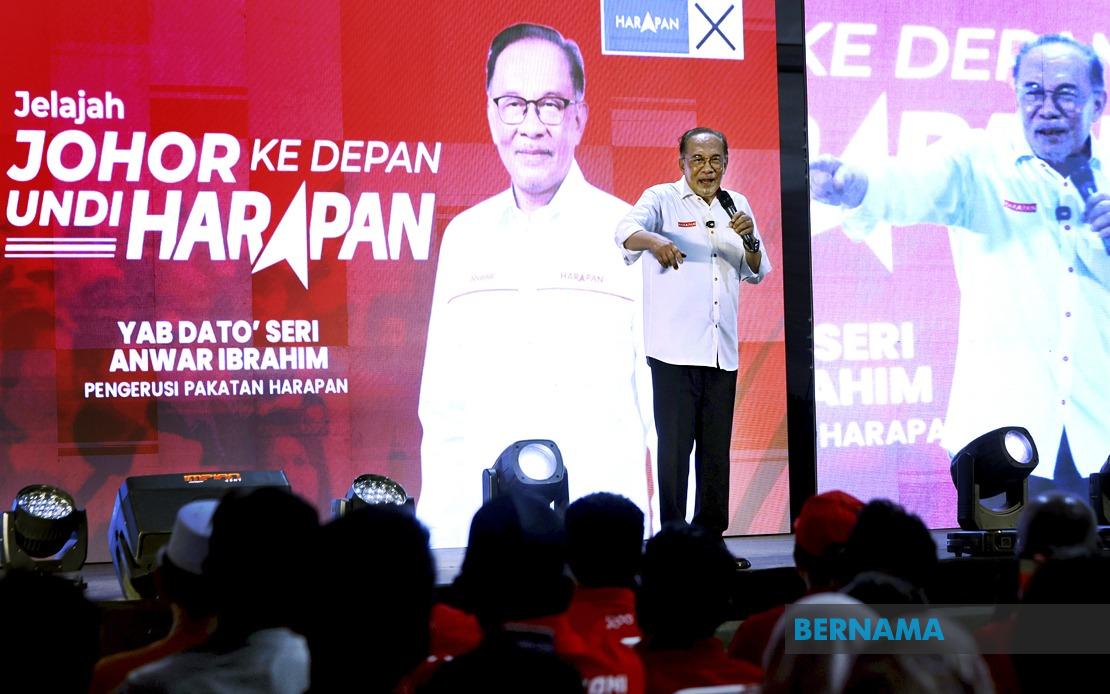
Prime Minister Datuk Seri Anwar Ibrahim has declared that Malaysia's era of systematic plunder and patronage politics has definitively ended, underlining the MADANI Government's resolve to establish transparent governance structures free from entrenched corruption. Speaking at a campaign engagement in Sungai Mati during the Johor State Election period, Anwar positioned anti-corruption efforts as central to his administration's identity, contrasting his vision sharply with what he characterised as the discredited practices of predecessor regimes.
At the heart of Anwar's message lies a fundamental reframing of leadership selection criteria. Rather than perpetuating divisions based on ethnicity or communal identity, he argued that voters should evaluate candidates exclusively on grounds of integrity and honesty. This represents a deliberate pivot away from the politics of narrow racial mobilisation, which Anwar suggested has historically provided cover for corrupt elites to consolidate power while concealing their misconduct. By explicitly endorsing leaders of all backgrounds—emphasising that he welcomes "Malays who are good, honest and not corrupt" and "Chinese who are good and not corrupt"—Anwar articulated a meritocratic framework that challenges the assumption that electoral legitimacy derives primarily from ethnic representation.
The Prime Minister's emphasis on systemic cleansing carries particular weight given Malaysia's recent political turbulence and repeated corruption scandals involving figures across multiple administrations. He framed the restoration of public wealth to the people as the government's overriding priority, asserting that every ringgit of Malaysia's resources must be deployed for genuine public benefit rather than private enrichment. This language reflects broader public expectations that the MADANI administration, formed following significant electoral shifts, would dismantle the informal structures and patronage networks that have historically enabled high-level corruption to flourish with impunity.
Crucially, Anwar's pledge of non-protection for corrupt officials extends beyond rhetorical commitment. By explicitly stating that "no one would be protected by the government if found to be involved in corruption during his tenure," he signalled willingness to pursue accountability regardless of political affiliation or personal connections. This stance carries particular significance in the Malaysian context, where selective enforcement and political calculations have previously insulated connected individuals from prosecution. The assertion that the government would "safeguard the system" and terminate practices of nepotistic contract allocation addresses specific grievances about how state resources have been historically diverted.
The Johor campaign setting provided a strategic platform for these messages. With 172 candidates contesting 56 state seats in the 16th Johor State Election scheduled for July 11, the state election represented a critical test of public appetite for the anti-corruption agenda. Anwar's eight campaign engagements across two days in Johor, culminating in this address alongside Penang Chief Minister Chow Kon Yeow and Ledang MP Syed Ibrahim Syed Noh, demonstrated the intensity of effort to mobilise support around integrity-focused governance. The participation of the Penang Chief Minister underscored the cross-state coordination of the Pakatan Harapan coalition in promoting a unified anti-corruption narrative.
Anwar's characterisation of opposition tactics as driven by "personal agenda to regain control of the federal government" reflects the intensely competitive political environment surrounding these elections. By framing opposition activity as self-interested rather than principled, he attempted to delegitimise alternative narratives about governance and economic management. This rhetorical strategy serves to consolidate support among voters inclined toward the MADANI coalition by suggesting that challenging the government's authority would merely restore the discredited practices of previous administrations.
The specific reference to the ending of what Anwar termed the "culture of plunder"—encompassing nepotistic contract awards, family enrichment schemes, and spousal involvement in government procurement—acknowledges the most visible and corrosive manifestations of corruption that eroded public trust in Malaysian institutions. By explicitly naming these practices as intolerable aberrations rather than legitimate political conduct, Anwar sought to establish clear moral and ethical boundaries for acceptable governance behaviour. This represents a departure from periods when such arrangements operated within accepted political norms or proceeded with minimal public accountability.
For Southeast Asian observers, Anwar's anti-corruption positioning carries broader regional implications. Malaysia's experience with large-scale corruption scandals, institutional weakness in combating high-level malfeasance, and challenges in maintaining public confidence in democratic institutions mirror challenges faced across the region. The MADANI Government's commitment to demonstrable anti-corruption action will be closely observed by other Southeast Asian governments and civil society actors evaluating whether institutional reform can genuinely arrest entrenched corruption networks.
The call for Johor voters to exercise their franchise by rejecting leaders lacking integrity framed the upcoming state election as a choice between continuity with discredited practices and transformation toward cleaner governance. Anwar's appeal to voters' forward-looking concern for "the future of the next generation" positioned anti-corruption efforts not merely as technical administrative improvements but as fundamental to Malaysia's long-term development trajectory and capacity to compete globally. By linking integrity to international standing and economic competitiveness, he connected anti-corruption messaging to aspirational development goals that resonate across different voter demographics.

