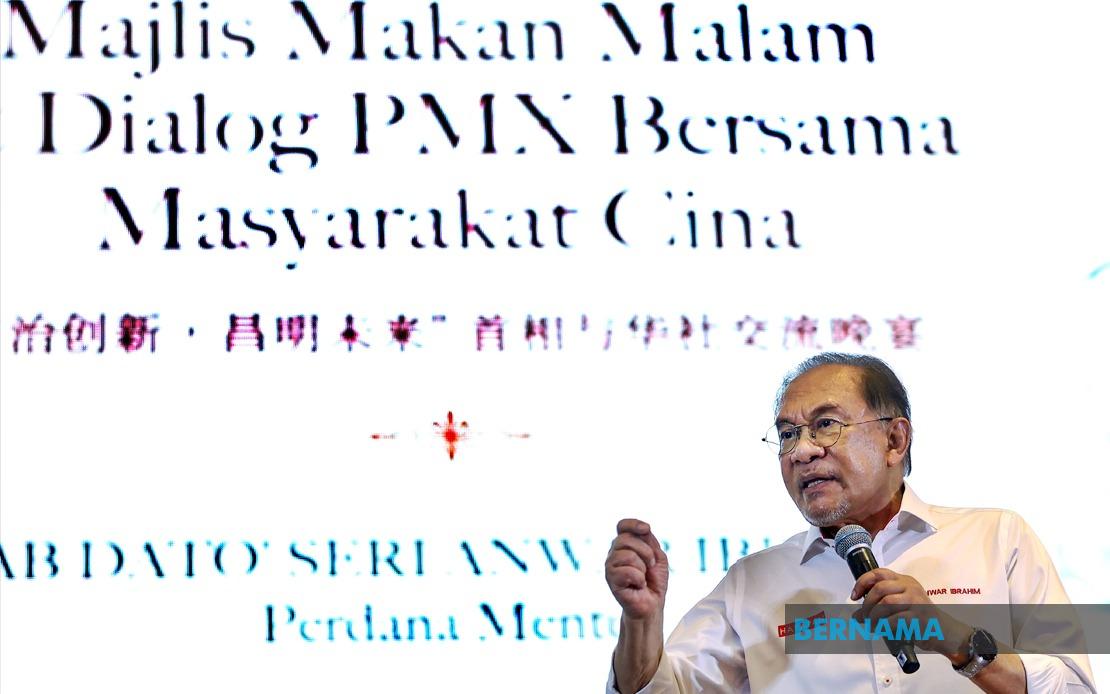
Prime Minister Datuk Seri Anwar Ibrahim has reiterated his determination to guide Malaysia toward prosperity and national success, framing his leadership mission around principles of fairness, integrity, and community engagement. Speaking at a gathering with members of the Chinese community in Johor Bahru on July 4, Anwar articulated a vision that transcends conventional political messaging, positioning himself as a leader genuinely invested in the welfare of every Malaysian regardless of ethnic background or religious affiliation.
At this stage of his political career, Anwar emphasized that his primary objective is not the accumulation of power or the pursuit of partisan interests, but rather the establishment of an administrative framework characterized by transparency and equitable service delivery. The Prime Minister's remarks reflect a conscious effort to distance his leadership from historical patterns of patronage and communal favoritism that have long characterized Malaysian politics, suggesting instead a governance model founded on universal principles of justice and equal treatment.
Anwar's language at the event underscored the personal dimension of his political philosophy. By invoking his advancing age and the finite nature of his tenure, he shifted the conversation away from immediate policy achievements toward the intangible yet powerful concept of legacy. His statement that he wishes to be remembered as someone who genuinely cared for the Malaysian people—and who earned reciprocal affection in return—reveals an understanding that political legitimacy ultimately rests on public sentiment and historical judgment rather than institutional machinery alone.
The emphasis on engagement across societal segments addresses a persistent vulnerability in Malaysian governance: the perception that elected leaders selectively represent certain communities while marginalizing others. By explicitly positioning himself as a servant of all citizens, Anwar attempts to rebuild public confidence in political institutions at a time when trust in government remains fragile following years of institutional crises and corruption scandals that preceded his administration.
For Malaysian readers, particularly those from minority communities who have historically navigated complex relationships with power structures, Anwar's commitment to non-racial leadership carries particular significance. The deliberate choice to deliver these remarks at a Chinese community dinner amplifies the symbolic importance of the message, suggesting that inclusive governance is not merely rhetorical flourish but a practical operating principle guiding his administration.
The presence of Parti Keadilan Rakyat vice president and Selangor Menteri Besar Datuk Seri Amirudin Shari at the event underscores the alignment between the federal leadership and state-level PKR administration on these governance principles. This institutional coherence signals that the commitment to fair and clean governance extends beyond the Prime Minister's personal philosophy to encompass the broader political coalition supporting the government.
Anwar's framing of national development as a collective responsibility—echoed in his statement that Malaysians must "look after this nation as our own, together"—reorients the conversation from top-down governance to participatory citizenship. This philosophical pivot suggests that in his view, national success cannot be achieved through hierarchical imposition of policy but requires voluntary cooperation and shared investment from all communities in the nation's wellbeing.
The temporal language employed by Anwar—references to his age, impending retirement, and posthumous reputation—carries psychological weight. By centering his legacy rather than immediate accomplishments, he invites the Malaysian public to evaluate his administration not through the lens of quarterly economic statistics or policy announcements, but through the accumulated record of how leadership was exercised and whether it genuinely served national interests over factional ones.
For Southeast Asian observers, Anwar's emphasis on clean governance reflects broader regional conversations about democratic resilience and anti-corruption initiatives. As neighboring countries grapple with similar challenges of restoring public confidence in institutions after periods of governance failures, Malaysia's trajectory under renewed leadership provides instructive lessons about the possibilities and limitations of reform-oriented governance within existing constitutional frameworks.
The substantive challenge ahead lies in translating these aspirational statements into institutional reforms and tangible policy outcomes. While rhetorical commitments to fair and inclusive leadership resonate with Malaysian audiences fatigued by decades of divisive politics, the genuine test of Anwar's legacy will be whether his administration implements structural changes that embed these principles into governance mechanisms rather than relying on personality-driven leadership.
For the Chinese community specifically, the dinner event represented more than symbolic inclusion; it reflected acknowledgment of their economic importance and social contribution to national development. The direct engagement between the Prime Minister and this constituency suggests a recognition that political stability and national prosperity depend on maintaining confidence among all major demographic groups through visible, consistent commitment to their interests and dignity.

