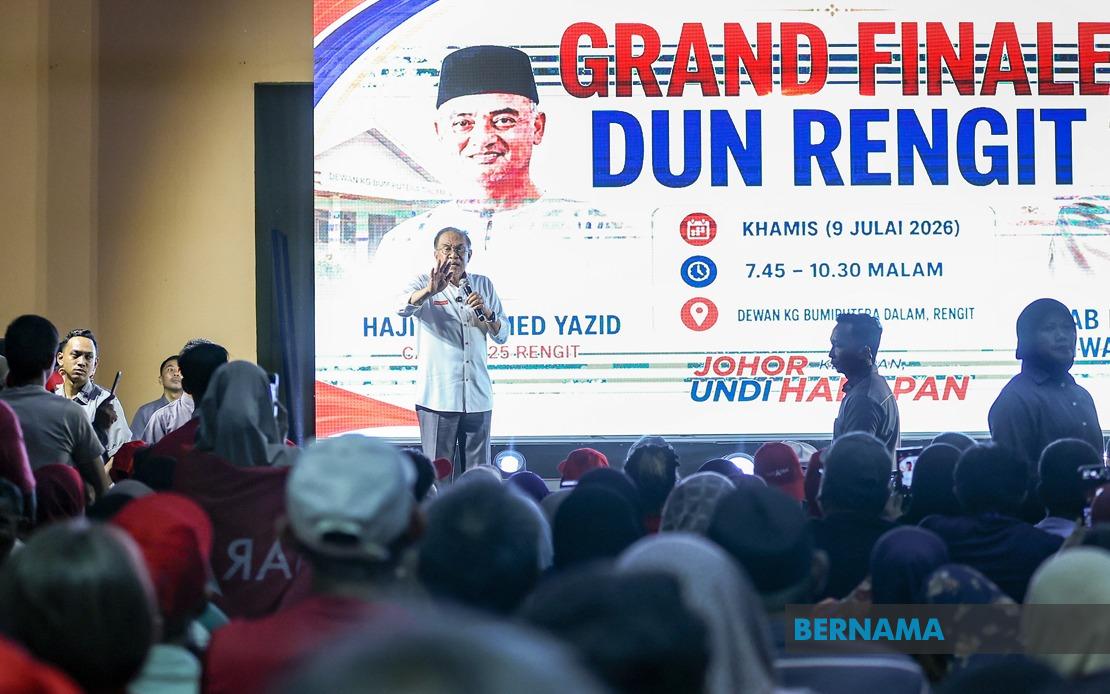
Prime Minister Datuk Seri Anwar Ibrahim has pledged concrete action to resolve chronic infrastructure deficiencies affecting Rengit residents, particularly the poor condition of health facilities and recurring water supply disruptions that have plagued the constituency for years. Addressing a Pakatan Harapan campaign rally in Batu Pahat on July 9, Anwar framed the commitment as essential to maintaining Johor's standing as a developed state, insisting that fundamental services cannot be compromised regardless of political considerations.
The prime minister articulated a broader philosophy concerning basic rights and government responsibility, asserting that access to clean water and functional healthcare must never be deprioritized or delayed. His remarks carried pointed criticism of the current state of infrastructure, with Anwar emphasizing the contradiction inherent in medical facilities that themselves require treatment rather than delivering it. This rhetorical approach directly challenges any administration that has allowed such deterioration and signals federal-level attention to grassroots grievances that often escape higher-order political discourse.
Anwar's visit to Rengit formed part of a more extensive campaigning operation across Johor on the night before the 16th state election, with the prime minister attending three separate PH events to energize the party machinery and demonstrate federal backing for state-level candidates. The strategic deployment of the prime minister's time and voice underscores the national government's investment in securing parliamentary-aligned representation in the state assembly, recognizing that divided governance can complicate policy implementation and development delivery.
The Rengit campaign event featured Sri Gading MP Aminolhuda Hassan, who leads Parti Amanah Negara in Johor, alongside Yazid Abu Bakar, the PH candidate contesting the Rengit seat. The presence of senior party figures alongside local candidates reinforced the message that infrastructure promises carry backing from multiple governance tiers, a recognition that voters increasingly demand assurance that political commitments translate into actual resource allocation and project execution.
Beyond infrastructure, Anwar articulated a comprehensive agenda positioning water, housing, education, and healthcare as non-negotiable government priorities that should anchor policymaking at all levels. This framing reflects growing public dissatisfaction with ad-hoc approaches to service delivery and establishes a platform against which future performance can be measured, creating implicit accountability mechanisms that extend beyond typical campaign rhetoric.
The prime minister also addressed governance culture more broadly, calling on government officials and community leaders to uphold integrity and resist the temptation to exploit their positions for personal enrichment. This appeal speaks to a persistent concern across Malaysian constituencies about whether elected representatives serve constituents or private interests, a distinction that influences voter behavior and shapes public trust in democratic institutions. Anwar's emphasis on this theme suggests awareness that infrastructure problems often reflect not merely budgetary constraints but also governance failures rooted in corruption or mismanagement.
Anwar's appeal for voters to elect representatives aligned with the Federal Government reflects the strategic calculus underlying Malaysian politics, where state governments controlled by opposition parties frequently encounter obstacles in accessing federal development funds or implementing national programs. He argued explicitly that alignment reduces friction in executing initiatives and improves efficiency and effectiveness, a pragmatic if contentious argument that opponents characterize as leveraging federal resources for partisan advantage.
For this election, Pakatan Harapan is presenting candidates across all 56 state assembly seats, with 20 from PKR, 19 from Amanah, and 17 from DAP. This full-seat strategy reflects confidence in the coalition's organizational capacity and resonance with Johor voters, though it also represents higher-stakes positioning given that any shortfall will be measured against maximum possible gains. The breadth of PH's challenge stands in contrast to a wider field where 172 candidates total are contesting, indicating competitive races across numerous constituencies.
For Malaysian observers, Anwar's infrastructure commitments and governance messaging acquire particular significance within the context of post-election implementation. Johor, as the country's second-largest state by population and a significant economic contributor, serves as a testing ground for how federal administrations deliver on campaign promises. Success in addressing long-standing Rengit grievances would strengthen claims of renewed governance standards, while failure would reinforce skepticism that electoral cycles produce meaningful change in service delivery patterns affecting ordinary Malaysians.
The specific focus on Rengit reflects broader dynamics affecting secondary towns throughout Malaysia, where aging infrastructure and inconsistent service provision create voter frustration that transcends typical partisan divides. Water supply instability and deteriorating health facilities represent tangible daily inconveniences that shape lived experience more directly than abstract policy debates, making infrastructure accountability increasingly central to electoral contests at state and federal levels across Southeast Asia's developed democracies.

