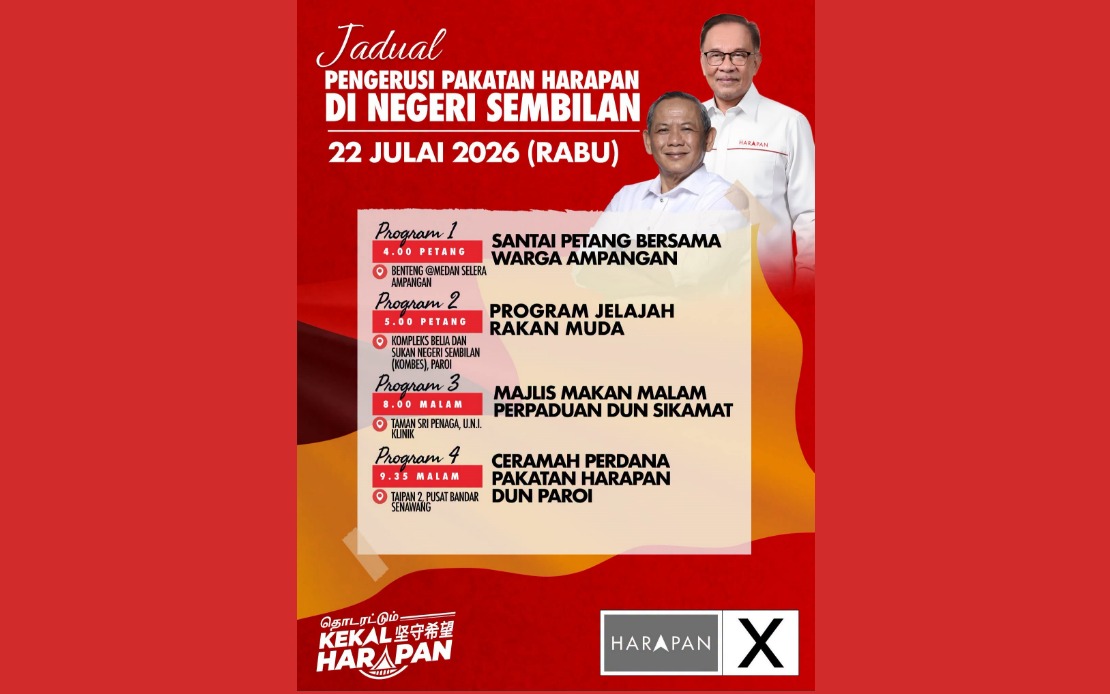
Prime Minister Datuk Seri Anwar Ibrahim is mounting an intensive campaign operation in Negeri Sembilan on July 22, deploying his political star power to invigorate Pakatan Harapan's efforts to maintain its grip on the state government. The PKR president's involvement on the fifth day of campaigning signals the coalition's determination to capitalise on its existing advantages and neutralise opposition gains in what shapes as a closely contested contest.
Anwar's presence carries substantial symbolic and strategic weight. As the nation's chief executive and the de facto leader of Pakatan Harapan, his personal endorsement of the coalition's campaign message and its candidates carries credibility that few other figures can match. His decision to commit significant time to the campaign underscores the importance Kuala Lumpur places on retaining Negeri Sembilan, a state that Pakatan Harapan captured in the 2022 general election and has held through the leadership of Datuk Seri Aminuddin Harun. The electoral stakes are high, as losing control of any state represents a potential psychological blow to the federal government's narrative of electoral strength and governing competence.
The itinerary Anwar has scheduled demonstrates a methodical approach to voter engagement. Beginning at 4 pm with the "Santai Petang Bersama Warga Ampangan" community gathering at Benteng @ Medan Selera Ampangan, he will proceed directly to the "Jelajah Rakan Muda" youth programme at the Negeri Sembilan Youth and Sports Complex in Paroi. The deliberate inclusion of youth-focused activities reflects the coalition's understanding that younger voters represent a demographic that Pakatan Harapan must energise to sustain its electoral coalition. Following these grassroots engagements, Anwar will attend the Sikamat constituency unity dinner before culminating his evening at the Paroi mega "ceramah" (public talk) in Pusat Bandar Senawang, a format allowing him to address larger audiences directly.
Packatan Harapan's campaign apparatus is organised around a 10-point manifesto unveiled earlier in the week, positioning the coalition's platform as a blueprint for advancing Negeri Sembilan's development trajectory. The manifesto emphasises creating a state that is simultaneously more economically advanced and more socially inclusive, messaging designed to appeal across demographic divides. Anwar's participation in promoting this document carries his personal imprimatur, lending executive gravitas to promises that might otherwise remain abstractions to voters evaluating competing platforms.
The coalition's internal composition across the 36 state seats contested reveals a carefully calibrated power-sharing arrangement. Pakatan Harapan has allocated 16 of its 36 candidacies to PKR, 11 to DAP, and nine to Amanah, a distribution reflecting both the parties' relative strengths within the coalition and the need to maintain internal balance. This structure prevents any single component party from dominating the state apparatus, a governance principle essential to coalition stability. For Negeri Sembilan voters, these numbers signal the likelihood that whoever administers the state will do so through negotiated consensus rather than unilateral decision-making.
The Election Commission's scheduling creates a compressed campaign window that shapes tactical considerations for all parties. Early voting is set for July 28, providing a mechanism through which overseas voters, military personnel, and individuals with mobility constraints can cast ballots ahead of the main polling day. The August 1 polling date itself offers Pakatan Harapan a timeline within which to build momentum and sustain voter attention, though the compressed schedule also limits the time available for campaign operations to gain traction or for opposition parties to recover from strategic missteps.
For Malaysian observers, the Negeri Sembilan election serves as a significant bellwether. The state's relatively balanced demographic composition, encompassing urban centres, suburban sprawl, and rural constituencies, makes it representative of broader electoral trends affecting the peninsula. Should Pakatan Harapan retain the state comfortably, it would validate the coalition's narrative that it continues to command voter confidence and can govern at both federal and state levels. Conversely, a close result or opposition breakthrough would suggest that the coalition's support has eroded or that local grievances have overridden national political considerations.
For Southeast Asian context, Malaysia's federation of states means that state-level electoral outcomes carry distinct political consequences distinct from federal politics. Unlike unitary systems where subnational elections are primarily referendums on national leadership, Malaysian state elections determine the composition of distinct governing institutions with genuine powers. This multi-level system creates opportunities for political parties to maintain presence and influence even when excluded from federal office, a dynamic that encourages competitive federalism and prevents excessive centralisation of political power.
Anwar's campaign itinerary reflects practical recognition that personal retail politics remains consequential in Malaysian electoral contests, notwithstanding the growing prominence of digital campaigning and social media. Direct encounters with voters in community settings, youth programmes, and public meetings allow political leaders to articulate their vision while simultaneously gauging voter sentiment and adjusting messaging in real time. The ceramah tradition, an established format in Malaysian political communication, provides a platform for substantive policy discussion that transcends the soundbite constraints of media interviews or digital advertising.
The broader significance of Anwar's Negeri Sembilan campaign extends beyond the immediate electoral contest. His personal engagement signals to Pakatan Harapan's rank-and-file party members and supporters that the national leadership is committed to defending the coalition's territorial holdings and expanding where possible. For Aminuddin Harun, the state Menteri Besar, having the Prime Minister actively campaigning on his behalf provides validation of his stewardship and suggests federal backing for continued leadership. This coalition reinforcement is essential to maintaining the internal discipline and morale that coalitions require to function effectively under electoral pressure.

