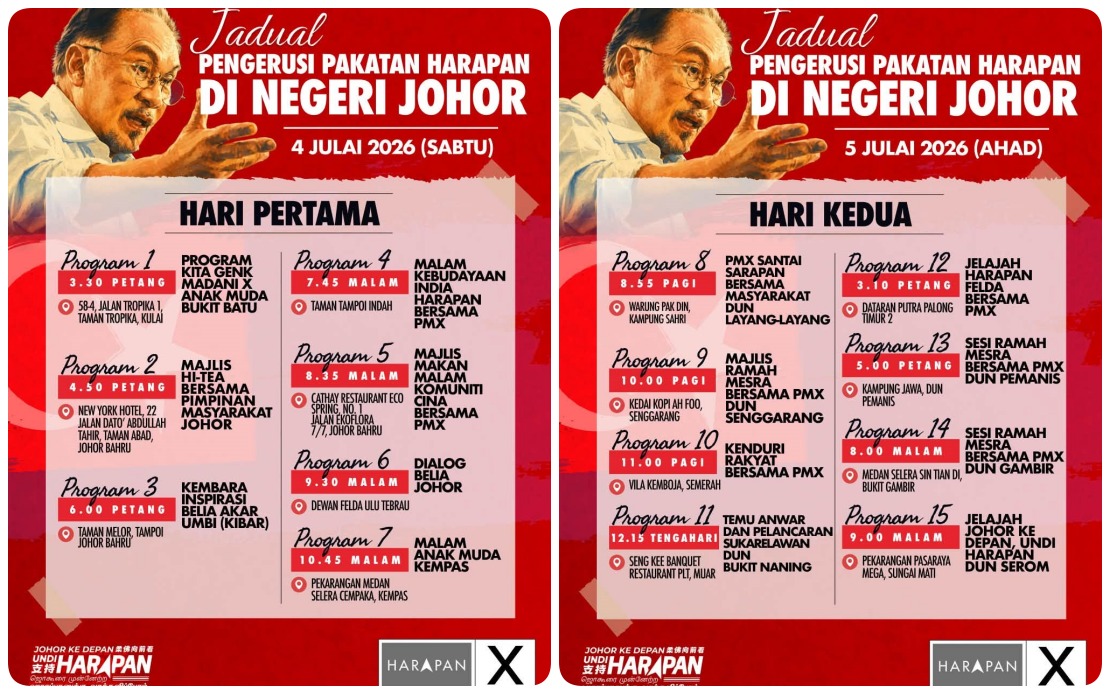
Prime Minister Datuk Seri Anwar Ibrahim is throwing Pakatan Harapan's full weight behind its Johor campaign, with the coalition chairman scheduling seven distinct events across the state today to energise supporters and reach voters from multiple constituencies. The intensive roadshow reflects the strategic importance of Johor to PH's electoral ambitions, particularly as Malaysia's second-largest state remains a bellwether for broader political sentiment in the peninsula. Anwar's packed itinerary demonstrates the coalition's determination to consolidate support ahead of polling day on July 11.
The Prime Minister's campaign schedule reveals a carefully calibrated approach designed to appeal to diverse voter segments. His early interactions with grassroots voters will transition into a high tea reception at a Johor Bahru hotel at 4.50 pm, where community leaders and professionals from various sectors are expected to gather. This segment of the schedule illustrates how PH is attempting to build bridges with established civic and business figures who hold considerable influence in their networks, potentially swaying undecided voters through respected intermediaries rather than relying solely on rallies and mass events.
Youth engagement represents a critical pillar of today's campaign activities. The scheduled Johor Youth Dialogue session at the Felda Ulu Tebrau Hall at 9.30 pm underscores PH's recognition that younger voters, who comprise a significant proportion of the electorate, require distinct messaging and platforms distinct from traditional campaigning. Young Malaysians have demonstrated increasing political consciousness and willingness to vote, making direct engagement essential for any coalition seeking to secure a convincing mandate. By programming dedicated youth sessions, PH acknowledges that one-size-fits-all politics no longer resonates with this demographic.
Anwar's campaign momentum is set to accelerate further tomorrow, with eight additional programmes planned across the state. This consecutive day of intensive campaigning signals PH's confidence in its organisational capacity and underscores the coalition's view that this election represents a crucial test of voter confidence. The staggered schedule across multiple days also serves a practical purpose, allowing campaign machinery to maintain momentum without exhausting volunteers and organisers, while ensuring media coverage extends across multiple news cycles.
Pakatan Harapan is contesting all 56 state assembly seats in Johor, with representation from its three primary constituent parties. The Democratic Action Party is fielding 17 candidates, Parti Keadilan Rakyat is putting forward 20 candidates, and Amanah is running 19 hopefuls. This distribution reflects the detailed negotiations between coalition members on seat allocation, a process that itself carries political implications for intra-coalition dynamics. Each party's allocated seats typically correspond to perceived strengths in particular constituencies, suggesting a sophisticated understanding of ground realities.
The overall electoral battlefield is considerably crowded, with 172 candidates competing for the 56 Johor assembly seats. This figure indicates that opposition and independent candidates remain active players in the state's political landscape, suggesting the election outcome cannot be taken for granted by any contending force. Higher candidate numbers typically reflect greater political fragmentation and can result in unpredictable outcomes, particularly in marginal seats where opposition votes might be split across multiple candidates. PH must therefore work to concentrate support behind its official nominees.
The election timeline provides a compressed campaign window. With polling scheduled for July 11 and early voting slated for July 7, campaigns have only days to make their final pitches to voters. This tight schedule places additional pressure on both major coalitions to execute flawlessly, leaving little room for course corrections if messaging falters or unforeseen events disrupt campaign plans. The early voting date may also suppress overall turnout if working voters find it inconvenient to vote early, potentially affecting which coalition's support base proves more mobilised.
Johor's political significance extends beyond its 56 seats. As Malaysia's second-largest state by population and a major economic contributor, Johor serves as a barometer for broader political trends. Election results here often foreshadow performance in subsequent national or other state contests, making this campaign a crucial testing ground for PH's current political strategy and messaging under Anwar's leadership. Any significant losses would damage the coalition's momentum heading into potential future elections, while strong performance would validate PH's governing approach and electoral positioning.
Anwar's personal involvement in the campaign also carries symbolic weight. The Prime Minister's decision to dedicate consecutive days to Johor campaigning underscores how central this state is to PH's political calculations. His physical presence lends legitimacy to coalition candidates and allows him to make direct appeals to voters based on his government's record and vision. For supporters, Anwar's involvement signals that PH takes Johor seriously; for critics, his campaign presence invites scrutiny of government performance in areas like cost of living and development spending.
The campaign events spanning grassroots engagement, community leadership forums, and youth dialogues demonstrate PH's multi-tiered approach to electoral politics. Rather than relying on single campaign formats, the coalition is tailoring its pitch to specific audiences, recognising that voters in different life stages and circumstances respond to different appeals. This segmented approach requires substantial organisational sophistication and suggests PH believes it possesses both the resources and strategic clarity needed to execute such a complex campaign across multiple constituencies simultaneously.

