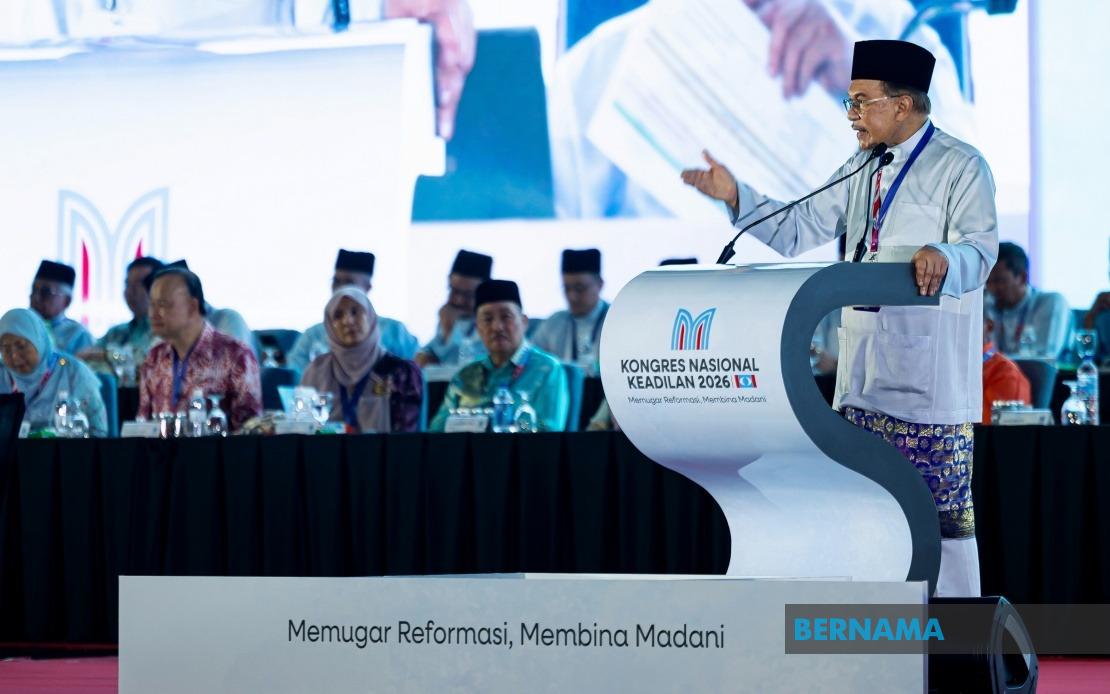
Prime Minister Datuk Seri Anwar Ibrahim moved swiftly on Thursday to extinguish speculation about tension between himself and Deputy Prime Minister Datuk Seri Dr Ahmad Zahid Hamidi, publicly reaffirming their collaborative partnership while addressing the 2026 PKR National Congress in Melaka. Speaking to journalists after his keynote address at the Melaka International Trade Centre, the PKR president and Pakatan Harapan chairman dismissed recent commentary from former Rembau Member of Parliament Khairy Jamaluddin as merely a personal interpretation rather than an accurate reflection of the current political landscape.
Khairy's assertions, made the previous day, had painted a darker picture of the coalition's cohesion, claiming that confidence between the Prime Minister and the UMNO supremo had reached unprecedented lows since the formation of the Unity Government following the 15th General Election in 2022. The former Youth chief had pointed to mounting friction between Barisan Nasional and Pakatan Harapan, citing BN's strategic decision to align with Perikatan Nasional during the Negeri Sembilan state election as evidence of a deepening rift in the governing coalition.
Anwar's response revealed a philosophical divide in how different political figures interpret coalition dynamics. He contrasted his own approach with Khairy's worldview, noting that where the former UMNO figure gravitates toward viewing situations through a lens of conflict and confrontation, he himself privileges dialogue and reconciliation. This distinction underscores a fundamental tension within Malaysia's political establishment between those who see coalition governance as inherently adversarial and those who believe consensus-building and peaceful resolution are possible within such complex arrangements.
During his congressional address at the gathering of PKR delegates, Anwar had specifically acknowledged Ahmad Zahid's instrumental contribution to establishing the Unity Government in its early formation stages. By publicly thanking the UMNO president and Barisan Nasional leadership for their role in facilitating this unprecedented political arrangement, the Prime Minister sought to reinforce the narrative that the two largest coalition partners remain aligned on fundamental governance principles. This public commendation served as both a substantive expression of appreciation and a strategic political signal to party members and the broader public.
The timing of Anwar's remarks is significant within the context of Malaysian coalition politics. The Unity Government, born from the fractious aftermath of GE15 in November 2022, represented an extraordinary convergence of Pakatan Harapan and Barisan Nasional—parties that had spent years in bitter electoral competition. Such arrangements require constant tending and communication to prevent accumulated grievances from hardening into permanent fractures. The decision by BN to cooperate with PN in state-level politics, as occurred in Negeri Sembilan, inevitably raises questions about whether coalition partners remain committed to a unified national strategy or are pursuing independent political interests.
Anwar's emphasis on resolution through discussion rather than confrontation reflects both his personal political philosophy and a practical necessity of managing a coalition government where no single bloc commands an absolute parliamentary majority. The presence of independent MPs and the fragmented nature of Malaysian politics means that maintaining goodwill among coalition partners is not merely about ideology—it is fundamental to governmental survival. When fissures appear, whether real or perceived, they immediately threaten the stability upon which all partners depend for implementing their legislative agenda.
The broader context involves substantive policy disagreements that periodically surface between the two major coalition components. Questions about constitutional reform, judicial independence, anti-corruption initiatives, and the pace of institutional change have at times seen Pakatan Harapan and Barisan Nasional adopt different public positions. These divergences, while often portrayed as minor tactical adjustments, occasionally reflect deeper anxieties about the direction of governance and the coalition's long-term viability.
For Malaysian observers and political analysts, the episode highlights the precarious equilibrium upon which the Unity Government rests. Coalition partners must simultaneously present a united front to the electorate and media while managing internal disagreements that inevitably arise from fundamentally different political bases and historical rivalries. Anwar's insistence that differences can be resolved through peaceful discussion, rather than escalation, suggests a determination to prevent minor friction from becoming major schisms. Yet the very fact that such reassurances require public articulation every few months indicates the inherent fragility of the arrangement.
The coming months will test whether Anwar's optimistic characterization of coalition health accurately reflects political reality. State elections, expected parliamentary business, and the management of competing economic and social priorities will continue to create pressure points. How successfully Anwar and Ahmad Zahid navigate these challenges will determine not only their personal working relationship but the viability of Malaysia's experiment in cross-party governance—a model that contrasts sharply with the winner-takes-all adversarialism that has traditionally dominated Malaysian politics.

