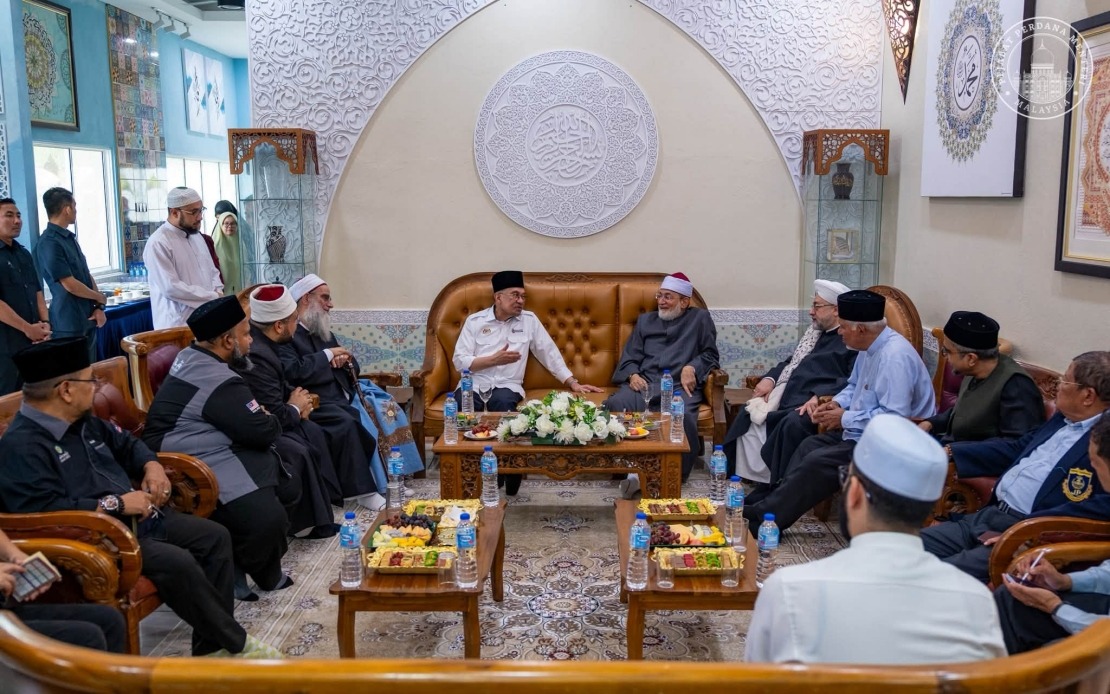
Prime Minister Datuk Seri Anwar Ibrahim has conducted a special visit to three internationally recognised Islamic scholars currently staying in Malaysia, underlining the government's commitment to engaging with leading religious figures and intellectual traditions. The unscheduled meeting, which took place at Nasyrul Quran, represents part of the Prime Minister's broader engagement strategy with the global Muslim intellectual community and reflects Malaysia's positioning as a destination for Islamic learning and dialogue.
The three scholars hosting the Prime Minister represent diverse yet complementary areas of Islamic scholarship. Egyptian hadith scholar Al-Fadhil Al-Allamah Al-Muhaddith Syeikh Dr Mustafa al-Nadwi Al-Hasani brings specialised expertise in the science of hadith, one of the most rigorous disciplines within Islamic studies. His presence in Malaysia indicates the country's appeal as a hub for advanced Islamic theological training and intellectual exchange. Alongside him is Al-Fadhil Al-Allamah Al-Muqri' Syeikh Dr Ahmad Isa Al-Ma'sarawy, whose international reputation as a Quran reciter and scholar has made him a sought-after figure for religious guidance and Quranic instruction across Muslim communities worldwide.
The third scholar, Al-Fadhil Al-Syeikh Maulana Al-Sayyid Afeefuddin Al-Jailani, holds the significant custodial role over the waqf, mosque and maqam associated with Syeikh Abdul Qadir Al-Jailani, one of Islam's most influential spiritual figures. This particular scholar's presence carries symbolic weight, as it connects Malaysia to broader Islamic heritage traditions and institutional practices that span centuries and multiple continents. The combination of these three scholarly figures suggests a deliberate curation of expertise spanning textual Islamic sciences, devotional practices, and institutional Islamic heritage.
According to the Prime Minister's social media statement, the visit was motivated by multiple objectives beyond mere courtesy calls. Anwar sought the scholars' counsel on matters presumably relating to governance, policy direction, and the spiritual dimensions of nation-building. The request for their prayers carries particular significance in Islamic tradition, where the duas of renowned scholars are considered especially valued and impactful. This spiritual dimension complements the secular aspects of governance and reflects an understanding that religious and temporal leadership operate within interconnected spheres.
The Prime Minister's emphasis on appreciating the scholars' willingness to visit Malaysia and share their knowledge suggests an active effort by the government to position the country as an intellectual destination within the Muslim world. Such visits by internationally acclaimed Islamic figures enhance Malaysia's soft power credentials and contribute to the nation's reputation as a centre for Islamic learning. This has practical implications for Malaysia's educational institutions, from universities to Islamic study centres, which benefit from exposure to world-class scholarship and pedagogical approaches.
Anwar's stated desire to promote Islamic teachings throughout Malaysia reflects a longstanding government priority, yet one that requires ongoing engagement with credible international voices to maintain authenticity and contemporary relevance. The presence of these scholars provides opportunities for knowledge dissemination through public lectures, academic seminars, and media engagements that reach broader audiences. Such activities can reinvigorate discussions around Islamic values and their application to modern challenges, from social cohesion to ethical governance.
The Prime Minister's reference to building a virtuous, knowledgeable society living in harmony encapsulates a vision that extends beyond religious instruction into broader social engineering and national development objectives. By associating these goals explicitly with the visiting scholars' contributions, the government signals that Islamic intellectual resources are viewed as instrumental to achieving inclusive, harmonious national outcomes. This framing is particularly relevant for Malaysia's diverse, multi-religious society, where demonstrating that Islamic scholarship supports pluralistic values and social stability serves important political and social functions.
The timing and nature of such visits merit consideration within Malaysia's current political and social landscape. Following periods of communal tensions and polarisation, high-level engagement with moderate, internationally respected Islamic scholars can serve to reinforce narratives of Islam as intellectually sophisticated, spiritually enriching, and fundamentally compatible with democratic governance and interfaith coexistence. The scholars' academic credentials and international standing lend credibility to such messaging in ways that purely domestic voices might not achieve.
For Southeast Asian readers, this development illustrates how Malaysia continues to navigate its role as a Muslim-majority nation within a diverse regional context. The engagement with prominent Islamic scholars demonstrates that Malaysia's government takes seriously the intellectual and spiritual dimensions of Islamic identity while maintaining commitments to pluralism and democratic governance. This balancing act remains central to Malaysia's appeal within ASEAN and globally, distinguishing it from more ideologically rigid approaches to religion and statecraft.
The visit also highlights the transnational nature of Islamic scholarly networks and how Malaysia remains embedded within broader circuits of religious knowledge and authority. The presence of scholars from Egypt and Iraq—representing the Middle Eastern heartland of Islamic civilization—reinforces Malaysia's connections to these historical centres while positioning the country not merely as a recipient of Islamic knowledge but as an active participant in global Islamic intellectual discourse. Such positioning has implications for Malaysia's educational exports, religious soft power, and regional leadership aspirations.

