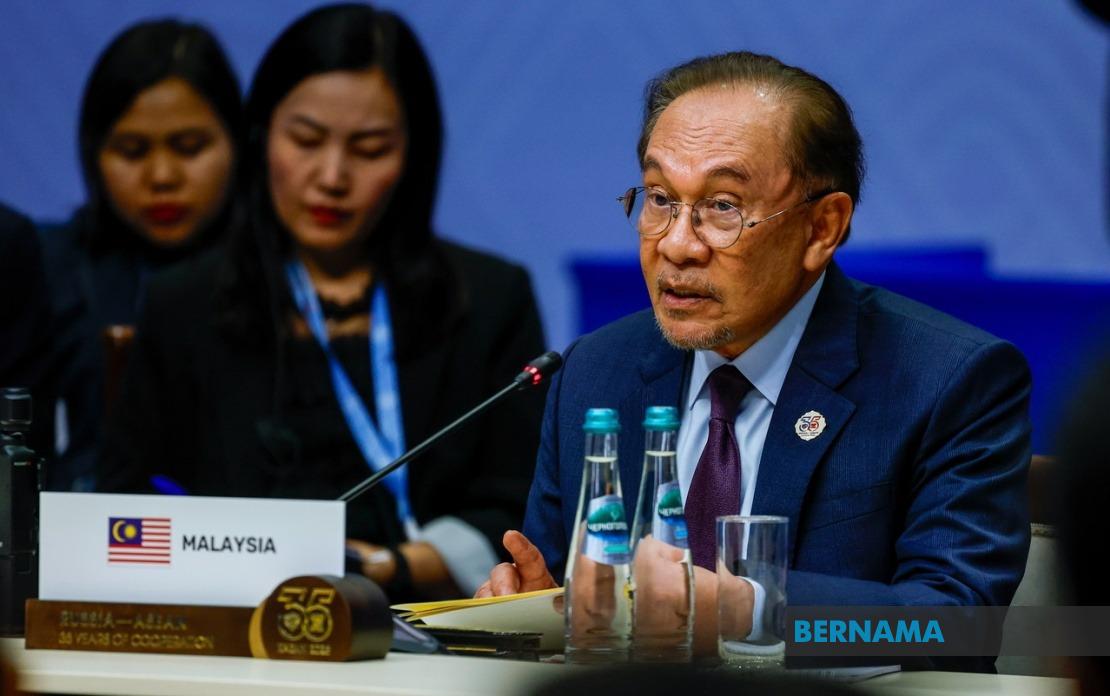
Prime Minister Datuk Seri Anwar Ibrahim has called on ASEAN and Russia to deepen their strategic partnership across a broad spectrum of areas, underscoring the critical role that sustained dialogue and diplomatic engagement must play in resolving conflicts and managing escalating geopolitical tensions. Speaking during a plenary session of the ASEAN-Russia Commemorative Summit in Kazan on June 18, Anwar positioned the gathering as a significant platform for advancing cooperation in an increasingly volatile and unpredictable international order characterised by multiple competing interests and rising uncertainty.
The Malaysian Prime Minister's remarks reflected a carefully calibrated approach to engaging Russia at a time when many Western nations maintain strained relations with Moscow over its invasion of Ukraine. By emphasising shared interests and common challenges, Anwar sought to establish common ground while maintaining Malaysia's principled positions on international law and peaceful resolution mechanisms. His intervention highlighted the distinctive role ASEAN plays as a neutral diplomatic space where major powers can engage constructively despite broader geopolitical divisions.
Anwar identified several priority areas for expanded ASEAN-Russia engagement, encompassing traditional sectors alongside emerging frontiers. Trade and investment partnerships form the economic bedrock of the relationship, offering mutual benefits as ASEAN countries seek diversified markets and investment sources while Russia pursues new trading partners amid international sanctions. The digital economy and information technology sectors represent fast-growing opportunities, particularly as Southeast Asian nations accelerate their digital transformation and require technology expertise and partnerships.
Artificial intelligence and advanced science and technology cooperation emerged as central themes in the Prime Minister's vision for future relations. As AI reshapes global competitiveness and development trajectories, ASEAN nations recognise the importance of engaging major technological powers to avoid being left behind in this transformative revolution. Energy security, another dimension Anwar emphasised, holds particular resonance for ASEAN members dependent on stable global energy markets and seeking alternatives to traditional supply chains. The halal industry represents a uniquely strategic sector where Muslim-majority ASEAN nations and Russia's growing Muslim population can establish mutually beneficial commercial and regulatory frameworks.
Food security cooperation addresses a vulnerability exposed during recent global crises, as ASEAN nations depend significantly on grain imports and agricultural trade. People-to-people exchanges form the cultural and social scaffolding that sustains long-term diplomatic relationships beyond official channels, fostering understanding and building networks that transcend government-to-government interactions. This multifaceted approach reflects a comprehensive vision of partnership extending beyond narrow security or economic concerns into domains affecting everyday citizens' lives.
The summit's timing carries particular significance as it commemorates thirty-five years of ASEAN-Russia relations dating back to 1991, marking the transition from Cold War antagonism to structured engagement. This historical milestone provided an opportunity to assess accumulated achievements and establish new benchmarks for future cooperation. The gathering assembled the highest echelons of ASEAN leadership, including Philippines President Ferdinand Marcos Jr, who currently holds the ASEAN chair, alongside representatives from all ten member states, signalling the association's collective commitment to the Russia relationship despite divergent national interests across the bloc.
Anwar reiterated Malaysia's foundational commitment to resolving disputes through dialogue, understanding, and adherence to international law—principles that carry heightened importance given escalating tensions in multiple regions. His invocation of these principles served multiple audiences: reassuring Western nations of ASEAN's commitment to rules-based order while signalling to Russia that ASEAN engagement need not come at the expense of fundamental values. This balancing act exemplifies the diplomatic tightrope ASEAN nations continuously walk when engaging major powers with competing interests.
The Prime Minister devoted particular attention to developments in West Asia, articulating Malaysia's demand for immediate cessation of hostilities in Gaza and unrestricted humanitarian access to affected populations. Malaysia's condemnation of Israeli military expansion into Lebanon and any attacks on the United Nations Interim Force in Lebanon underscored the association's broader commitment to regional stability and international humanitarian principles. These statements, delivered at a Russia-centric summit, also reflected the interconnected nature of global geopolitics where regional conflicts have consequences extending far beyond immediate areas of conflict.
The summit is expected to produce four substantive outcome documents that will shape ASEAN-Russia relations for years to come. The Kazan Declaration commemorating thirty-five years of relations serves as a symbolic reaffirmation of the partnership's enduring value. Separate joint statements on energy and cultural cooperation target specific sectors identified as priorities, while a comprehensive plan of action for 2026-2030 provides detailed implementation mechanisms and timelines. These documents reflect the maturation of ASEAN-Russia relations from symbolic engagement toward institutionalised cooperation with measurable objectives and accountability frameworks.
For Malaysia specifically, the summit reinforces the country's role as a significant voice within ASEAN on strategic matters and its commitment to non-alignment and pragmatic engagement with all major powers. Malaysia's diplomatic positioning benefits from active participation in forums like this, where it can shape ASEAN consensus positions and demonstrate its ability to navigate complex international relationships. The summit also creates opportunities for bilateral Malaysia-Russia cooperation in identified priority sectors, potentially expanding commercial ties and deepening mutual understanding.
The broader implications extend to Southeast Asia's regional order, where maintaining stable relationships with major external powers remains essential for preserving ASEAN's centrality and freedom of manoeuvre. As great power competition intensifies globally, ASEAN's ability to engage Russia, China, the United States, and India in balanced fashion becomes increasingly difficult yet increasingly valuable. The Kazan summit demonstrates that despite international divisions, structured dialogue platforms and shared interests can sustain productive engagement even amid broader strategic contestation.
Looking ahead, the success of the new 2026-2030 partnership plan will depend on effective implementation and demonstrated commitment from all participants. Whether cooperation in emerging areas like artificial intelligence and digital technology can translate into concrete commercial benefits and capacity building for Southeast Asian nations remains to be seen. The summit, however, establishes the foundation for enhanced engagement and demonstrates that ASEAN's approach of principled pragmatism—advancing cooperation while maintaining commitments to international law and peaceful dispute resolution—remains viable even in an increasingly polarised global environment.

