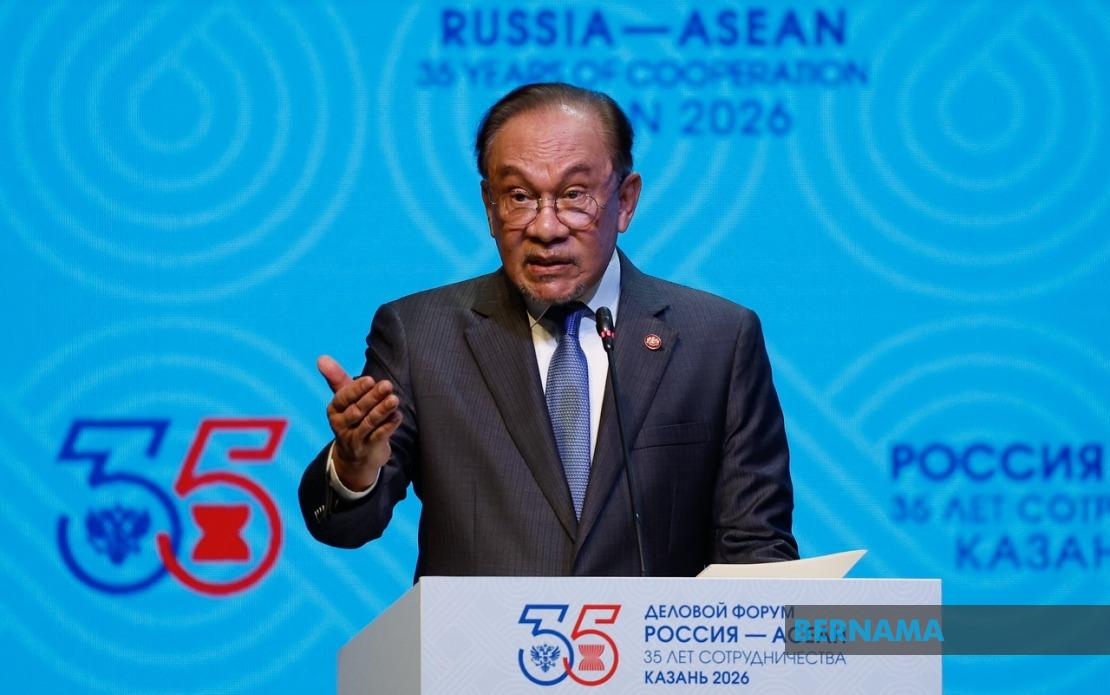
Prime Minister Datuk Seri Anwar Ibrahim has signalled Malaysia's commitment to strengthening ties with Russia across multiple fronts, using his participation in the ASEAN-Russia Business Forum in Kazan to outline an ambitious agenda for expanded bilateral and regional cooperation. Speaking to international media at the forum, Anwar presented a vision of partnership that extends far beyond the limited economic engagement that currently characterises the relationship between the 10-nation Southeast Asian bloc and Moscow, framing the untapped potential as a significant strategic opportunity for both sides.
The Malaysian premier's remarks reflect a broader recalibration of ASEAN's foreign policy approach, one that seeks to diversify partnerships and reduce overreliance on traditional Western and Chinese economic ties. Anwar emphasised that while ASEAN maintains established economic relationships with the United States, China and India, the corresponding relationship with Russia remains substantially underutilised. This positioning is particularly significant given the geopolitical complexities of the current international environment, where middle powers like Malaysia are attempting to navigate competing great-power interests while maximising their own strategic autonomy.
During his address at the forum, Anwar identified several concrete areas where ASEAN-Russia collaboration could yield substantial dividends. Energy security emerged as a primary focus, reflecting Southeast Asia's ongoing vulnerability to global energy price fluctuations and its dependence on stable supply chains. Beyond energy, he highlighted possibilities in cybersecurity—a domain of increasing critical importance given the region's rapid digitalisation—alongside agriculture, digital technology advancement, scientific research partnerships, and higher education initiatives. This multisectoral approach suggests recognition that sustainable partnerships require diversified engagement rather than reliance on single commodity or sector relationships.
Anwar's characterisation of his recent meeting with Russian President Vladimir Putin as productive underscored the personal diplomatic dimension underlying these broader discussions. The focus on economic cooperation and energy security in those exchanges indicates that Russia views Southeast Asia as a viable market for its energy exports and technological services, particularly as Western sanctions have prompted Moscow to seek alternative partnerships in Asia. For Malaysia and other ASEAN members, such engagement potentially offers leverage in negotiating favourable terms for energy supplies while reducing vulnerability to supply disruptions from other quarters.
The Prime Minister also directed attention toward Tatarstan specifically, the Russian republic hosting the forum, noting its impressive track record of technological innovation, scientific advancement, defence capabilities, and educational excellence. This focus on regional expertise within Russia opens possibilities for knowledge-sharing arrangements and sectoral partnerships that could benefit Malaysian institutions and businesses. Tatarstan's particular strengths in technology and research align with ASEAN's broader development aspirations, suggesting concrete areas where targeted collaboration could yield mutual benefits.
Beyond the conventional terrain of economic and strategic cooperation, Anwar devoted considerable attention to cultural dimensions of the relationship, a perspective that distinguishes his diplomatic approach. His interest in Russian literature—particularly the works of Leo Tolstoy, Anton Chekhov, and Boris Pasternak—and his evident enjoyment of Russian musical traditions reflects a belief that sustained international relationships require emotional and cultural foundations alongside institutional frameworks. The fact that numerous Russian literary classics have been translated into Malay further enables such cultural engagement at grassroots levels, potentially fostering deeper popular understanding between societies.
This cultural emphasis carries particular diplomatic significance in a region historically shaped by diverse influences and multiple overlapping identities. By stressing the importance of poetry, literature, and artistic exchange alongside technological and economic cooperation, Anwar articulated a holistic vision of international relations that prioritises human understanding. His point that effective international partnerships must encompass the complete spectrum of human endeavour—not merely technological advancement or commercial gain—represents a refreshing counterweight to purely transactional approaches to diplomacy. Such positioning may also resonate with Russian policymakers who value cultural soft power and civilisational dialogue.
The Prime Minister's remarks on international affairs, particularly regarding tensions involving Iran and the United States, reflected Malaysia's longstanding commitment to mediating regional conflicts and advocating peaceful resolutions. His references to discussions with Iranian President Masoud Pezeshkian, Pakistani Prime Minister Shehbaz Sharif, Egyptian President Abdel Fattah El-Sisi, and Turkish President Recep Tayyip Erdogan illustrate Malaysia's positioning within a network of moderate Muslim-majority and regional powers seeking diplomatic solutions to Middle Eastern tensions. This coalition-building approach enhances Malaysia's influence while advancing a specifically Southeast Asian perspective on global security challenges.
Anwar's sustained emphasis on the humanitarian catastrophe in Gaza demonstrated his willingness to address contentious international issues directly, even in diplomatic forums focused on economic cooperation. His criticism of international double standards in applying human rights principles and democratic values reflected frustration widely shared across the Muslim-majority world regarding perceived selective enforcement of international norms. By linking Gaza to broader questions about the credibility of the international system, Anwar positioned Malaysia within a constituency of nations questioning whether existing global governance structures genuinely serve universal principles or primarily serve powerful states' interests.
The two-day working visit to Kazan for the ASEAN-Russia Commemorative Summit represents a significant moment in regional diplomacy. Malaysia's participation, and specifically Anwar's energetic engagement with the forum's substantive agenda, signals that ASEAN takes seriously the prospect of deeper Russia relations despite their current limitations. The breadth of topics addressed—spanning energy security, cultural exchange, technological cooperation, and geopolitical crisis management—suggests that future ASEAN-Russia engagement may develop along multiple parallel tracks rather than remaining confined to narrow commercial interests.
For Malaysian policymakers and businesses, Anwar's remarks open pathways worth exploring. Energy partnerships with Russia could diversify supply sources and improve negotiating positions with traditional suppliers. Technological and scientific collaborations could accelerate Malaysia's digital transformation and research capabilities. Educational exchanges could expose Malaysian talent to different perspectives and methodologies. Simultaneously, the emphasis on cultural understanding may help counteract misconceptions and historical suspicions that have limited deeper engagement between ASEAN societies and Russia.
The visit also positioned Malaysia as a constructive bridge-builder between ASEAN and Russia—a role consistent with its broader foreign policy objectives. By demonstrating serious engagement with Russia while maintaining other partnerships, Malaysia demonstrates the non-aligned approach increasingly characteristic of regional powers. This balanced positioning enhances Malaysia's relevance in a multipolar world where flexibility and multiple partnership options constitute strategic assets rather than liabilities.