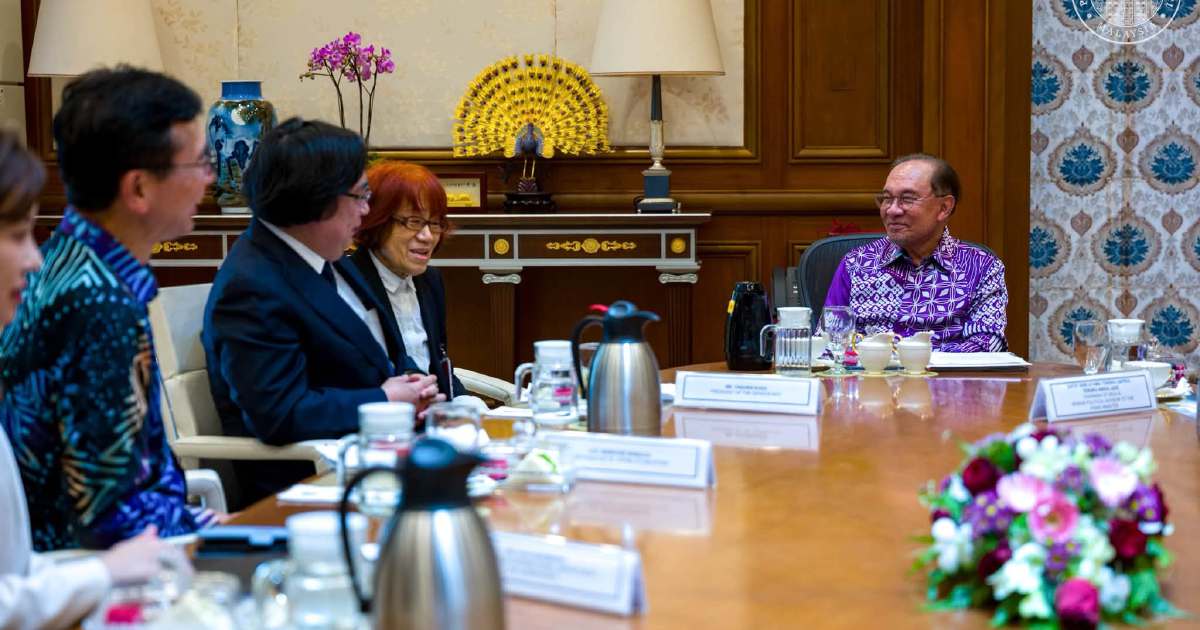
Prime Minister Datuk Seri Anwar Ibrahim received Genron NPO president Yasushi Kudo at his office in Kuala Lumpur, marking a significant engagement aimed at reinforcing the bilateral relationship between Malaysia and Japan at a time when both nations are navigating complex regional security dynamics and economic interdependencies.
The meeting reflected Malaysia's commitment to maintaining robust channels of communication with influential Japanese policy networks and think tanks. Genron NPO, a leading non-profit public policy research organisation in Japan, has historically played a pivotal role in shaping diplomatic discourse and informing high-level government decision-making on international affairs across the Asia-Pacific region.
Discussions during the courtesy call concentrated on mechanisms for deepening strategic dialogue between the two countries. This reflects broader efforts by Malaysia to strengthen partnerships with developed democracies in the region, particularly as Malaysia seeks to position itself as a hub for regional cooperation and economic integration. Japan remains one of Malaysia's most significant trading partners and a major source of foreign direct investment, making the relationship critical to both nations' long-term economic strategies.
The engagement with Kudo's delegation suggests an interest in exploring how formal and informal diplomatic channels can be better utilised to address shared concerns ranging from trade and investment facilitation to regional security architecture. Japanese think tanks like Genron NPO often serve as trusted intermediaries for candid discussions on sensitive policy matters that might not be easily addressed through official diplomatic channels.
Malaysia-Japan relations have historically been characterised by strong economic ties and cultural affinity. Japan has long been a provider of advanced technology transfer, manufacturing expertise, and significant investment in Malaysia's manufacturing and service sectors. The relationship extends beyond commerce to include defence cooperation, educational exchanges, and people-to-people connections that have steadily deepened over decades.
The timing of this engagement carries particular significance given the broader strategic environment in Southeast Asia. With geopolitical tensions in the region intensifying, both Malaysia and Japan have demonstrated interest in multilateral platforms and dialogue mechanisms that can facilitate consensus-building and reduce misunderstandings among regional actors. Malaysia's non-aligned foreign policy stance complements Japan's cautious approach to regional security matters, creating space for collaborative problem-solving.
Genron NPO's involvement in this discussion underscores how non-state actors and civil society organisations have become increasingly important in shaping bilateral relations and regional diplomacy. The think tank brings intellectual resources, policy expertise, and access to influential networks that can contribute substantially to the evolution of Malaysia-Japan engagement beyond traditional diplomatic formalities.
The strategic dialogue focus suggests both nations recognise that contemporary challenges—from supply chain disruptions to climate change and technological competition—require sustained, multi-level cooperation. Malaysia's growing emphasis on economic transformation and digital innovation aligns well with Japan's expertise in these domains, pointing toward potential areas for enhanced partnership.
From Malaysia's perspective, strengthening ties with Japan serves multiple strategic objectives. It reinforces Malaysia's positioning as a reliable partner for developed economies while maintaining the country's independence in foreign policy matters. For Japan, engagement with Malaysia reflects its broader Indo-Pacific strategy and commitment to supporting stable, prosperous nations in Southeast Asia that can serve as anchors for regional peace and prosperity.
The emphasis on strategic dialogue during this meeting also hints at potential areas for future cooperation on issues affecting the broader Asia-Pacific region, where Malaysia and Japan share interests in maintaining freedom of navigation, rules-based international order, and peaceful resolution of disputes. Both nations have demonstrated commitment to ASEAN-led mechanisms and regional stability frameworks.
Looking forward, such high-level engagements and think tank involvement can be expected to inform future policy initiatives and bilateral initiatives. The meeting represents a continuation of steady diplomatic engagement that has characterised Malaysia-Japan relations and suggests both nations are committed to exploring new dimensions of cooperation that address contemporary challenges while building on historical foundations of mutual respect and shared interests.

