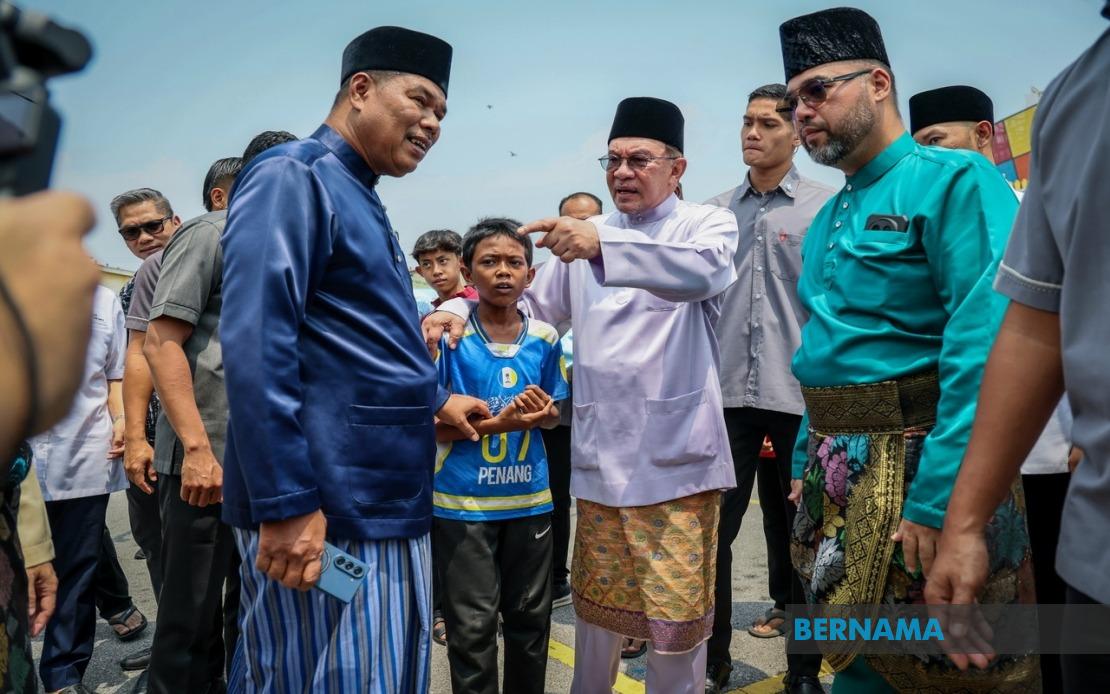
Prime Minister Datuk Seri Anwar Ibrahim has made clear that the corruption investigation and prosecution of former Human Resources Minister Datuk Seri M. Saravanan are exclusively the domain of law enforcement and legal authorities, with no role for the prime ministerial office. Speaking to reporters after Friday prayers at Masjid Sembilang in Butterworth on August 28, Anwar underscored the separation between political leadership and judicial processes, emphasising that once a matter enters the investigation or prosecution phase, it falls entirely within the purview of independent agencies.
Anwar's remarks came in response to a letter Saravanan had submitted to the Prime Minister regarding his legal situation. The former minister had previously clarified that the correspondence was not an attempt to solicit political intervention or seek dismissal of the charges against him, but rather a communication to articulate his perspective on the matter. This distinction proved important in how Anwar framed his response, suggesting that even explanatory correspondence from an accused does not warrant prime ministerial engagement with active cases.
The Malaysian Anti-Corruption Commission and the Attorney-General's Chambers, Anwar stated, are the appropriate bodies to conduct thorough examinations of the allegations. By explicitly naming these institutions and declaring them custodians of the process, the Prime Minister reinforced institutional boundaries and signalled adherence to the rule of law—a commitment that carries particular weight in Malaysia's governance context, where perceptions of political interference in enforcement have historically fuelled public concern.
Saravanan, representing the Tapah constituency, appeared before the Kuala Lumpur Sessions Court on the same morning to enter his plea. He maintained a not guilty stance against three corruption charges, with the allegations involving RM1.097 million allegedly linked to the approval of foreign worker quotas. The specificity of the charge amount and the nature of the alleged impropriety—relating to labour quota administration—point to a matter with operational implications for Malaysia's foreign worker regulatory framework, an issue of growing economic and social importance in the country.
The case carries broader implications for Malaysia's anti-corruption enforcement architecture. The MACC has intensified its focus on high-level officials in recent years, and prosecutions of sitting or recently-serving ministers remain relatively uncommon, making each such case a test of the institution's independence and the government's willingness to allow investigations to proceed without political obstruction. Anwar's statement essentially announces that his administration will respect this process, a position that attempts to demonstrate political maturity in handling sensitive matters involving former colleagues.
The Tapah MP's decision to send correspondence to the Prime Minister, despite disclaiming any intention to seek intervention, reflects an understanding of political dynamics that remains relevant across Southeast Asia. Even in jurisdictions with robust rule-of-law commitments, accused persons sometimes attempt to establish a narrative of transparency or fairness through communication with executive leadership. Anwar's handling of this—by acknowledging receipt but firmly demarcating it outside his purview—illustrates an effort to construct a reputation for institutional respect that distinguishes his administration from its predecessors in the public eye.
Corruption allegations involving foreign worker quota approvals are particularly resonant in Malaysia, where the management of migrant labour intersects with economic interests, law enforcement, and public sentiment about national resources. The alleged manipulation of these systems through corrupt approvals carries implications not merely for the individual accused but for the integrity of administrative machinery affecting millions of workers and multiple stakeholder interests. This context renders the case more than a personalised legal matter; it touches on systemic governance concerns.
The MACC's investigation into Saravanan aligns with a broader enforcement trajectory visible across Malaysia's public administration in recent years. High-profile prosecutions of officials from various administrations have proceeded with varying degrees of institutional independence, and observers of Malaysian governance increasingly scrutinise whether cases move forward without political direction or obstruction. Anwar's explicit declaration that such matters are outside his remit therefore functions partly as a signal to both domestic and international audiences about his administration's approach to accountability.
For Saravanan, the forthcoming legal process will determine guilt or innocence through evidence presented in court. The three corruption charges will be examined on their merits before a judicial officer, with the prosecution and defence presenting their respective cases. The formal plea of not guilty establishes the starting position, with the burden of proof resting on the state to demonstrate the allegations beyond reasonable doubt. This standard judicial pathway now supersedes any narrative about political connections or ministerial office.
Anwar's positioning also reflects political calculation. By maintaining distance from an active case, he avoids accusations of selective enforcement or political persecution—charges that have periodically shadowed Malaysian administrations. Simultaneously, refusing to intervene demonstrates to anti-corruption advocates and institutional partners that the Prime Minister respects investigative autonomy. This approach attempts to occupy a middle ground between perceptions of strength and perceptions of fairness, crucial in Malaysia's politically fractious environment where governance legitimacy remains contested.
The distinction between political leadership and law enforcement that Anwar articulated carries implications extending beyond this single case. It establishes a precedent in how his administration frames its relationship with independent institutions, contributing to broader questions about whether Malaysia is consolidating institutional protections against political manipulation or whether these boundaries remain contingent on political circumstances. Each such statement and action accumulates into a governance record that either reinforces or undermines public confidence in institutional independence.

