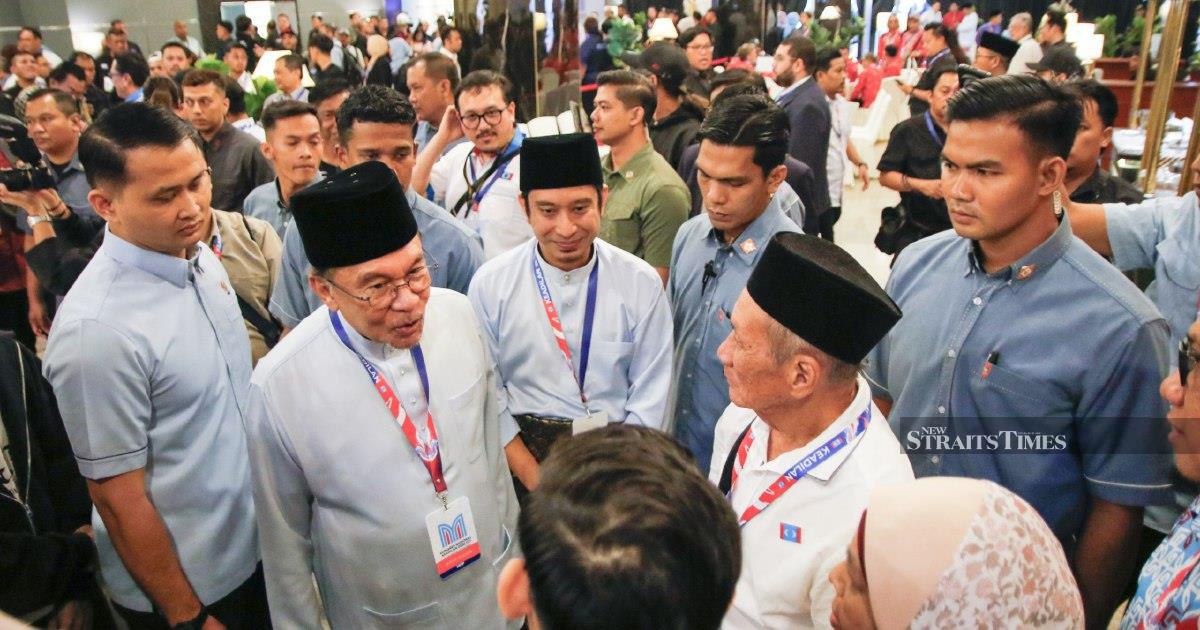
Prime Minister Datuk Seri Anwar Ibrahim moved swiftly on Wednesday to quell rumours of discord within the country's top leadership, categorically stating that his partnership with Deputy Prime Minister Datuk Seri Dr Ahmad Zahid Hamidi continues to operate effectively. Speaking in Ayer Keroh, Anwar addressed growing public concern about possible tensions at the highest echelons of government, a matter that carries significant implications for Malaysia's political stability and the broader agenda of his administration.
The timing of Anwar's statement underscores the sensitivity surrounding leadership cohesion in Malaysian politics. In a nation where coalition governments have historically fragmented over perceived slights or policy disagreements, any visible crack in the relationship between a prime minister and deputy prime minister can trigger wider speculation about government collapse or ministerial reshuffles. By intervening directly to characterise the relationship as fundamentally sound, Anwar appears conscious of how interpretations of internal dynamics could affect investor confidence, parliamentary stability, and the public perception of his administration's capacity to govern.
The deputy prime minister's portfolio encompasses significant responsibilities within the federal government structure, making the quality of their working relationship material to Malaysia's operational governance. Zahid's influence extends across critical administrative and political networks that directly affect policy implementation and legislative progress. Any genuine deterioration in their professional engagement would create practical obstacles to decision-making and could embolden backbench MPs to question government direction or withdraw conditional support.
Anwar's denial reflects a broader pattern in Malaysian political life where leaders routinely face speculation about internal rifts, often amplified through social media and political gossip rather than substantive reporting. The Prime Minister's intervention suggests awareness that such narratives, whether grounded in reality or not, can accumulate into perceptions that weaken his political position. By making an explicit statement at a public venue, Anwar has created a record he can reference if rumours resurface, while also signalling to his coalition partners that he considers the relationship sufficiently important to address publicly.
The relationship between Anwar and Zahid carries particular historical weight. Both men come from substantial political backgrounds and maintain independent power bases, circumstances that occasionally generate tension in any leadership partnership. The fact that Anwar felt compelled to address this issue directly suggests that whispers about their working relationship had reached a threshold where silence might itself be interpreted as tacit acknowledgment of problems. In Malaysian political communication, what leaders choose to address publicly often matters as much as what they say about it.
From a Southeast Asian governance perspective, Malaysia's stability depends significantly on whether its senior leadership team functions cohesively. The region has witnessed instances where coalition governments fractured due to personal animosities or policy disagreements between top officials, creating vacuums that either invited external interference or triggered destabilising political manoeuvres. Anwar's statement can be understood partly as reassurance directed at international observers and trading partners who monitor Malaysian political health as part of their broader regional risk assessments.
The nature of deputy prime ministerial roles in Malaysian governance means that Zahid's portfolio and influence cannot be easily circumscribed or diminished without triggering the very crisis that Anwar seeks to avoid. Unlike ministerial positions that can be reshuffled with relative ease, removing or marginalising a deputy prime minister sends seismic signals through the coalition and opposition benches. This structural reality means that both leaders have incentives to maintain at least the appearance of operational harmony, regardless of underlying tensions.
Anwar's emphasis on ties remaining good "at the national level" contains subtle language that deserves examination. This phrasing might suggest compartmentalisation of their relationship, with national-level cooperation distinct from other dimensions of interaction. Such formulations often appear in political statements when leaders wish to deny fundamental problems while allowing for the possibility of disagreements on specific issues or decisions. This linguistic precision suggests Anwar has carefully calibrated his response.
The deputy prime minister's role under the current administration carries weight that extends beyond ceremonial functions. Malaysia's governance structure places the deputy prime minister in a position to influence cabinet decisions, parliamentary tactics, and coalition management. Should genuine friction develop between Anwar and Zahid without resolution, the consequences would ripple through multiple government functions and could eventually force a political reckoning. Anwar's preemptive statement appears designed to prevent speculation from crystallising into a genuine crisis.
For Malaysian citizens and observers, such denials raise the natural question of what prompted the statement in the first place. Political leaders rarely address matters unless they sense public awareness or concern. The fact that Anwar felt obliged to speak suggests that reports of tension had achieved sufficient circulation to require direct contradiction. This dynamic illustrates how political narratives in Malaysia gain momentum through informal channels before reaching mainstream attention.
Looking ahead, Anwar's statement establishes a public baseline against which future developments can be measured. Should visible discord between the two leaders emerge in coming months—through policy disagreements, differing public statements, or administrative conflicts—observers will reference today's denial as evidence that underlying problems had already surfaced. Conversely, if the administration demonstrates coordinated governance and aligned messaging, today's statement will be remembered as a wise preventive communication that helped stabilise perception of leadership unity.
The broader implications for Malaysia's political future remain substantial. Coalition governments depend on maintaining sufficient internal cohesion to weather inevitable policy disagreements and competitive jockeying for influence. By addressing rumours of internal discord directly and unequivocally, Anwar has signalled that his government takes such perceptions seriously and remains committed to projecting stability despite Malaysia's complex multi-party political environment.

