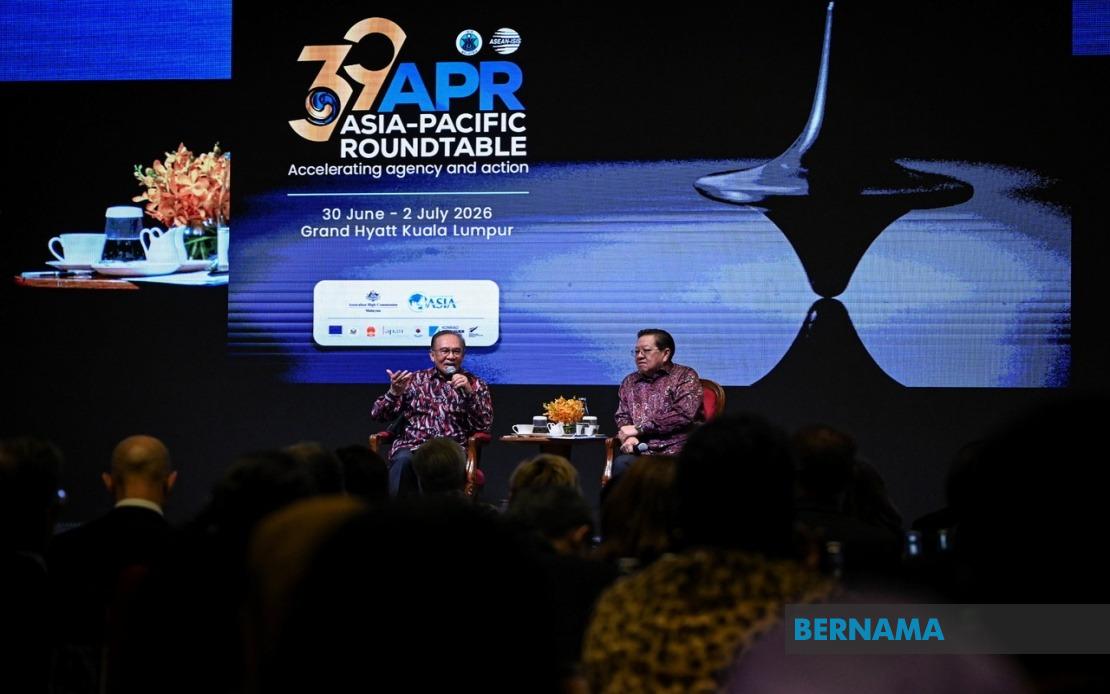
Prime Minister Datuk Seri Anwar Ibrahim has firmly rejected the pessimistic narrative surrounding the South China Sea, asserting that conflict is neither inevitable nor desirable for the region. Speaking during a question-and-answer session at the 39th Asia-Pacific Roundtable in Kuala Lumpur on Thursday, Anwar stressed that Malaysia's approach remains anchored in diplomacy, mutual understanding, and respect for international legal frameworks. His remarks come amid heightened international attention on maritime tensions in one of the world's most strategically important waterways, where overlapping territorial claims have long posed challenges to regional stability.
Anwar emphasised that Malaysia has successfully maintained substantive and constructive engagement with China despite the existence of maritime disputes in the South China Sea. Rather than allowing these disagreements to dominate bilateral relations, the Prime Minister has prioritised direct communication with Beijing's leadership, including personal discussions with President Xi Jinping and Premier Li Qiang. According to Anwar, these interactions have consistently produced positive outcomes, with no significant friction emerging between the two countries on this or other major policy matters. This pragmatic approach contrasts sharply with more alarmist depictions of Sino-Malaysian relations, suggesting that competing interests in contested waters need not preclude broader cooperation.
Central to Malaysia's diplomatic strategy is the reinforcement of multilateral frameworks designed to manage maritime disputes peacefully. Anwar highlighted China's expressed commitment to the United Nations Convention on the Law of the Sea, which establishes internationally recognised principles for maritime conduct. He also noted the ongoing negotiations between ASEAN and China on a Code of Conduct for the South China Sea, describing this initiative as a crucial mechanism for translating goodwill into concrete operational guidelines. The Prime Minister's emphasis on these institutional approaches reflects Malaysia's belief that establishing clear, mutually acceptable rules is far more effective than allowing fears and misunderstandings to drive policy.
The Malaysian leader cautioned observers and commentators against amplifying narratives that emphasise the likelihood of military confrontation in Southeast Asia. Such discourse, he suggested, can become self-fulfilling by creating unnecessary anxiety, hardening positions, and eroding the trust necessary for productive dialogue. Anwar's warning appears directed at international media outlets and think tanks that frequently publish conflict scenarios for the region. Instead, he advocated for ASEAN to remain steadfast in its commitment to diplomacy and sustained engagement with all stakeholders, including major powers with interests in regional waters.
Anwar also drew attention to ASEAN's historical success in maintaining peace across the region, attributing this achievement to the close personal relationships among member states' leaders. These relationships facilitate direct communication channels that allow differences to be addressed before they escalate into serious disputes. This emphasis on personal diplomacy and informal mechanisms reflects a distinctly Southeast Asian approach to conflict prevention, one that prioritises face-to-face engagement and quiet negotiation over public posturing. Malaysia itself benefits considerably from this consensus-oriented model, given its own exposure to maritime disputes and its desire to avoid polarisation within the regional grouping.
Beyond the South China Sea, Anwar demonstrated Malaysia's commitment to addressing longstanding regional issues through dialogue. He welcomed the continued commitment of Cambodia and Thailand to negotiate their border disagreements, acknowledging that many such disputes in Southeast Asia are historical legacies of the colonial era. By framing contemporary disputes within this broader historical context, Anwar suggested that their resolution requires patience, understanding, and recognition that borders drawn by colonial powers may not align perfectly with current geopolitical realities. His confidence that sustained dialogue and mutual trust will ultimately produce peaceful settlements reflects an optimistic but grounded assessment of regional conflict resolution potential.
The Prime Minister's remarks also carry implications for Malaysia's balancing act between major powers. As a country with significant economic and strategic interests tied to both China and Western nations, Malaysia must maintain relationships with multiple actors while avoiding being drawn into zero-sum competition. Anwar's rejection of conflict narratives suggests that Malaysia intends to resist pressure to choose sides in any putative confrontation, instead positioning itself as a voice for pragmatism and de-escalation. This approach aligns with ASEAN's official stance of centrality and non-alignment, though implementation remains challenging given the divergent interests of member states.
For Malaysian businesses and investors, the diplomatic emphasis on stability carries tangible benefits. The South China Sea remains vital for regional trade, with billions of dollars in commerce passing through its waters annually. Malaysian ports, manufacturing sectors, and logistics industries all depend on maritime security and freedom of navigation. By actively promoting dialogue and rule-based mechanisms for dispute resolution, Anwar is protecting these economic interests while also serving broader regional prosperity. Instability in the waterway would disrupt supply chains affecting everything from semiconductor exports to energy shipments that Malaysia depends upon.
Anwar's vision also encompasses broader institutional reform at the global level. He advocated for ASEAN and Malaysia to push for reforms of multilateral institutions, including the United Nations and the World Trade Organisation, ensuring that developing nations have meaningful voice in global governance. This positioning reflects Malaysia's conviction that more inclusive and representative international institutions would better serve regional interests and reduce the tendency for powerful nations to impose solutions unilaterally. By coupling his South China Sea commentary with calls for institutional reform, Anwar suggested that regional peace is inseparable from global governance structures that treat all nations fairly.
The practical implications of Anwar's stance are significant for Southeast Asia's trajectory over the coming years. If Malaysia and other ASEAN members can maintain the diplomatic momentum he describes, the region may avoid the military escalation that some observers fear. Conversely, if incidents at sea multiply or if external pressures force ASEAN members to take more explicit sides, the consensus-building approach Anwar champions could fracture. His comments therefore represent not merely rhetorical positioning but a substantive commitment to defending the diplomatic architecture that has underpinned regional peace for decades.
Looking ahead, Anwar's emphasis on dialogue and international law sets expectations for how Malaysia will navigate future maritime challenges. Rather than military buildups or inflammatory rhetoric, the Prime Minister has signalled that Malaysia will pursue negotiations, strengthen multilateral frameworks, and maintain bilateral channels even amid disagreements. This approach carries risks, as it requires sustained commitment from all parties and assumes that agreements reached will be honoured. Yet for a mid-sized power like Malaysia, diplomacy offers far better prospects than military competition with larger neighbours or major powers. Anwar's rejection of conflict narratives thus represents both a philosophical commitment to peace and a hardheaded assessment of Malaysia's interests in maintaining regional stability.

