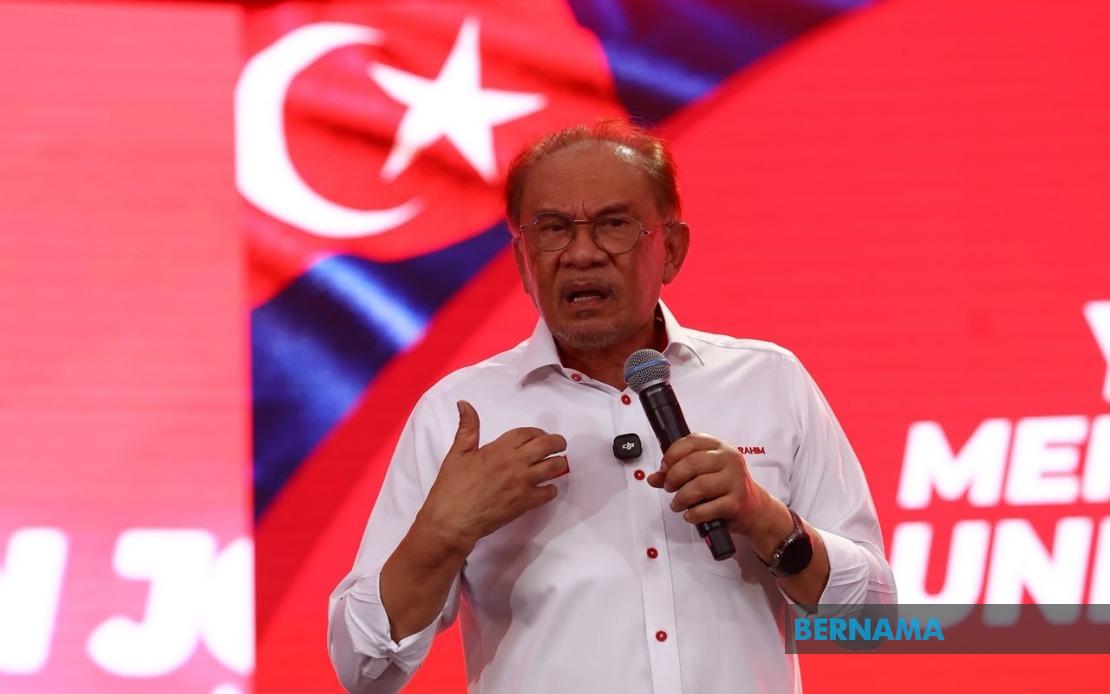
Prime Minister Datuk Seri Anwar Ibrahim has flatly rejected claims circulating on social media that he recently acquired a new BMW for his personal use, dismissing the allegations as false and misleading during a campaign event in Johor. Speaking at a Pakatan Harapan rally in Senggarang on July 9, Anwar directly addressed the controversy, emphasising that critics were spreading misinformation about his integrity and relationship with material possessions. The allegations had suggested a contradiction between his public messaging about poverty alleviation and his purported luxury purchases—a line of attack designed to undermine his credibility ahead of the 16th Johor state election scheduled for the following Saturday.
The Prime Minister's categorical denial came backed by an official statement from the Prime Minister's Department (JPM) and the Ceremonial and International Conference Secretariat Division (BIUPA), which clarified that the BMW in question is neither new nor privately owned. Instead, the vehicle represents an existing government asset that has long been part of BIUPA's fleet management portfolio, designated specifically for official government logistics and transport operations. This distinction is crucial in Malaysian political discourse, where questions about ministerial vehicle usage and asset ownership frequently surface as concerns about public resource stewardship and accountability. The distinction between personal ownership and government asset designation carries particular weight in a nation where transparency in leadership expenditure remains a contentious political issue.
Anwar also used the occasion to address another related matter—the Mercedes-Benz vehicle he currently uses as his primary official transportation. The Prime Minister clarified that this automobile was a gift bestowed upon him by His Majesty Sultan Ibrahim, King of Malaysia, and that he had deliberately registered the vehicle under the Prime Minister's Department rather than claiming personal ownership. This decision reflects a deliberate choice to maintain institutional rather than personal control over the asset, a position Anwar emphasised during his remarks. By explaining his approach to official vehicles in these terms, the Prime Minister sought to position himself as someone who respects the distinction between state resources and personal property—a stance he contrasted with unnamed others whom he suggested engage in corrupt practices.
The campaign remarks carried unmistakable political messaging. Anwar framed his explanation not merely as factual correction but as a broader statement about his character and governance philosophy. His statement that he is "not like others who siphon off and steal the people's money" represented a direct appeal to voters about integrity and trustworthiness, qualities that political campaigns centre on when personal probity comes under scrutiny. In Malaysian politics, where perception of leadership frequently determines electoral outcomes, such public clarifications serve a dual purpose—they address immediate controversies while simultaneously constructing or reinforcing a particular leadership narrative that Anwar wishes to project to the electorate.
The timing of these comments proved strategic, arriving as Pakatan Harapan campaigned across all 56 state seats in Johor. The coalition was mobilising its resources and personnel for what represented a significant electoral test, with the party clearly seeking to build momentum in a state that had historically alternated between different ruling coalitions. By addressing the BMW allegation directly and proactively at a campaign event rather than allowing it to circulate unchallenged through social media channels, Anwar's team demonstrated an awareness of how misinformation can accumulate and damage political prospects if left uncontested. The presence of high-profile coalition figures at the Senggarang event—including Communications Minister and PH communications director Datuk Fahmi Fadzil—underscored the importance Pakatan Harapan attached to this particular state election.
The broader context of these allegations reflects evolving patterns in Malaysian political communication. Social media has become an increasingly significant vector for political claims and counterclaims, with rumours about leadership behaviour spreading rapidly before official fact-checking can occur. The proliferation of such allegations, whether substantiated or not, creates a persistent background of noise that political leaders must actively manage. Anwar's direct engagement with the BMW matter at a public campaign event represented one strategy for combating this phenomenon—meeting claims head-on with categorical denials backed by official departmental statements rather than allowing them to fester in digital spaces where verification becomes more difficult.
The incident also highlights ongoing societal interest in how Malaysia's political leadership manages state resources and personal assets. Across Southeast Asia, questions about ministerial vehicles and official asset usage remain sensitive touchstones in political discourse, reflecting broader concerns about governance standards and whether leaders maintain appropriate separation between public and private resources. In Malaysia's context, where memory of high-profile corruption cases remains recent and relevant to political discourse, such questions gain particular resonance. Citizens and political opponents alike scrutinise leadership spending patterns as potential indicators of ethical standards and commitment to public interest.
Packaging these clarifications within a campaign event served multiple communicative objectives. The rally setting in Senggarang allowed Anwar to address the allegations before a sympathetic audience while simultaneously advancing Pakatan Harapan's electoral agenda in Johor. The presence of state candidates for the Senggarang, Semerah and Penggaram constituencies—Onn Abu Bakar, Mohd Khuzzan Abu Bakar and Felicia Poh Rui Ling respectively—meant that the Prime Minister's remarks could lend momentum and visibility to local campaign efforts. This integration of party messaging with national leadership communication illustrates how Malaysian political campaigns operate across multiple registers simultaneously.
Looking forward, the success of Anwar's denial in neutralising the BMW allegation likely depends on whether subsequent evidence or claims emerge to contradict the official statements provided by JPM and BIUPA. In contemporary Malaysian politics, where institutional credibility has varied over different administrations, the effectiveness of government denials depends substantially on whether the public perceives the statements as authoritative and reliable. Anwar's personal emphasis on the distinction between public and private asset management, combined with official departmental confirmation of the vehicle's status as an existing government asset, represented a layered approach to addressing the controversy. Whether voters in Johor accepted these explanations would become apparent through their electoral behaviour on polling day, when the state's 56 seats would be contested and Pakatan Harapan's political fortunes would be tested.

