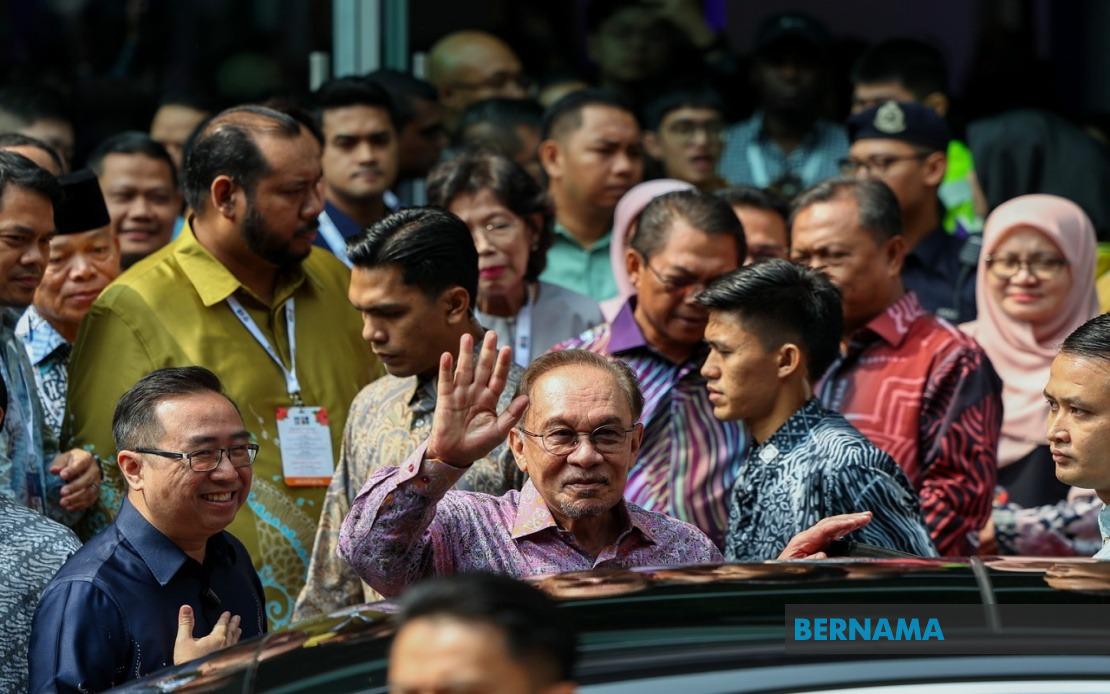
Prime Minister Anwar Ibrahim has distanced himself from suggestions that former PKR deputy president Azmin Ali was being courted to return to the party, declaring he had no knowledge of any formal approach to the current Bersatu secretary-general. When questioned after opening the National Innovation and Commercialisation Expo at Kuala Lumpur Convention Centre, Anwar offered a terse response, emphasizing his lack of involvement in whatever recruitment discussions may have been occurring within party ranks.
The denial comes just days after Azmin, now serving as secretary-general of Parti Pribumi Bersatu Malaysia, publicly stated his intention never to rejoin PKR despite such invitations circulating among the party's former luminaries. His categorical rejection underscores a significant rift that remains unhealed between the longtime politician and the party leadership, a schism that deepened following his dramatic departure in 2020 that ultimately contributed to the collapse of the Sheraton Move coalition arrangement.
PKR's recent recruitment drive appears considerably broader than merely targeting Azmin, however. The party has reportedly been reaching out to other former members of prominence, including two ex-parliamentarians whose returns would signal a consolidation of support ahead of the next general election. The presence of these overtures suggests party leadership is working to rebuild its organizational strength and parliamentary numbers, a strategic calculation particularly relevant given the fluid nature of Malaysian coalition politics.
Former Bandar Tun Razak member Kamarudin Jaffar and former Nibong Tebal representative Mansor Othman have reportedly received such overtures, signalling that the party is casting a wide net to retrieve experienced political operators who departed during periods of internal turbulence or coalition realignment. The targeted nature of these recruitment efforts indicates PKR is attempting to recover institutional memory and electoral capacity that was lost during the party's various schisms over the past four years.
The party has already confirmed at least one significant return to the fold. Former PKR vice-president Xavier Jayakumar has publicly announced his intention to rejoin, marking a symbolic reclamation of senior leadership cadre. Jayakumar's homecoming carries particular weight given his previous standing within party structures and his prominence during earlier phases of PKR's development as a major peninsular political force.
Anwar's apparent distancing from the recruitment campaign raises questions about the coordination and authorization within PKR's internal machinery. If invitations were being extended to prominent former members without the direct knowledge or approval of the party president, this suggests either a deliberate autonomy granted to lower-ranking party officials or a disconnect between different power centers within the organization. Such structural ambiguities are not uncommon in Malaysian political parties where factional dynamics often operate beneath formal hierarchies.
The Azmin question remains particularly fraught given his ascension to a cabinet-equivalent position within Bersatu, making his return to PKR politically untenable without significant ministerial reshuffling and coalition reconfiguration. His departure with an entourage of supporters fundamentally altered the balance of power within PKR and contributed to the subsequent political realignments that produced the current government. Any move to welcome him back would represent a remarkable reversal carrying implications far beyond party management.
For Malaysian observers monitoring coalition stability, these party machinations reflect the continuous jostling for position that characterizes the current political environment. PKR's efforts to reabsorb former members must be understood within the context of broader governmental succession planning and the perpetual concerns about parliamentary majorities that haunt coalition governments in Malaysia's fractious political system.
The episode also illustrates how Malaysian political parties continue to view departing members as potential assets to be recovered rather than permanent losses. This transactional approach to party membership reflects deep structural features of Malaysian politics where personal relationships, factional loyalty, and calculated defections remain more significant than ideological coherence or institutional stability.

