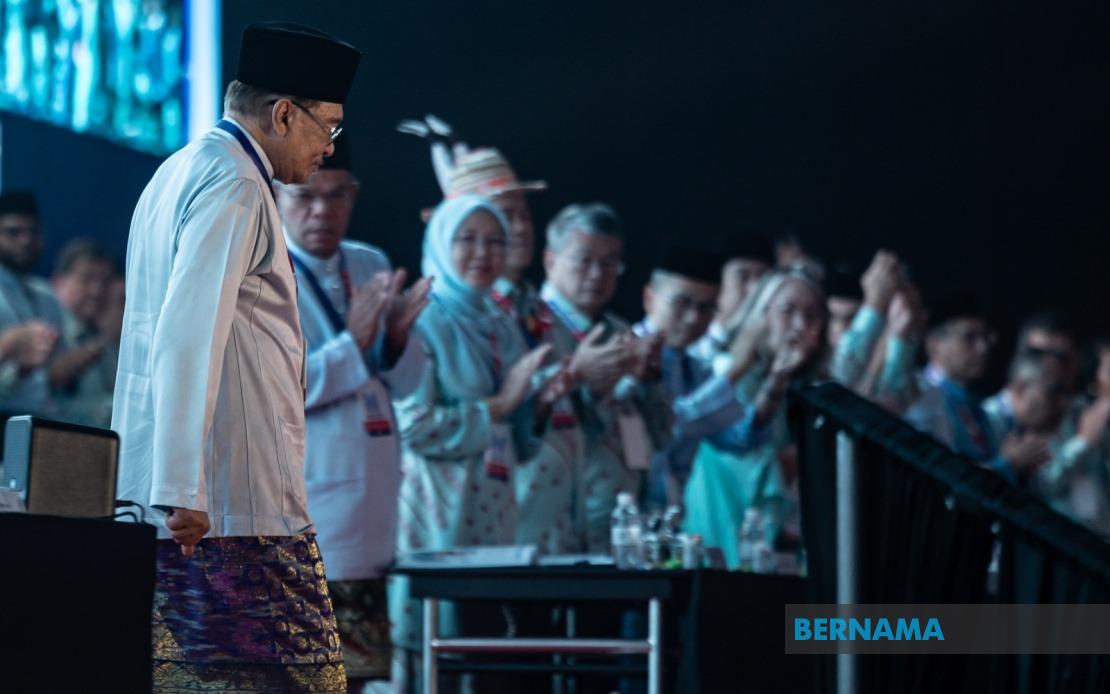
Prime Minister Datuk Seri Anwar Ibrahim defended his administration's reform track record during the PKR National Congress in Melaka, contending that meaningful institutional changes have been achieved despite continued pressure for accelerated transformation. Speaking at the 2026 party gathering, Anwar sought to reframe the debate around his government's MADANI reform programme, insisting that the pace and scope of change should not be overshadowed by calls for additional measures.
The Prime Minister's remarks reflect the delicate political position of his administration as it seeks to maintain coalition cohesion while addressing expectations within PKR and the broader Pakatan Harapan alliance. Anwar acknowledged the legitimate desire for comprehensive reform while simultaneously arguing that six decades of institutional stagnation cannot realistically be reversed in mere months or even a few years. His comments at the Melaka International Trade Centre highlighted the tension between idealistic reform aspirations and the pragmatic constraints of governing within a complex Unity Government framework that includes parties with divergent interests and priorities.
Anwar catalogued several legislative achievements to substantiate his claims of meaningful progress. Amendments to the Audit Act 1957 represent a significant step toward enhanced parliamentary oversight, while the Parliamentary Service Act and Public Finance and Fiscal Responsibility Act 2023 address longstanding governance concerns that had persisted across previous administrations. The establishment of the Special Task Force on Agency Reform signals an attempt to tackle bureaucratic inefficiencies systematically, while the Consumer Credit Act and gig worker legislation address contemporary economic protection gaps. These measures, taken collectively, demonstrate institutional evolution in areas that had remained largely untouched for generations, even if each individual reform might appear incremental to critics seeking wholesale systemic overhaul.
The Finance Minister's implicit acknowledgment that "not all steps taken by the government had been perfect" reveals an administration willing to concede implementation challenges while maintaining overall commitment to its reform agenda. This honest assessment distinguishes the current government's approach from predecessor administrations that often remained defensive about policy missteps. For Malaysian readers accustomed to political grandstanding, Anwar's willingness to admit imperfection while defending overall direction suggests a shift toward more measured political communication, even if sceptics might view such concessions as political calculation.
The formation of the Unity Government following the 2022 general election has fundamentally altered the reform calculus from PKR's initial opposition-era positioning. As the principal party within the coalition, PKR has had to navigate the competing interests of Amanah, Gabungan Rakyat Sabah, and other partners who joined the government framework with their own constituencies and priorities. Anwar's emphasis on negotiation and compromise reflects this new reality—the party that once championed sweeping change from outside government now confronts the institutional friction inherent in coalition governance. This shift resonates across Southeast Asia, where multiparty coalitions face similar tensions between ideological reform commitments and operational necessity.
Anwar's invocation of a staged implementation approach represents a sophisticated political argument, though one that risks disappointing constituencies that interpreted the 2022 election result as a mandate for rapid transformation. The Prime Minister's assertion that "change must take root and be carried out in stages" suggests an understanding that institutional reforms require embedded cultural acceptance to function effectively. Rushed legislative changes without proper foundation and stakeholder buy-in can easily become undone under subsequent administrations, a lesson evident across the region where reform efforts have repeatedly stalled. However, this gradualist framing also provides convenient cover for parties accused of moving too slowly or compromising excessively with recalcitrant coalition partners.
The presence of PKR deputy president Nurul Izzah Anwar, Amanah president Datuk Seri Mohamad Sabu, and other coalition figures at the congress underscores the delicate unity the government maintains. Each party brings distinct reform priorities and institutional bases, making comprehensive transformation impossible without negotiated compromises that frustrate purists within each coalition member. For PKR activists who envisioned more radical change, Anwar's defence of incremental progress may feel insufficient, yet the coalition framework makes broader unilateral action virtually impossible without risking government stability. This tension between internal party dynamics and broader coalition considerations has become central to understanding Malaysian governance under the current administration.
The MADANI reform programme's actual scope merits scrutiny beyond the Prime Minister's claims. While legislative reforms address important governance concerns, critics might note that transformative changes affecting the administrative state's operational culture, entrenched patronage networks, and resource distribution patterns require deeper institutional reconstruction than legislation alone permits. Law books and procedural frameworks, however well-intentioned, often encounter resistance from bureaucratic actors with vested interests in maintaining existing arrangements. Whether the Special Task Force on Agency Reform possesses sufficient authority and resources to overcome such resistance remains an open question that Anwar's speech did not directly address.
Anwar's comments also contain an implicit appeal to patience from reform-minded constituencies—a request that carries political risk for a government whose legitimacy partly rests on delivering tangible change. The Malaysian electorate, particularly younger voters and urban constituencies who drove the 2022 outcome, did not accept the status quo as inevitable. When Anwar argues against "rushing" reforms, he invokes rational incrementalism, yet opposition voices will inevitably characterise such patience as abandonment of earlier principles. The political sustainability of this position depends heavily on visible, consistent progress that keeps reform momentum visible even if the pace disappoints ambitious reformers.
For Southeast Asian observers, Anwar's balancing act illuminates broader regional governance challenges. Across the region, reform movements have often struggled to maintain momentum once the exhilaration of electoral victory fades and governing realities intrude. Thailand, Indonesia, and the Philippines have each witnessed cycles of reform promise followed by institutional inertia. Malaysia's current government's attempt to demonstrate sustained reform commitment, even within coalition constraints, represents a test case for whether institutional change can proceed through democratic mechanisms amid competing political pressures and institutional resistance.
Looking forward, the government's challenge lies in maintaining momentum sufficiently visible to justify continued public support while managing coalition partners who may have limited enthusiasm for aggressive institutional disruption. Anwar's framing of reform as a multigenerational project requiring foundation-building speaks to this challenge, yet also risks becoming a rhetorical strategy for indefinitely deferring transformative change. The administration's credibility ultimately depends less on speeches defending past achievements than on demonstrable future progress that addresses the concerns that motivated voters to reject the previous order. Whether the current coalition government can sustain that trajectory while managing multiple competing interests remains the central question for Malaysian politics in coming years.

